


> Interviews
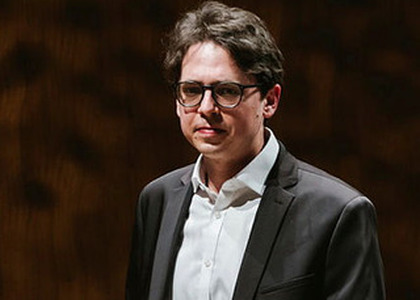
Interview with pianist Lucas Debargue
The French pianist Lucas Debargue, laureate of the prestigious Tchaikovsky International Contest from Moscow, is the soloist of the George Enescu Philharmonic Orchestra, for the concerts on February 26th and 27th, at the Romanian Athenaeum. Before his arrival in Bucharest, our colleague Monica Isăcescu Lup sat down with the pianist for a conversation. Here you have a fragment:
Mr. Lucas Debargue, why did you choose Concerto No. 2 by Rahmanikov as your debut in Bucharest?
Maybe because, if I was to have only one piano concert in the repertoire, this one would be it. I think it is unique. The psychological and emotional content of this piece is unmatched. At the same time, it is the story of a man who comes back to life, of the man and composer Serghei Rahmanikov, after a major depression. I see this concert almost as a single phrase, like a melody that comes straight from the soul, from beginning to end, without pause. It is extraordinary: a classic concert - e parts, the first and third in form of a sonnet, the second ABA. And yet, you don't think about the structure while listening to it, because it is simply a great melody that flows from beginning to end. It is a song about life and death, love and despair. It comes from the depths of the soul, from the heart. It is not "fabricated." I cannot think of another piano concerto that is so true, so authentic in every element. There is nothing gratuitous about this score. Everything has meaning and it is extremely intense. And I think there is a reason why audiences and pianists love it so much: it is a very deep piece and probably the most accomplished concerto ever written.
You will be coming to Romania for the first time. What do you associate our country with, from a musical standpoint?
It seems to me that the genius Enescu is still an underappreciated composer, even in France. I have a very good friend who won the Enescu - Josu de Solaun Competition. You probably know him. He is an extraordinary, absolutely fantastic Spanish pianist, and he won this competition years ago. He is a true philosopher; he has a blog, he is a phenomenal mind and a man with a big soul. I think that Enescu's piano music, for example, is still not as well known as it deserves. Other musical symbols of Romania are of course the pianist Dinu Lipatti and the conductor Sergiu Celibidache. Romania is full of great musical personalities, and this is also because it has a very deep folkloric tradition. Two years ago, I spent some time in Hungary and played there with Răzvan Popovici, an extraordinary violist. After the concert I listened to folk music - it is a kind of tradition there. The musicians played both Romanian and Hungarian music. And I could hear the differences between the traditions. For an ear like mine, which is not very familiar with them, it was very useful.
I cannot wait to come to Bucharest. And, without a doubt, I will find a place where I can listen to folk music. Because, what I find the Romanian folk, is an incredible mix of something angelic and demonic at the same time. The reversals can occur in the same musical phrase: something very dark, then, suddenly, a very sweet melody, like a lullaby. Of course, it takes more than two words to describe a national tradition, but I am very impressed by this heritage, by the Romanian artists I know, and by the very deep roots of Romanian musical culture, embodied by composers and performers.
If you were to define music, not as a profession, but as a human experience, how would you do it?
It would have to do with freedom, with security. Space, time, openness, curiosity. It is also very sensual, very physical, but at the same time very intellectual. It is a painful pleasure or a pleasing pain. I think the greatest musical works make us cry, sometimes make us suffer, but also make us feel happy at the same time. For me, music is the best thing humans have invented.
Translated by Elisabeta Cristina Ungureanu,
University of Bucharest, Faculty of Foreign Languages and Literatures, MTTLC, year II
Corrected by Silvia Petrescu


