


> Interviews
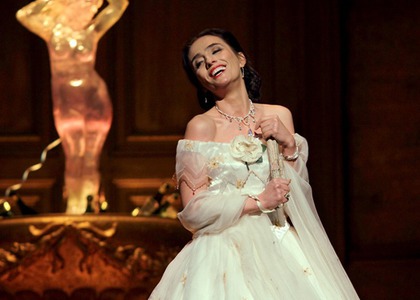
Ermonela Jaho and Donizetti: in search of the Truth
Our dialogue with Ermonela Jaho has been ongoing for many years, at least since 2021, when the great singer won the ICMA Award in the Vocal Music category with her recital Anima rara, released by the Opera Rara label. Despite the restrictions of the Covid period, she came to Vaduz for our gala and stunned the audience with a captivating performance of Violetta's 'Addio del passato' (Goodbye to the Past). So much so that the jury unanimously decided to nominate her as Artist of the Year for the 2023 ICMA edition, held in Wroclaw. Ermonela has since become a sort of honorary member of the ICMA family: after the two interviews conducted for the aforementioned occasions, Jury member Nicola Cattò (Musica) return to speak with the great Albanian soprano, who once again won first prize in the Vocal Music category with her recording of Donizetti's melodies, with Carlo Rizzi on piano, again for Opera Rara.
How did you get involved in the Donizetti complete works project?
As you know, Opera Rara's philosophy is to bring back forgotten works by great composers of the past: it was Roger Parker, in particular, who rediscovered these Donizetti romances, and he found more than 400 for different voice types. I immediately became passionate about the project because I feel at home with Opera Rara; I'm their ambassador: I've been working with them for a long time on the verismo repertoire, to which I now dedicate myself assiduously. At first, I was a bit skeptical about the quality of these works: they're often very simple, they're not the high-level Donizetti we find in the most famous operas, but the melody is there, the feeling is there, and it was right to make them known. We're filling a gap in our knowledge of this composer. I've studied 42 of them, and I must say it was a lot of work. Most of them lack dynamic markings, and when the same melody has to be repeated three or four times on different texts, you have to constantly invent new details and expressive alternatives. Maestro Rizzi and I worked on this to give these pieces the dignity they deserve. There are romances in Venetian and Neapolitan, which are very entertaining and set to simple, popular texts, but also some derived from literary masterpieces like the Divine Comedy. Those in French, on the other hand, are more heartfelt, more intense, perhaps because they were created within literary and artistic circles, to whom Donizetti brought them as occasional gifts (as Roger Parker told me: this is why some are completely missing the piano parts, which we had to reconstruct). They have a certain melancholy, a pervasive sadness. I think these romances can be useful for young singers as an exercise: they are technically simple and help develop expressiveness and spoken singing, telling a story, however simple it may be.
When you do a complete recording, it's inevitable that some pieces will be of lower quality: how do you deal with a score you don't believe in?
It happens, it's undeniable, that you sing songs that don't resonate with you. In this case, the artist must idealize, must delve into their own subconscious, to make the audience believe that the value of the music is much greater than it actually is: they work hard on dynamics, on colors, because the human ear craves variety. In this way, they make the music more beautiful than it really is.
Many romances are in strophic form: did you add variations or embellishments?
Not many. The philosophy was to bring these romances to the public as they were written, with minimal changes. We worked, as I mentioned before, on the dynamics, which are used to vary pieces that can last over ten minutes: the idea was to tell a story as if we were speaking to children.
What's the difference between the Italian and French ones?
The Italian ones are direct, unfiltered, even in the singing style; the French ones, on the other hand, have an intimate, internalized, delicate atmosphere. Less explosive, if I may say so.
What is your relationship with Donizetti's theatre? You sang Maria Stuarda, Anna Bolena, Elisir, Don Pasquale...
True, I've encountered several of his works in my career: we know how prolific Donizetti was and how eventful his life was. But he was certainly a true genius, with a keen theatrical instinct, and his works display a clearly bravura quality. Donizetti's coloratura, however, always has an expressive purpose. Donizetti's theatre is complete, capturing every human nuance.
Last December, again for Opera Rara, you recorded Puccini's La rondine in London: an opera that was always considered a minor work, but is now enjoying a certain success. Why, in your opinion?
I immediately fell in love with this opera when it was first performed in Trieste in 2008: it's a very modern opera, and contains perhaps the most beautiful act of any Puccini (I'm talking about the second), combining avant-garde dramaturgy with overwhelming cantabile. Perhaps it was misunderstood in its time, because it lacks the dramatic dimension associated with Puccini: sure, no one dies, but the drama is deeper, because Magda dies inside. She takes on everyone's sins; she's an adult sacrificing an impossible love: a truly extraordinary opera, one I understand more and more every time I sing it. Even the third act, which everyone calls weak, needs to be emphasized in every word of the text.
But in London you proposed a special edition…
In the first version, Magda is composed and resolute. But Puccini wasn't satisfied; he wanted to delve deeper into Magda's human drama: the second and third versions are completely different, because Ruggero leaves Magda. In the second, she stays with Prunier (who is a baritone here), while in the third (which we recorded) Ruggero is more aggressive, perhaps to emphasize the drama. There are many differences between the various versions: and I'm proud to be the only soprano to have sung all three!
In short, the album still holds value today as a cultural instrument!
Absolutely yes: all the various pieces of the puzzle of La Rondine deserve to be known. They will be on the album, even though we performed a third version live in London: the audience was enchanted. In general, all Puccini opera is made up of rewrites and rethinking: and it's interesting to follow them to understand how Puccini worked in search of expressive truth.
I would like you to say a few words about your commitment to young artists, especially in your country, Albania.
After a 33-year career, I believe I've achieved many goals, but it wasn't easy, especially coming from Albania. However, I did it, and this proves that dreams can come true if you give it your all and fight without giving up. Furthermore, as the years pass, you don't get any younger, your voice won't last forever, and it's important to leave something behind: not out of presumption, but because in such a complicated world, dreaming of being able to make a living from your art is almost a miracle. But you can't live without music, without art: that's why I believe it's my duty to give back, starting with my country. I teach courses and masterclasses, I bring agents when I see exceptional talent, and I try to support their careers by facilitating auditions with artistic directors. And I do this not only in Albania, but also at the Royal Opera House with the Young Artist Program.
Is it more difficult today than when you started?
Yes, because everything moves too fast: think of social media, which helps if you know how to control it, but which risks destroying people and careers. A like isn't reality: my heroes were Mirella Freni, Renata Scotto, Maria Callas, who fought tooth and nail to assert themselves in the real world. Today, too many only care about appearances, and a generation of depressed people is growing up, who don't have the tools to cope with disappointments and defeats. They are fragile.
Are there any upcoming projects with Opera Rara?
Yes, another verismo opera. But I can't give too many details.
And what about your theatre commitments?
I'm about to say goodbye to Violetta after so many performances: after London, I'll sing it at the Met and then, finally, at the Rome Opera. I have concerts in Paris, at the Peralada Festival, in Madrid, I'll be Liù (Turandot) in Torre del Lago and at the Bavarian State Opera, Suor Angelica in London, Butterfly and Adriana in Vienna. I'll return to La Rondine in Zurich, and then in the future there are more Iris, Il pirata, Medea...
Nicola Cattò


