


> Interviews
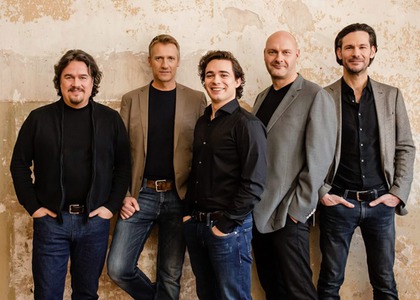
Amarcord: "The audience needs to be offered something special"
The Leipzig vocal ensemble Amarcord won an ICMA award this year for its recording Maria - Josquin in Leipzig. Jury member Martin Hoffmeister (Gewandhausradio) spoke with Daniel Knauft, the bassist of Amarcord.
Mr. Knauft, with the album Maria, the Amarcord ensemble won the 2026 ICMA in the Early Music category. Early music, including very early music, i.e. repertoire from the Middle Ages and Renaissance, is a central focus of the ensemble's work. One might almost say that this repertoire is part of Amarcord's artistic DNA. Did this focus develop naturally over the years, or is the repertoire in question more or less predetermined in an ensemble that consists largely of former members of the St. Thomas Choir?
That's an interesting question because it makes you wonder whether this is the DNA that the St. Thomas Choir gave us, or if we have developed it ourselves over time. The fact is that during our time with the St. Thomas Choir, this music did not have the importance one might assume. Of course, Bach always acted as a father figure for us, but the composers before Bach in Leipzig hardly played a role, so this rich repertoire was an inexhaustible playground that we were able to explore little by little. Names such as Heinrich Schütz and Johann Hermann Schein, who were very present in Leipzig, were of course as familiar to us as Bach, but everything else, works dating back to the 16th century and earlier, we acquired ourselves, precisely because we wanted to sing them.
With works from the Middle Ages and the Renaissance, especially vocal music from these periods, you usually only reach a small portion of even the classical music-loving audience. However, if you attend Amarcord concerts around the world, you will find the locations packed out. What is the specific appeal of this historically distant repertoire? And: if this music were known to a wider audience, could it not serve as an ideal corrective in troubled times?
I am convinced that the audience needs to be offered something special. They need the opportunity to get to know things in the first place. It's not particularly difficult to appeal to people who are already familiar with this repertoire, connoisseurs, etc. The real challenge for us is inspiring people who may not even know what they are missing if they never expose themselves to these things. And whenever we sing in churches, the visitors react with real enthusiasm. Sometimes we also improvise, historically based, so to speak, on certain Gregorian melodies and spread out throughout the church, taking the audience on a journey, so to speak. And that then leads, for example, to a motet by Josquin. I am deeply convinced that the future lies in such concert formats. Not in a culture of bite-sized pieces, not in what people already know and want, but in familiarizing the audience with things that are eminently evocative, but which the visitors did not know before.
This year, Amarcord won an ICMA award for their album Maria. What repertoire does the album feature?
The CD mainly features material by Josquin Desprez, the grand master of Renaissance vocal music. In terms of his artistry, he can truly be compared to Michelangelo or Leonardo da Vinci. Like many composers of his time, he was a singer himself, and this relevant expertise is also evident in his music.
He was undoubtedly a genius, capable of creating magnificent art from the simplest of things. Moreover, he made the music of that time incredibly emotional. So much so that even today we still have to be careful not to get carried away by certain emotional twists and turns in the music.
Another special feature of the works we have compiled on the CD is that this is music we discovered in Leipzig, in the university library. Others could have found it too. But they didn't. It's quite remarkable, you have to say. And in addition to the works from the Renaissance, the CD also includes Gregorian chant and early medieval music from the Thomas Graduale, i.e., music that was performed at St. Thomas. Finally, Marian sequences complete the Marian program.
Amarcord is one of the world's most decorated vocal ensembles, having now been honoured repeatedly with an International Classical Music Award. What significance does this award have for the ensemble, and do such awards generally improve marketability?
I used to say that awards are for parents, to give them the feeling that their children did the right thing when they gave up their middle-class professions. Of course, parents should be proud, but it also gives us another opportunity to say that, despite all our daily work, it's really time to celebrate and acknowledge that Over the past 30 years, we have created something lasting. Quite apart from that, there have been few other awards that have generated comparable press coverage. After the press reports, reviews and inquiries piled up, and there were lots of congratulatory emails and phone calls, including from agents. It's actually unbelievable in times when you think you're just ONE ensemble among many, and CDs are a dying medium anyway. And that brings us to market relevance: such a highly decorated award generates visibility in particular. And visibility is the number one currency for artists. Against this backdrop: great gratitude and joy!


