



> Interviews
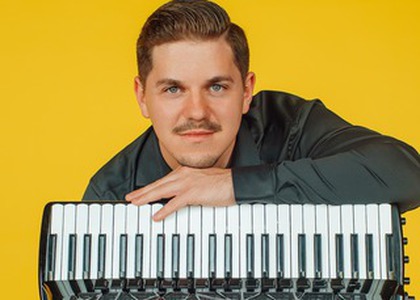
Accordionist Radu Rățoi - Guest of the Week on Perpetuum Mobile
Radu Rățoi, my guest this evening, is an artist originally from the Republic of Moldova, currently based in Denmark, but very well-known and admired thanks to his performances on major stages around the world, including in Romania.
Good evening, Radu. Can you hear us here on Radio România Muzical?
Good evening, yes, I can hear you.
You should know that we constantly follow your artistic development. We even found a news item in our archive from 2020, when you won the international accordion competition held in Moscow: you were 22 at the time. What has changed in your artistic life since then?
Many things have changed. I've performed on many stages since then; I think I've developed as an artist, and hopefully I have gained a certain maturity as well. So yes, quite a lot has changed in these five years.
Another important milestone in your career was, I believe, winning the Young Concert Artists Auditions in New York, wasn't it? A remarkable achievement both for you and for the accordion, since it is one of the relatively new instruments that has made its way into the traditional concert halls.
Yes, absolutely. When I applied for those auditions, I knew I had less than a 1% chance of winning, but I believed in it and decided to try my luck. For the accordion, it is indeed something unusual. I think I'm only the second accordionist to win these auditions. As for Moldovan or Romanian musicians, I'm not sure how many have won, I didn't look into it that closely. In any case, it's a very demanding competition which, of course, broadened my horizons and created some new opportunities for me.
I know that it's been 197 years since the first accordion patent was issued, to the Armenian Cyrill Demian, who was actually born on what is now Romanian territory, in today's Gherla in Transylvania. How is the accordion perceived today in concert halls? Does it still surprise audiences with its potential, or do the concertgoers already have certain expectations?
The accordion will probably continue to surprise audiences for quite some time, simply because the instrument is developing at an enormous pace from year to year. From a historical perspective, five or ten years is very little, but compared with ten or twenty years ago, the accordion now performs a completely different repertoire. It is evolving every day: better performers are emerging, technical possibilities are expanding. So I believe this sense of novelty or surprise for audiences will remain for some time, because the instrument is still in a process of development. The accordion is viewed more and more positively, I see a very encouraging trend worldwide. Of course, it is very popular as a folk instrument, in Romania, Moldova and many other countries. But it is also gaining recognition as a classical instrument, because it has possibilities that no other instrument really approaches or possesses.
You are currently in Stuttgart, where you will make your debut in two concerts: one on March 5th at lunchtime and another on Friday, March 6th, at 8:30 p.m. RO time, which will also be broadcast for Radio România Muzical listeners. How is the atmosphere there? What is the orchestra like? How are you getting along with the conductor?
We had our first rehearsal today, and it went very well. The orchestra is, of course, excellent: it's one of the best in Germany. We'll also be performing a very beautiful piece: Astor Piazzolla's Concerto for Accordion and Orchestra, Aconcagua. So all the ingredients are there for a truly memorable concert.
How do you see this work? I know it has been in your repertoire for quite some time. The concerto was originally written for bandoneon. How do you experience this piece by Astor Piazzolla, which his publisher named Aconcagua, after the highest peak in South America, considering it the summit, or the culmination, of Piazzolla's creative output?
Yes, I agree that it's a work that somehow brings together many of Astor Piazzolla's compositional techniques. You can practically find a bit of everything he wrote in it, not necessarily in terms of specific motifs, but in terms of compositional language. Since it was written for bandoneon, which belongs to the accordion family, you can achieve a very similar sound, although the accordion offers a much wider range of possibilities. Every time I perform this concerto, I discover something new. Even the second movement, which might seem somewhat simpler at first, is incredibly beautiful, and every time I return to the piece I find new details. So yes, it truly is a peak in Piazzolla's oeuvre.
Radu, after Friday's performance, what other events are included in your schedule?
After the concert on Friday, I'll travel to Chișinău for a concert with a very well-known bandoneon player in Europe, Stefano Pietrodarchi, together with the National Chamber Orchestra of Moldova. Then I'll go to the United States, where I'll perform several concerts with other orchestras, and afterwards I'll return to Europe.
When will you return to perform in Romania? Is there already a plan for that?
I'd have to check my calendar. I'm sure there is something scheduled for the autumn, but I tend to take things step by step, week by week. I know what I'm doing until the end of this month, and then I look again at the calendar. Spring is an especially busy period right now. I won't be in Romania this spring, but I will definitely return in the autumn. I'll also perform with the National Radio Orchestra in Bucharest, I believe on March 26th 2027, and in other cities as well: Iași, Bacău, and Craiova.
Radu Rățoi, I wish you all the best in your concerts in Stuttgart. From here in Romania we'll be listening with double excitement: because of Piazzolla's music, but also because you are one of the valuable representatives of the artistic world of the Romanian-Moldovan cultural space.
Absolutely. I consider myself one. Thank you very much.
Best of luck.
Translated by Oana-Elena Dragnea,
University of Bucharest, Faculty of Foreign Languages and Literatures, MTTLC, year II
Corrected by Silvia Petrescu


