



> Interviews
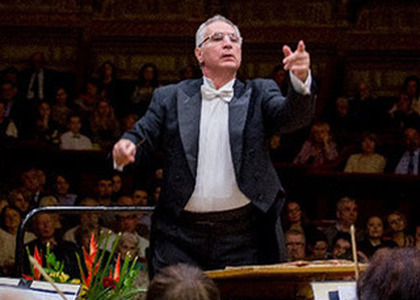
Interview with Andrei Iliescu, conductor of “Petru Ghenghea” Engineers’ Orchestra
"Petru Ghenghea" Engineers' Orchestra will perform on Monday, 9th of March 2026, on the stage of the Romanian Athenaeum, in an anniversary event marking 70 years since the founding of the ensemble. Conductor Andrei Iliescu spoke with Ioana Țintea about the significance of this moment and the story of a unique ensemble in the Romanian musical landscape.
To begin with, Mr. Andrei Iliescu, I would like to invite you to take a brief look at the history of the ensemble. How did the Engineers' Orchestra come into being, and what was the vision of its founder, Professor Dr. Eng. Petru Ghenghea?
The Engineers' Orchestra was founded in 1956 as part of a technical institute of higher education called the Railway Institute, at the initiative of its founder, Petru Ghenghea. At the time, he was a university assistant at the institute's Department of Thermal Engineering.
He had had the idea many years earlier, starting in 1948-1949, the founder wanted to revive the tradition of an older professional orchestra of the Romanian Railways (CFR). During the interwar period, CFR was a privileged socio-professional group, it also had a professional symphony orchestra, which had been conducted by the great Romanian musicians Theodor Rogalski and Constantin Bobescu. On the 4th of April 1944, following the American bombing, the orchestra's base located at the Grivița Workshops, along with all its logistics, instruments, musical scores and inventory, had been destroyed.
Part of the professional orchestra in which Petru Ghenghea had played as a cellist, were several teachers at the Railway Institute who came together, and people with a refined education, as was the culture among interwar families, they decided to get together to form an orchestra, but this time as amateurs, to satisfy their passion for music and, at the same time, to offer the results of their work to a developing audience, which they wanted to attract towards the great music.
What are the key moments in the history of the orchestra during its 70 years of activity?
That is a difficult question, because in seven decades, of course, there are many memorable elements, but I would obviously start with the opening concert, which marked the beginning of the activity, which took place at the Railway Institute, whose premises used to be on Mihail Moxa Street, with the students and the teachers of the institute as an audience. Then, the first concert on a Bucharest music stage, which took place in 1956, at the Dalles Hall. I would like to outline the moment in 1958, the first appearance on the stage of the Romanian Athenaeum. Since 1958 until today, most of the concerts of the Engineers' Orchestra have taken place on the stage of the Romanian Athenaeum.
I would also like to mention, of course, the encounters with the great artists of the Romanian representative art, who endorsed the quality of our performances - Lola Bobescu, maestro Valentin Gheorghiu, Alexandru Tomescu, Cristina Anghelescu, and many, many more.
And, of course, the orchestra's tours abroad. The four tours in 1990, '92, '93, and 2009 in the United Kingdom, the tour of three concerts in the United States in 2005, in the Republic of Malta, in Germany, in Italy, and in the Republic of Moldova.
You took over the baton of the orchestra in 1998, following the wishes of Petru Ghenghea. What did that moment mean to you?
I would say that maestro Ghenghea stubbornly wanted the engineering tradition to be preserved, and he had been preparing me for several years, with me being at his right hand, both figuratively and literally in the orchestra, because as the maestro arranged the orchestra on stage, I was the leader of the second violins, I was on his right side, and I was also close to the maestro throughout the preparation, and I was saying that he really wanted the engineering tradition to be continued by an engineer.
In 1998, the maestro was already at an advanced age, he was 85 years old, and it was becoming increasingly difficult for him to conduct, thus he gradually withdrew from the conductor's podium, but remained close to the orchestra for many years, until his passing away in 2006, participating in all of our rehearsals.
I have been and continue to be a follower of everything he has accomplished. I am deeply grateful to him for the legacy he has left behind. It is a belief that must be preserved with great dedication, because through everything he had built, through everything he had created, the maestro left behind a legacy that we must carry on with all our passion and desire to serve music.
Going back to the anniversary concert on Monday, 9th of March, what sort of surprises do you prepare for the audience at the Romanian Athenaeum?
The anniversary concert is, first and foremost, a gesture of utmost gratitude to the founder Petru Ghenghea, who created this temple of amateur music. It is an opportunity to honor the generations who established the orchestra and who laid the path to its fame, and it is also an opportunity to show our pride regarding the results of our work and the passion with which we prepare each concert.
The concert features symphonic works that showcase the orchestra's capabilities. The program includes Symphony No. 9, "From the New World" by Antonin Dvořák, and we are thrilled to perform George Enescu's two Rhapsodies. I hope this program will delight the fans of our orchestra, and in any case, we are doing it with great joy because we have worked very hard for this concert.
Translated by Diana Sitaru,
University of Bucharest, Faculty of Foreign Languages and Literatures, MTTLC, year II
Corrected by Silvia Petrescu


