



> Interviews
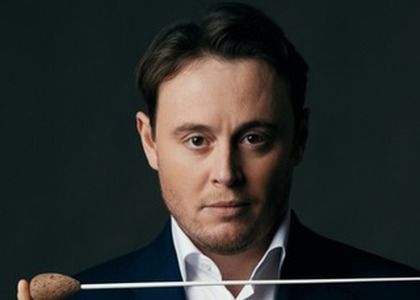
Interview with conductor Michele Mariotti
The acclaimed conductor Michele Mariotti, in Bucharest for the first time, will once again lead the Orchestra and Choir of the George Enescu Philharmonic today, March 6th, 2026. The program to be presented on the stage of the Romanian Athenaeum is entirely dedicated to one of the most innovative vocal-symphonic works of the 19th century - A German Requiem by Johannes Brahms.
"A German Requiem" by Johannes Brahms is often described as being more a requiem for the living, conceived to bring comfort to those who remain. Do you agree with this statement?
Yes, I do agree. There is no drama, none of that rhythmic gravity we encounter in the Requiems by Mozart or Verdi. We find no Dies Irae; there is no sentence, no judgment, no fear of being judged. It is a deeply human requiem - Brahms himself would have liked to call it that. Of course, it is called A German Requiem because it does not follow the Catholic Latin text; instead, Brahms selected various passages from the Bible, in Martin Luther's translation. The score is full of major tonalities. D minor, the usual key of the requiem, appears perhaps in only one movement, the third, yet even there it immediately modulates to F major. What makes this work so special is its meaning: the idea of consolation that we can find in God, consolation that we can even find in death. For death is part of our life and perhaps even the best part of it, as it marks the end of human suffering on earth. That is why some say it is a requiem for living. I would not call it optimistic, but it is filled with a sense of well-being, with a feeling of peace - the peace we may find in the life that comes after, beyond our earthly existence.
"A German Requiem" is considered one of the most innovative vocal-symphonic works of the 19th century. What do you find distinctive about the way it is constructed and what challenges does it bring for the orchestra and the choir?
Brahms's creation is always like a composition manual. The way he builds the theme, the counter-theme, the secondary theme and the relationships between them remind me of a cathedral. But in this requiem the main challenge lies in creating the necessary atmosphere. And I truly love that, because as a conductor I enjoy working on shaping the right sound: a velvety, warm, comforting sound. We work very well with the orchestra, the choir and the soloists - everything comes down to finding the details; it is really about working on details. Sometimes we have repetitions of the same musical idea, but the second appearance is never identical to the first. Even if we do not change a single note, we still must work to change the character. The music is so rich… In fact, everything Brahms wrote is like that. Just two weeks ago I conducted the Fourth Symphony. Every interpretation is a different journey, because when you work with such masterpieces you always discover something new. We ourselves change, and the process of studying the score never really ends.
Is this focus on sound and creating the right atmosphere a central aspect of your work as a conductor?
It's definitely one of them - and without a doubt the one I enjoy the most. Musical tempi changes, because we change, life changes, the world changes. And I believe you can justify almost any interpretive choice. If you want a passage played faster than usual, you can find a reason; if you want the opposite, you can just as easily justify it. If you want to be different from others, you'll find a justification for that too. The question is: what do you choose to preserve logic and naturalness? Because music should feel natural… For me, the most important thing remains working on the sound. I truly enjoy going deeper and deeper to create the right sound, the sound I feel is appropriate.
How would you describe your collaboration with the other artists involved in performing this score - the Orchestra and Choir of the George Enescu Philharmonic and the soloists?
I savor it immensely! I absolutely love working with the orchestra. The musicians are incredibly quick to adapt. In our very first rehearsal, within just twenty minutes they had already changed their sound because they understood exactly what I was asking for. They are very fast at understanding and realizing what I propose. I'm also very happy with the choir - we work extremely well together. And the soloists, soprano Chen Reiss and baritone Liviu Holender, are truly excellent. They know the work and the style intimately, and with them we also spend a lot of time on the details.
You studied composition and also have a background in the humanities…
Yes, and I was also a soloist in a Gregorian choir - something almost no one knows. I erased all traces - I even burned all the CDs - but yes, for four years I sang in a Gregorian choir. This was back when I was at the conservatory, around 2001 - 2002, at the very beginning of my training. It was a lot of fun and at the same time incredibly beautiful. We traveled a lot and sang Sunday mornings at services, in various places across Italy, mostly in the central regions. I loved the experience of singing in a choir, and I consider it very valuable.
Did you always know you wanted to become a conductor?
Yes, it was my dream from a very young age… so I consider myself very lucky! I also wanted to become a basketball player, because in Pesaro, my hometown, there is a strong basketball tradition. I was quite good, but I'm too short. Ten months a year I wanted to play basketball, and during the Rossini Opera Festival in Pesaro I dreamed of becoming a conductor. I wanted it very much. I remember that when the orchestra came to Pesaro, the day before rehearsals, I couldn't sleep out of excitement, because I knew the next day I would be able to see the rehearsal or the orchestra's first reading of the score. When you're young, you're like a sponge: you absorb everything.
Translated by Adina Gabriela Văcărelu,
University of Bucharest, Faculty of Foreign Languages and Literatures, MTTLC, year II
Corrected by Silvia Petrescu


