



> Interviews
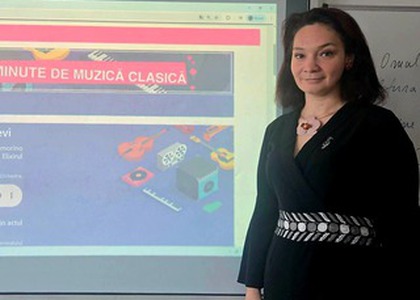
Interview with teacher Ana Maria Pavel about the “Listen to 5 Minutes of Classical Music” project
The "Listen to 5 Minutes of Classical Music" project returned to schools on March 2nd 2026. Teacher Ana Maria Pavel from the Art High School in Râmnicu Vâlcea spoke with Ioana Țintea about how this initiative can be used in teaching and about its impact on students.
Mrs. Ana Maria Pavel, on Monday, March 2nd 2026, the project "Listen to 5 Minutes of Classical Music" resumed in schools across the country. During the 2025-2026 school year, children will listen to a total of 54 musical works. I know that online you encourage fellow teachers to make use of this project in their teaching. What first convinced you of its usefulness in the classroom?
The usefulness of the "Listen to 5 Minutes of Classical Music" program, initiated by Radio România Muzical, convinced me first of all through its simplicity and pedagogical effectiveness. In just a few minutes, students come into direct contact with musical heritage in an accessible and engaging way.
In the classroom I have noticed that these short listening moments help students improve their attention, artistic sensitivity, and cultural curiosity.
Moreover, the program very easily creates interdisciplinary contexts, because music can be discussed in connection with literature, history, or the visual arts. For me, this is the program's greatest strength: in a very short time, it manages to transform musical listening into a complete and meaningful educational experience for students.
What do you think about both the selection of works and the explanations provided after the listening session?
I believe the selection of works in the program is very well conceived from a pedagogical perspective. The chosen excerpts come from the universal musical repertoire and are accessible to students, while at the same time being artistically valuable. This selection allows students to gradually discover different styles, composers, and instruments, thereby building a solid foundation of musical culture.
The explanations provided for each listening session are also very helpful, as they enable students to better understand the context of the work and the expressive elements of the music. They function as a listening guide, directing students' attention toward important details and encouraging discussion in the classroom. In this way, listening does not remain a passive experience but becomes a moment of reflection and artistic understanding.
In your opinion, what role does guided musical listening play in students' artistic education?
In my view, guided musical listening plays an essential role in students' artistic education, because it helps them move from simple listening to a conscious understanding of music. When students are encouraged to observe certain elements-such as instrumental timbre, the character of the music, or the emotion it conveys-the listening experience becomes active and formative.
Within the program "Listen to 5 Minutes of Classical Music," produced by Radio România Muzical, guided listening helps students improve their attention, aesthetic sensitivity, and their ability to interpret the artistic message.
At the same time, this type of activity contributes to shaping cultural taste and musical literacy. Through the discussions that follow the listening session, interdisciplinary connections can be made with literature, history, or the visual arts. In this way, guided musical listening becomes a pedagogical tool through which students gradually build an authentic relationship with art.
Looking to the future, do you think initiatives like this can help cultivate a young audience for classical music?
Yes, I strongly believe that such initiatives can help cultivate a young audience. When students listen to classical music from an early age in school, within a guided context adapted to their age, they begin to perceive it as something familiar and valuable. Over time, these repeated experiences contribute to the development of artistic taste, cultural curiosity, and openness toward concerts, opera, or other forms of musical art.
Radio România has launched the campaign "Stay Safe Online," dedicated to the digital safety of minors. Do you believe such a campaign is necessary in today's context, where children spend more and more time online?
Yes, I believe such a campaign is very necessary in the current context. Radio România's initiative through the "Stay Safe Online" campaign responds to a clear reality.
From an educational perspective, it is important that students be guided to develop skills for safe and critical use of the internet, to understand the risks of the online environment, and to build balanced digital behaviour.
In my opinion, campaigns of this kind complement the educational mission of the school very well and contribute to shaping a generation that not only uses technology, but does so consciously, responsibly, and safely.
What role can schools and teachers play in educating students to behave responsibly in the digital environment?
Schools and teachers have an essential role in shaping responsible digital behavior among students.
Beyond transmitting knowledge, schools also have the mission of developing students' ability to use technology critically and responsibly, so that they understand both the opportunities and the risks of the online environment.
Teachers can contribute to this process by integrating discussions and activities related to internet safety, personal data protection, respectful online communication, and the critical evaluation of information into their teaching.
At the same time, it is important to encourage students to use the digital environment for educational and creative purposes.
Translated by Oana-Elena Dragnea,
University of Bucharest, Faculty of Foreign Languages and Literatures, MTTLC, year II
Corrected by Silvia Petrescu


