



> Interviews
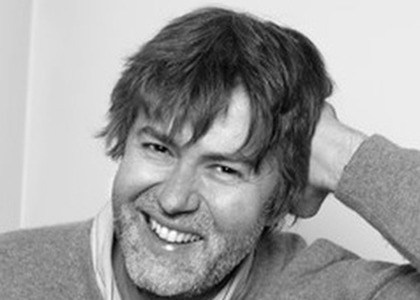
Interview with pianist and essayist Andrei Vieru
The pianist Andrei Vieru returns tonight on the Romanian Athenaeum's stage. In the performance's schedule that begins at 19:00 there are preludes and fugues by Johann Sebastian Bach and two pieces by Anatol Vieru - "Ricercar" and "Mirabilis". After the performance there will be an autographsession for his book: "Elogiul trădării" - Mic tratat de traducere și interpretare" (The Praise of Betrayal - A Short Treatise on Translation and Interpretation (Vremea Publishing House), distinguished with a special award, granted by the Writer's Union.
In the performance you will present on March 10th on the Romanian Athenaeum's stage, twelve pairs of Bach preludes and fugues are intertwining with two creations by your father, the composer Anatol Vieru. How do you view the relationship between these two creative essences?
Through the "architecture", so to speak. Both of them are, in their own way, architects of music. Or, at least, that's how I see them.
Would you say that this program represents an exploration of polyphony from two different perspectives?
Yes, there is polyphony in Bach, everyone knows already, there is polyphony in the Ricercar piece, too, which is free fugue. Bach wrote himself at least two ricercar pieces, I performed myself the ones from musical Offering. Anatol Vieru's writing is, or at least, seems to be freer than Bach's, it seems to be less rigorous. In reality, the things are perceived differently on the surface and the other way around too, in depth. The two Anatol Vieru's works are part of of an unfinished cycle, which he was working on in 1998, when he passed away and did not complete the entire cycle; but nine pieces are finished and exist in edited form. In fact I'm not the first performer, at least of one part. I would like to pay tribute to Sorin Petrescu and Dan Dediu, who performed parts of this cycle in a truly remarkable way. I perform this pieces not because he is my nor is the centenary of Anatol Vieru's birth but because I like them. And I find the contrast in style, language, atmosphere, meaning between Bach and Vieru interesting, this interweaving of Bach's preludes and fugues with pieces by Anatol Bieru can be interesting.
You believe in a living art, always opened to interpretation. Do you think that, by putting some scores in a new context, like in this case, something fundamental changes in how music reaches the listeners?
The music reaches the listeners based on many factors that we cannot list, but obviously the performer matters, each interpretation, their own vision; there are also imponderable factors related to the specific condition of the time. Of course, music exists in itself. Schopenhauer said that if we imagined the universe would disappear, the music would remain even outside the existence of the universe. Obviously this an absolutist point of view, in a way, that I don't disagree with, but I would add with the idea that music must have a living existence, a life of its own throughout the centuries.
How do you feel about returning on the Romanian Athenaeum's stage?
It's always a pleasure because it is a very beautiful hall to which I have memories from my earliest childhood, first as a listener, and then it happened to perform there for numerous times. So, all these things somehow matter and are part of sentimental luggage with which I return to Romania, in Bucharest, on the Athenaeum's stage.
After your performance, there will be a signing session on your book. "Elogiul trădării, mic tratat de traducere și interpretare"(The Praise of Betrayal - A Short Treatise on Translation and Interpretation). Would you say that your work as a thinker, essayist and as an interpreter feed off each other?
Yes, I remember Nicolae Coman, who was a music composer, chess exercise composer and poet whom I admire, said that he was resting by doing a different activity than the normal ones. It is true, probably for the majority of people who have more activities. But I think it's more than that and the answer lies in your question: yes, there is a mutual feeding. I wrote about the music as well but it wasn't my main theme. But when it happened to reread a couple of years ago some text, I realized that there was a music aspect in them, not really in a poetic sense, a somebody would said about poetry in music but at the level of architecture, the way certain themes recur in a condensed form towards the end of the text. Now, because I used the word poetry, in the book that I mentioned there are some verses I translated, verses by Pushkin. In fact, it is about the Pushkin's theater in verse, which I wanted to translated firs into French and then into Romanian. So, all of the theater in verse is there and it's preceded by an essay on the translation and interpretation problems, in fact, there are some parallels that I establish between interpretation and translation. The book's title is "Elogiul trădării". The title is funny, I would say but it is not totally disconnected from the book's content and the ideas I have about the issue. That is, I am against this kind of bureaucratic and clerical loyalty. I take some liberties, knowing that, in reality, literal translations don't work. There has been a whole trend of glorifying the literal translation by Walter Benjamin and Nabokov, to name two of the famous figures who have dealt with translation, both from a literary and philosophical point of view. In fact, it is not clear whether translation theory belongs to literature of philosophy. Probably both. In fact, I don't make a real difference between literature and philosophy, because great novelists have written novels with profound philosophical implications, sometimes, and some of the philosophers have demonstrated, first about literary virtues. I'm thinking about Cioran, for instance, who for me is more of a writer than a philosopher. There is much to be said about this.
Translated by Cosmin Șerban,
University of Bucharest, Faculty of Foreign Languages and Literatures, MTTLC, year I
Corrected by Silvia Petrescu


