



> Interviews
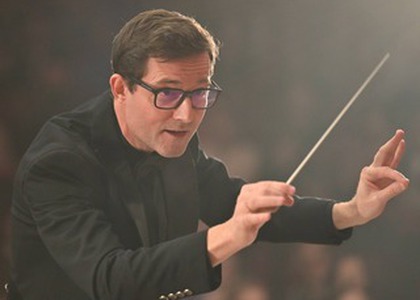
Interview with conductor Tiberiu Dragoș Oprea
Thursday, 12th of March, 2026, the Pitești Philharmonic's Symphonic Orchestra will be performing a vocal-symphonic concert at Centrul Multifuncțional ("The Multifunctional Centre"). Soprano Bianca Mărgean and tenor Liviu Indricău will perform as soloists and conductor Tiberiu Dragoș Oprea will be leading the orchestra. He talked about this event in an interview with Cristina Cîrjan.
Mr. Tiberiu Dragoș Oprea, on March 12th you will be conducting the Pitești Philharmonic's Symphony Orchestra in a vocal-symphony concert. How did you conceptualize this event?
I'm glad we're discussing the Pitești Philharmonic's concerts. It's a young institution, compared to others, but more innovative. We organize concerts that are very diverse from a stylistic standpoint, trying to meet as many of our audience's expectations as possible, and, of course, evolving in as many artistic dimensions as possible. The concert, which will be taking place Thursday, March 12th, at 7 PM, is a vocal-symphony concert. The evening's protagonists, making their debut at the Pitești Philharmonic, are soprano Bianca Mărgean and tenor Liviu Indricău. From Giacomo Puccini's Tosca and La bohème, Ruggero Leoncavallo's Pagliacci, works with dramatic accents, in the verismo style, to Emmerich Kálmán's "Silvia" ("The Gypsy Princess"), where the main character makes her entrance by dancing a fiery csárdás, the pieces are fragments of famous operas, operetta, canzonettas, short stories, intense emotional experiences, displaying love and the joy of living.
The program reunites famous fragments from the works of famous composers such as Giacomo Puccini, Richard Wagner, Georges Bizet or George Grigoriu. What were the criteria by which these pieces were selected?
We had a preliminary discussion with our singers, depending on their preferences and the demands of the audience. We always try to find a balance between the education we, as an institution, want to give to the audience, and their wishes, music for all tastes, more palatable, such as canzonettas and operettas. The program includes more serious and dramatic music too, and, towards the end, the atmosphere relaxes as the usual encores are performed. No matter how much it was sung, O sole mio is always on the audience's lips and in their applause.
You have a vast experience as a conductor, from classical repertoire, to film soundtrack and "crossover" projects. Which of these directions appeals to you the most as a conductor?
I won't say "no" to anything, as far as valuable musical art is concerned. Obviously, there's a filter. I'll give you the answer I was given by one of my teachers, Ludovic Bács, when I asked him: "Maestro, what's your favourite piece or style?". "As conductors, we're not allowed to like something in particular." In other words, by working with and studying a certain style or piece, you end up loving it, to then serve it and offer it to the audience in all its splendor. I can't say I have a favorite style. I like to strike a balance while tackling anything, any time and I think styles aren't mutually exclusive. Whether we're talking about a symphonic work, an opera, an operetta, a "crossover", at the right time and right place, anything is welcome.
Looking towards the near future, what concerts or artistic projects do you have in your agenda?
My agenda relates to the two institutions I mainly work for, aside from the permanent collaborations I have throughout the country. I'm talking about the Pitești Philharmonic and the "Oleg Danovski" National Opera and Ballet Theatre in Constanța. So, I alternate between symphony programs and opera. I think this is a combination that completes any conductor or artist.
As is the case for the entire musical and artistic world, at the Pitești Philharmonic we intend to greet the year that marks 200 years since the death of composer Ludwig van Beethoven with a complete symphony and concerto program. My goal for 2027 at the Pitești Philharmonic, and, maybe, somewhere else too, is to perform all of Beethoven's concertos and symphonies.
Regarding the National Opera and Ballet Theatre in Constanța, we were invited again, me, personally, for the third time, to the Bucharest Opera Festival. We're honoured by the invitation. This year we'll be performing Charles Gounod's Faust, with the "Oleg Danovski" National Opera and Ballet Theatre in Constanța. These are just a few.
|Nowadays, the internet has become one of the main ways that young people discover music. How do you think the online environment can be used responsibly and safely in this process?
It's a hard question that puzzles us as both artistic trainers and parents. As a parent of three, one of age and two minors, I can tell you that it's about a decision and a balance that we have to maintain every day in their education, both at school and at home. The internet is, of course, a good thing, as long as it's used responsibly, but it can also "steal" attention. These "shorts", as we call them, I think that when they're used irresponsibly, they do more harm than good. Musical education should start in school, when children are young, because it builds the child's sensibility like few other things can. The internet is good if it's used properly. After all, the difference between poison and panacea is proportion.
Translated by Alexandra Teodora Ciolacu,
University of Bucharest, Faculty of Foreign Languages and Literatures, MTTLC, year II
Corrected by Silvia Petrescu


