



> Interviews
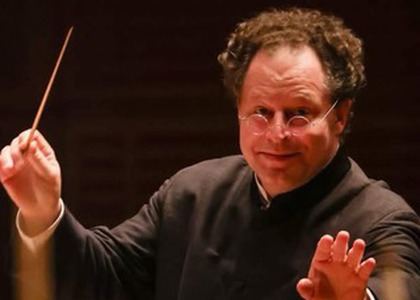
Interview with conductor John Axelrod
American conductor John Axelrod returns to the podium of the National Radio Orchestra on Friday, March 13th 2026, for a concert featuring Gustav Mahler's Symphony No. 9. In the interview he gave to Ana Sireteanu, the musician speaks about his vision of this work, but also about how he looks back on the 30 years of artistic career he celebrates in 2026. Last but not least, he reflects on the impact that social media and the internet have on children as well as on young musicians.
In 2026 you celebrate both your 60th birthday and 30 years of your international career. How would you describe this journey, and what artistic credo guides you today?
I've spent half my life waving my hands: that is, conducting, so this time has certainly left its marks on my body. Now that I'm turning sixty, I've had to start paying closer attention to my health. The main reason I'm thinking about this is that I have a seven-year-old son, and I want to stay healthy so that I can be with him for as long as possible. For the past thirty years, my artistic credo has been: live your life and translate it into music. But today I feel that my destiny is perhaps more directed toward being a parent than toward my professional life. For many people, being a father seems almost incompatible with being a conductor, because we are usually away from our families for long periods of time. After thirty years of my career, I can also say that experience is built over time. Even though many young conductors today are given opportunities and access to scores and education, especially here in Bucharest, where I serve as jury president and coordinator of the Bucharest Conducting Academy, I'm happy to see so many young conductors entering the world of classical, symphonic, and operatic music. But sometimes I feel they are pushed onto the rostrum a little too early. And when that happens, the ones who suffer most are the musicians and the audience.
So my artistic credo today, at sixty, is shaped by my perspective as a teacher: give knowledge more time to settle and don't accept opportunities too early. They are tempting, of course, everyone wants experience and the chance to stand in front of an orchestra, but first impressions matter, and they can remain attached to your image for a long time. So be sure you are truly ready to step onto the conductor's podium in front of a great orchestra. And I'll repeat the words I say at every conducting class: choose wisely.
On Friday, at Sala Radio, you will conduct Gustav Mahler's Symphony No. 9. You studied under Leonard Bernstein, a very influential musician and a great advocate of Mahler's music. Did your mentor inspire your affinity for Mahler?
Of course, because I studied Mahler's music with him. In fact, Symphony No. 9 was the last work we studied together, and during that period he gave me his baton: the one I still conduct with today. Bernstein saved this work for the end because it truly represents an ending. I believe that in the 1980s "Lenny" (Leonard Bernstein) also felt that his own end was approaching. Music as sophisticated as Mahler's takes time to understand. But even more importantly, to perform it you must understand life and death, the full range of human emotions and experiences: love and the loss of a loved one, comedy and tragedy. Many conductors in their twenties or thirties feel the need to gain experience by conducting a Mahler symphony, but if they haven't experienced the loss of someone close to them, I would advise them to wait a little longer before conducting this music. If you haven't truly lived these lessons of life, it's very difficult to express them authentically. This is one reason why the stereotypical image of a conductor is someone with experience. It takes time to understand life's lessons. And then those lessons must be translated and expressed through the conductor's vision so that the musicians in the orchestra, and the audience, can understand the message of the music. For my part, I had to live through life in order to understand these lessons. It took me thirty years to truly grasp the meanings of this music.
I believe that in this symphony Mahler says farewell: to life, to love, to nature, and to the homeland he loved; to a society that was both a source of pride and of shame for him. It is, ultimately, a farewell to life itself. Mahler expresses in his music extreme sonorities, the transparency and intensity of sound, which he then reduces to something as small as an atom or a proton. You can hear all these images: the music evolving from fortississimo to meditation, especially at the end of the first movement and in the Finale. In this way, we understand that life itself is multidimensional. Today we hear people speaking about the multiverse, about the possibility that there are multiple universes we know nothing about. I would say that Mahler's music is a path toward understanding these multidimensions through our human and divine experiences: our human bodies and our divine spirit.
Radio România is currently running the campaign "Stay Safe Online," which aims to support young people and their parents in addressing the risks of the digital environment. Since you mentioned that you are also a teacher, how would you describe the impact the internet has on young musicians?
I know the consequences directly, because I'm a father, and I'm fully aware of the negative impact that social media and video games can have on children's mental and emotional health. The increase in dopamine levels can have harmful effects and may lead to aggressive behavior in children, especially those under thirteen. For older teenagers, social media can have even more serious consequences. Parents often allow young people to spend more and more time on social media without taking one factor into account: the algorithm. The algorithm doesn't care who you are. It simply continues to deliver media content based on what you click on. If you click on something out of curiosity, the algorithm will give you more content from that same sphere.
On the other hand, I think YouTube is one of the greatest inventions of all time, and my advice is: use the algorithm carefully. This connects again to the first question you asked me: choose wisely what you watch. If you use the platform to listen to classical music, and I think it's wonderful that you can find so many classical recordings on YouTube, then the algorithm will continue recommending classical music. So we cannot blame the internet, just as we cannot blame a gun or a piano for the effects they have on people. The responsibility lies with the person playing the piano or pulling the trigger. In the same way, it lies with the person using social media.
Parents, often stressed, simply hand their children a phone or a tablet. If children are left unsupervised, the algorithm doesn't care whether they are six years old or sixty, they may see things they shouldn't see. The alternative for parents is to set time limits for using these devices and to talk with their children, explaining that social media can be just as dangerous as touching a hot pot or crossing the street without looking. I believe the most important thing is to choose wisely and use the internet for educational purposes.
For young musicians, complete access to the classical music discography, including audio and video recordings, is an extraordinary resource, something we have never had before. You can see that the growing number of young conductors and performers is directly connected to this possibility of research and education. If we hadn't had YouTube, we would probably have fewer conductors and music students today. The internet is extraordinary, but, returning to my artistic credo, we must choose wisely.
Translated by Oana-Elena Dragnea,
University of Bucharest, Faculty of Foreign Languages and Literatures, MTTLC, year II
Corrected by Silvia Petrescu


