



> Interviews
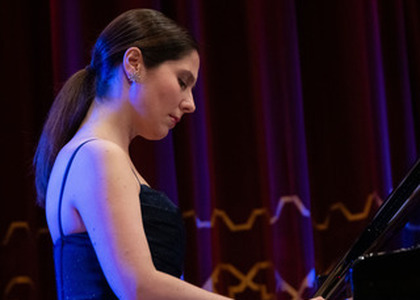
Interview with pianist Alina Bercu
Alina Bercu, what is the title of the book you'll presenting us today?
Thank you for having me. I find it so wonderful to talk about literature and books because we are very rarely asked about such topics so I'm really glad and it is a pretty difficult question, I must admit. I have been thinking deeply about this topic over this several days because it's very difficult to recommend only one book or one author. I think literature is so beautiful and infinite, if you will, because, yes, it has this specific power to transport us in other dimensions, places or times and it's very hard to limit myself to only one book or one author.
I would like to say some things about me so you can understand my choice. Ever since I was a child I've had this bad habit of getting bored quickly, whether things, situations or whatever. I understand very quickly what it is about in a specific moment, situation or context and so I often find myself after a short time wanting to escape, to leave, to change the scenery because it seems to me that our life is very repetitive and the same things happen pretty much all the time, don't they? Or at least that's my vision and I've been identified with this feeling for many years. If I had a magic button to push it and teleport myself in another place, dimension or era I would do it without thinking twice, and for this kind of things we have Haruki Murakami, a Japanese writer born in 1949, who, for me, has this fantastic ability to teleport me, with just a few words or sentences, to a completely different place or dimension. I could describe his style as that unique feeling where you don't know exactly if you are dreaming or you're still awake. That's pretty much where you found yourself reading the novel, and this medicine named Murakami is, for me, absolutely fantastic because I've managed to escape just in a few sentences, exactly what I often find myself wishing for. I discovered this author during the pandemic.
The first book I have read was Kafka on the Shore, an extremely bizarre and weird book, but thanks to his incredible simple writing style in which he explains in very simple and very human words how he brews his coffee or cooks his noodle soup, in just a few words you don't even realize when you crossed the threshold from the real world into the fantastical one, and in this novel very interesting things are happening. It's about an old man who chats with some cats or it starts raining with fish from the sky instead of water, so there are extremely bizarre things happening, but somehow he makes you believe completely in what's happening out there that the moment you closed the book and go outside, you almost expect or wouldn't be surprised seeing fish falling from the sky instead of water. Or in his most complex novel, 1Q84, where it's about a situation in which there's two moons in the sky, a normal one and a greenish one. Another interesting element in his novels is this musical tone, because he owned a jazz club before he became a writer, he's a huge jazz lover so in all of his novels that I've read there's this musical tone and often the song described in that specific story or novel is that precise element that connects the real and fantastical worlds. So I'm not sure if I answered your question, I find it very difficult to recommend you just one book. I've read some of his books, not all of them, because there are so many but in any case, he's an author who's very dear to me, and in the times we live, where we're surrounded by negativity wherever we look, on the news, for instance, something horrible It's happening somewhere on the planet. I think it's a beautiful escape, a little trip to another dimension, to a fantastical world where we discover beautiful things.
Why do we need to read? How does reading help us in our daily life?
I'm not sure if we need to read, because, often, this idea of "needing to read" does more harm than good. I think it's about being open, curious, in approaching everything in this life and as I already said, I believe literature has a fantastic power of helping us travel when we can't do it for real. We can practice the empathy within a novel, identify with certain characters or discover that in fiction, it is in fact, a great deal of reality and that describes the real life we live in, but of course, from a different approach or another perspective.
Translated by Cosmin Șerban,
University of Bucharest, Faculty of Foreign Languages and Literatures, MTTLC, year I
Corrected by Silvia Petrescu


