



> Interviews
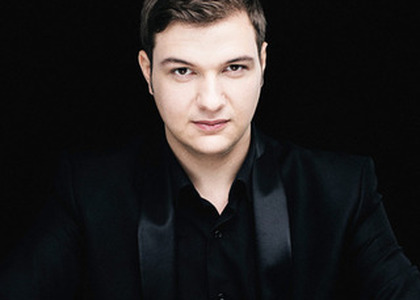
Interview with cellist Andrei Ioniță
Cellist Andrei Ioniță is the Radio Chamber Orchestra's soloist in the concert taking place tomorrow, March 11th, at Sala Radio. You'll hear him perform pieces by Antonin Dvořák and Pyotr Ilyich Tchaikovsky. The young cellist is here, with me, in the Radio România Muzical studio. Good evening.
It's nice to see you again.
I'd like to start with a few words about rehearsals. From what I understand, they've just ended.
Yes, it's always a delight to return to the Sala Radio's stage. It's not my first time collaborating with the Radio Chamber Orchestra. I have such fond memories of three years ago, when I was offered the opportunity to perform in two solo roles, as a cellist and as a pianist. This time, I'll be sticking to the cello, and I'm glad to be collaborating with conductor Jiří Rožeň, here, in Bucharest. We already know each other, we performed together with the Moravian Philharmonic Orchestra in a tour across the Czech Republic, consisting of five concerts. Our repertoire back then was the Dvořák concerto. After that collaboration, I'm glad that he accepted the invitation to come to Bucharest to perform alongside us. The rehearsals went well. The "Variations on a Rococo Theme" is a well-known piece that's loved by the audience and the orchestra and we can't wait to present our entire repertoire to the audience.
I'd like to go back to your relationship with the conductor. I understand that it was a tour consisting of five concerts. What can we, the audience in Bucharest who doesn't know the conductor, expect? What kind of orchestra leader is he?
I think he's an extraordinary conductor, an intellectual who can handle a very wide repertoire, both well known pieces and less performed, but perhaps more interesting, more unique pieces. Starting from our first collaboration, I liked the fact that he was willing to go into detail down to the essence of every musical cell, of wide structures. And, as I've said before, I was glad to have him here as a musical partner
From what I understand, I assume such a stage partner is an ideal. Regardless of whether they're a conductor, a pianist, or any other kind of musician, a person who pays attention to details would be important, because I'm focusing on the "musical cells" phrase.
Yes.
Is attention to detail important?
It's how I built and improved my performance skills in my formative years, starting from the smallest movements on the instrument, physically speaking, and analysing every musical cell and this capacity to coordinate, compose, to even create a single sound. We won't even get into discussing wide structures. Not to sound like I'm bragging, but I've been asked many times, told, about my ability to perform long phrases. How do I do it? I can do it because I focus on detailed instrumental performance, and it's exactly because take care of each individual note that I manage to create a complete and coherent musical discourse.
How does the relationship with the orchestra work towards this? If a soloist addresses everything down to the smallest detail, how can they communicate it to the orchestra?
Yes, when it comes to communicating with any stage partner, be they chamber or orchestra, what's important is creating a relationship of mutual trust and, let's say, working on a solid phrasing foundation to leave space for various interpretations and for the spontaneity needed in a concert. It's possible that my performance tomorrow won't perfectly match what we rehearsed to day, but because we worked in-depth and established certain dynamics and all sorts of entries, transitions and so on, we have the necessary confidence and we function as a coherent and concise ensemble, to then afford various liberties during the concert.
Speaking of working with the orchestra, I'd like to remind the audience that we're on the eve of the concert, since, as I understand, the first rehearsal was today, which is the norm in today's world. As a soloist, you can't have it any other way, because, let's admit it, this is the schedule. How much does the extra rehearsal matter?
With very famous conductors I had the luck to cross a cordon two hours before the concert. Even in the case of a well-oiled ensemble, even when you return to the stage with the same ensemble, with the same piece, things change, the atmosphere changes from day to day. I remember that even during that five concert tour, depending on the new concert space, the acoustics of each hall, we often had to skip important parts of the performance, even though we're talking about Dvořák's "Cello Concerto", performed in his birth country. Every day is different, which is exactly why it's important for the ensemble to knit together and trust each other at least a day before the performance.
It's said that you can tell a musician's intelligence by how they perform Bach. At least that's what I heard when I was in middle school, high school and college. I'd like to point out the fact that we can notice this in all of your recordings, or at least the ones I know. What's obvious is that this doesn't diminish the joy of listening to Dvořák or Tchaikovsky. What I'd like to discuss in the next few minutes is how did you choose the pieces we'll be listening to tomorrow evening?
First of all, thank you for your appreciation. Regarding Bach, I consider Johann Sebastian Bach to be a sort of universal man of classical music, because he can be considered the most mathematical composer. The structure of his music is so clear that, in my opinion, his music speaks for itself, especially the "Cello Suites" for unaccompanied cello, which have an extremely clear structure and bassline, for example. That's why I fell like Bach's musical discourse is natural, as long as you're able to recognize the elements that build the micro and macro structure of the discourse. Regarding tomorrow evening's repertoire, Jiří Rožeň thought of a program that is, in this central European space, Czech-Polish. The first thing that came to mind was this beautiful piece, "Silent Woods", or, in German, Waldesruhe. I don't know if there's an official Romanian translation, perhaps Liniștea pădurii ("Silence of the Forest") or Liniștea codrului ("Silence of the Woods").
Probably, yes. Especially because its a 19th century piece.
Romantic, exactly, by Antonin Dvořák. Its a shorter piece, which is why it's not often included in programs for a consistent symphony concert, precisely because Tchaikovsky's "Variations on a Rococo Theme" isn't the longest concertante piece in a cellist's repertoire. I thought to include this clam, peaceful, descriptive piece as an introduction, a piece that, as its title suggests, takes its inspiration from nature. In it, we find distinct sonorities and a dialogue with wind instruments that often may become a metaphor for birdsong, and I don't know how often this piece is performed or included in a program in Romania and we thought it would be a fitting opportunity to have it live at Radio România Muzical.
Naturally, we're grateful for this. I admit, this will be the first time I listen to it. I heard it for the first time before this interview and I wanted to know where you know it from. How do you come across pieces like this?
I've always known about this piece. I still remember the recordings I heard of Yo-Yo Ma or Jacqueline du Pré and I was deeply impressed by the romantic wave, that was, at the same time, natural and easy, full of emotion, with which they somehow managed to interpret this piece. I've been trying, here and there, to include it in a program, and it looks like it worked.
I would assume there aren't many new things to say about the Rococo Variations, especially because we should leave instruments to instrument players.
I hope the interpretation is new. What I like about this piece is its somewhat improvisational nature and the fact that, considering the reduced instrumentation, it allows the performer to use their imagination and fantasy, but keeping the simplicity and the elegant spirit. It's interesting, because Tchaikovsky is the most famous and beloved Russian composer, all things considered, through this neoclassical spirit, the piece somehow gains Central or West European dimensions and I think it fits in the landscape of the entire program.
I'd like to know, and I'm sure so do our listeners, what is next on your agenda.
In April and May, what's waiting for me are a few trips and tours to Korea and Japan, in Tokyo, together with the New Japan Philharmonic. I'll be able to perform all of Bach's six suites again in a Tokyo concert, at Hamarikyu Asahi Hall. For the Romanian audience, I'll be waiting to see them again in April together with the Cluj and Satu Mare Philharmonic Orchestras, and in Iași, in May.
I'm sure the audience in all these cities and obviously the Bucharest audience and the listeners of Radio România Muzical are waiting for you tomorrow evening on our station's frequencies, together with the Radio Chamber Orchestra.
Translated by Alexandra Teodora Ciolacu,
University of Bucharest, Faculty of Foreign Languages and Literatures, MTTLC, year II
Corrected by Silvia Petrescu


