



> Interviews
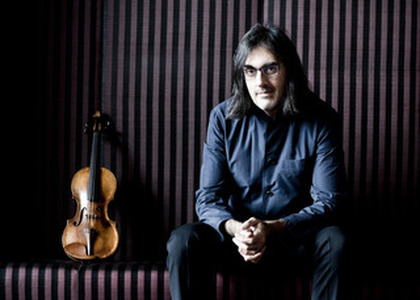
Interview with violinist Leonidas Kavakos
This week, the celebrated violinist Leonidas Kavakos appears for the first time as soloist with the George Enescu Philharmonic Orchestra. Following last night's concert, the musician will once again take the stage of the Romanian Athenaeum today to perform Pyotr Ilyich Tchaikovsky's Violin Concerto in D major.
You have probably performed Tchaikovsky's Violin Concerto countless times by now. What does it mean for you to return again and again to the same musical text?
Each time it is a new experience, or at least I try to make it so. I performed this concerto very often when I was young, but at some point I felt that my interpretation was no longer evolving in a clear direction, so I stopped playing it for about ten years. After that I returned to it, and since then I have performed it regularly, occasionally adjusting small details.
What is extraordinary about the life of a performer is that every time you return to a work, you are no longer the same person. In the meantime we live our lives, we gather experiences, and our perspective on music changes. So even if you have played a piece many times, every encounter with it is entirely different.
It is one of the great concertos, and the music is simply of remarkable beauty, while at the same time full of colour, as is always the case with Tchaikovsky. He has this unique ability to create atmosphere through the way he orchestrates his music.
What more could one say about this concerto? It simply belongs among the masterpieces. At the time it was written, it was a profoundly revolutionary work, and it was initially rejected.
The music has an almost dreamlike atmosphere from beginning to end. We do not find here the dramatic passion that appears in some of Tchaikovsky's other works, especially the later ones. Instead, the piece is filled with colours and moods of every kind, all woven into this "dream." There is joy, melancholy, nostalgia, sadness, practically every emotion, yet expressed in a way that never becomes excessively dramatic.
Tchaikovsky's concerto always makes me think of Saint Petersburg, of that particular kind of classical beauty. The city was built under the sign of Italian inspiration, evoking the great cities of Italy, especially Venice, with its canals and splendid palaces. I sense something of that classical elegance in the violin concerto as well. Tchaikovsky, after all, greatly admired Mozart. In this work one might say there is a kind of Saint Petersburg atmosphere, cosmopolitan, yet at the same time very elegant, richly ornamented, and deeply imaginative.
What impressions has your collaboration with the George Enescu Philharmonic Orchestra made on you so far?
It has been a very pleasant experience. There are many young musicians and the atmosphere is excellent. It is the first time I have performed with this orchestra and, in fact, only my second experience with a Romanian orchestra. Two years ago I played with the Cluj-Napoca Philharmonic Orchestra in Greece. The level of the string players here is very high, there is clearly a strong tradition, a school behind it, and this is very much reflected in the quality of the performance.
I am very happy to be here and I look forward to the concert with great interest. I am also collaborating with Andrei Boreyko; we performed together often in the past, although we had not seen each other for nearly twenty years. It is wonderful to meet him again, he is a marvelous musician. Overall, it has been a very enjoyable experience.
I would also like to talk about your sensitivity to folk music, since there have been musicians devoted to this genre in your family. How has that perspective influenced you?
I had the opportunity to see closely how this kind of music works. Unfortunately, I never learned to play folk music myself, which I regret. At the time there was a certain mindset among folk musicians that their music was somehow inferior to classical music. As a result, if someone played classical music very well, it was assumed that they no longer needed to play folk music as well. Of course, this idea is completely mistaken, since a large part of classical music has its roots in folk traditions.
For me, it was extremely valuable to be in contact with that world, to observe how folk ensembles perform, how they rehearse, how they improvise. Their approach is much more relaxed than in classical music. That dimension of improvisation, of spontaneity, is extremely important.
In classical music we need to recreate the impression of spontaneity, Tchaikovsky's score is the same as it was when it was written, and it will remain the same forever. The question is: how do you bring freshness to the music?
In folk music, the songs themselves may remain the same, but because they are not written down and are learned by ear, musicians have the freedom to present them in their own way. And that is something classical musicians can learn a great deal from.
Translated by Carmen Badea,
University of Bucharest, Faculty of Foreign Languages and Literatures, MTTLC, year II
Corrected by Silvia Petrescu


