


> Interviews
Interview with composer Adina Dumitrescu
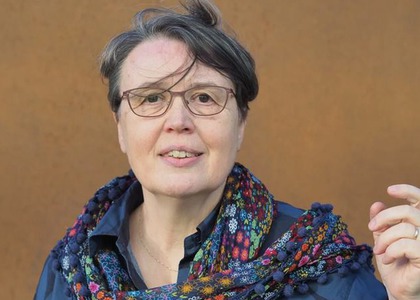
Composer Adina Dumitrescu writes a new work presented in its world premiere as part of the Sibbe Live! concert hosted on Wednesday, March 18th, 2026, by the Sibelius Museum in the Finnish city of Turku. On this occasion, the Romanian musician, who has been living in Finland for many years, spoke with Ioana Țintea.
Ms. Adina Dumitrescu, your new work, Letters from the Other Shore for clarinet and piano, in which the pianist also has a vocal role, will be heard in its absolute premiere in Turku, during a concert hosted by the Sibelius Museum. How did the idea for this score come about and what inspired you in the creative process?
I'm glad to say a few words about this work and its premiere.
I have known Mikko Raasakka - the clarinetist - and Antti Vahtola - the pianist - for a long time; I've known Mikko for almost 15 years, I think, and in 2015, when Mikko and Antti came to Bucharest to give a concert at the Țintea Muzicală Festival, I grew closer to them. They are exceptional musicians and wonderful people; I always enjoy writing for them. It helps me a lot when composing to have in mind the performers I am writing for and who will give the premiere. Of course, you don't always know who will perform the piece, but if I do know, it's even better.
The idea of the work Letters from the Other Shore was born from my life experience in Finland and Romania, because I am divided between these two countries. I left Romania more than 20 years ago, but I never left completely. I could say that was when I began to divide myself between Romania and Finland.
And these letters are dedicated to myself and written by me for the two selves, from the two countries, which are never separated and always live together.
What can you tell us about the structure of the work?
There are five letters, so five movements. I knew the recital was for bass clarinet and piano, but I asked Mikko to let me also use the B-flat clarinet. I also knew that Antti has a very good voice-he sings in the Helsinki chamber choir-and I wanted to write for his voice as well. So, out of the five letters, two are for piano and B-flat clarinet, and the other three movements are for the remaining combinations: bass clarinet with voice, bass clarinet with piano, and B-flat clarinet with voice.
How would you describe the musical language used in conceiving the work, and what place does this opus occupy in your creation?
It's my latest work; I didn't have the desire to write in a particular way, I just wanted to be who I have been until now. From the performers' point of view, the reaction was fantastic-I didn't expect them to enjoy it so much. They said that my earlier style, or from a few years ago, blends very well with some new ideas. So I couldn't really say whether my style has changed or whether there is something new in the language. I'm sure, however, that I wanted to be very authentic.
For many years you have lived and created in a very active musical environment, that of Finland. How has this context influenced your artistic path?
Mikko helped me a lot at the beginning-that's the truth. I can't say I am very present; I am present as much as I dare to be, but it helped me become freer.
Now things also overlap with getting older, so I can't really say whether it's the passing of time or the fact that I've seen what happens here that has helped me become freer in my approach to composition.
What themes or directions currently concern you as an artist and composer?
I write with great pleasure for the voice. I also had a portrait concert in November where I included several vocal works. I have started to become interested in microtonal music. Recently, I also enjoy writing for the organ and especially for orchestra. But with orchestra it's more difficult; until you get a work performed, it's more complicated. Still, I really like combining colors.
Translated by Darius Baciu,
University of Bucharest, Faculty of Foreign Languages and Literatures, MTTLC, year II
Corrected by Silvia Petrescu


