



> Interviews
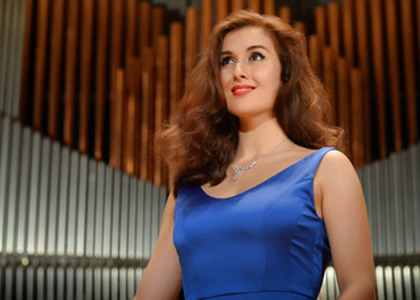
Interview with pianist Sînziana Mircea
On Friday, March 20th, 2026, pianist Sînziana Mircea will be the soloist of the National Radio Orchestra, conducted by Nicolae Moldoveanu. The musician will perform two concertante works: Rhapsody in Blue for Piano and Orchestra by George Gershwin, and Piano Concerto No. 2, Op. 14 by Nikolai Kapustin. For more details, Sînziana Mircea speaks with Ioana Țintea.
Sînziana Mircea, at the concert at Sala Radio you will perform, in its Bucharest premiere, Piano Concerto No. 2 by Nikolai Kapustin, a work rarely performed worldwide. How did you discover this score and what particularly attracted you to it?
Kapustin is a composer I have known since my student years in Germany. He is one of the most interesting composers of both classical and jazz music, and this Concerto No. 2 is an explosion of energy and rhythm. It is written in a classical three-movement form, but what lies inside is pure jazz. It feels like a suite of improvisation. In the second movement, there are moments that sound exactly like an improvised jazz piano solo. The third movement is a nonstop perpetuum mobile, a toccata that reaches an incredible tempo and raises your pulse to the sky. So for me, it was an incredible discovery.
I really wanted to bring it to the stage, and I will be giving the Romanian premiere-it has never been performed in Romania or by a Romanian pianist abroad-on March 18th in Brăila and then on March 20th at Sala Radio.
I have already rehearsed with Maestro Moldoveanu. We had a first meeting at two pianos, and it was an instant connection. Everything went smoothly, and it is a great honor for me. I was supposed to perform with him in 2020, but it became the first concert canceled due to the pandemic. Since then, I've felt regret at missing such an encounter with an incredible musician.
In Brăila, I will perform with an American conductor, Barnaby Palmer, who was also very enthusiastic, because it is a very difficult work. It involves a symphonic orchestra with piano, electric guitar, jazz percussion-all of which must come together in a short time, as happens in rehearsals for a concert season. I am very grateful to both the National Radio Orchestra and Maestro Moldoveanu, as well as the Brăila Philharmonic.
What were the biggest challenges you discovered while preparing this score?
It is written in a different musical language-it's like a foreign language. All the chords are slightly different… there is always a dissonant note. The classical structures are completely different. I had to erase everything I knew from memory-and from muscle memory, so to speak. Every chord is a different combination of notes than it would be even in Rachmaninoff, for example, or even in Gershwin, since in the same evening I will perform Rhapsody in Blue. That too is inspired by jazz, but with a much more classical language.
For this, I actively prepared: I attended jazz concerts. I went to Blue Note in Milan, a venue that hosts some of the most important jazz concerts in Italy. I listened to many recordings by Oscar Peterson, of course works by Kapustin as well-I wanted to get into the mood. It was a very intense period. I've been preparing it for almost a year, and I'm very happy and eager to perform it.
Another work in the Sala Radio program is Rhapsody in Blue, a piece with enormous popularity. However, that very fame sometimes creates certain expectations from the audience. What is your perspective on such a well-known work?
It is very difficult to bring something new-that's the reality-when there are dozens of recordings, when we have Bernstein, Yuja Wang, Katia Buniatishvili. But this pairing with Kapustin places both works in a very beautiful light. And I wanted at least one work to be familiar to the audience, because when you propose a completely unknown piece, like Kapustin, there is a risk that the audience might feel intimidated and think it might be difficult contemporary music. So I thought: at least Gershwin will be something everyone knows-and then they will surely have a pleasant surprise with Kapustin.
You mentioned in an interview that whenever you are in front of a piano, you feel at home. How does this return "home" to Sala Radio feel, alongside the National Radio Orchestra and the Bucharest audience?
Returning to Sala Radio feels like returning to my childhood and to my entire journey. I owe so much to Radio Romania. I literally grew up in Sala Radio, in Mrs. Rodica Sava's programs, "Musicians of Today, Musicians of Tomorrow", where I performed live. What an enormous responsibility for a child-and what an incredible opportunity-when I was seven or eight years old on Radio România Cultural! Then came the programs and especially the concerts organized by Radio România Muzical, Mrs. Cristina Comandașu, who gave me the chance to perform at the 18th anniversary of the station, when I was 20-almost the same age as the station.
My first concert in the Imagine series-immersive concerts that go beyond the classical recital format-was organized within "The Heirs of Musical Romania" in 2019. And with the National Radio Orchestra and the Chamber Orchestra, I have built a friendship since 2019. I performed works such as Beethoven's Piano Concerto No. 4, Mozart No. 21, and I also gave the first post-pandemic concert with an audience. I am very grateful to Director Staicu for giving me the opportunity to perform Beethoven and now Kapustin.
For me, Sala Radio is the most "home-like" musical place possible, because from early childhood until today I have had incredible opportunities there. I am very happy and deeply grateful.
Translated by Darius Baciu,
University of Bucharest, Faculty of Foreign Languages and Literatures, MTTLC, year II
Corrected by Silvia Petrescu


