

> Interviews
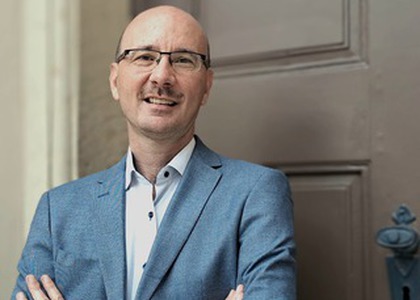
Interview with Zoltán Horváth, initiator of the “Bach Marathon” project
Saturday, 21st of March 2026, the fifth edition of the "Bach Marathon" project will take place in Cluj Napoca, a series of concerts that are performed annually across 12 hours in the Pietati Church. The project will be taking place on the day when, back in 1685, the composer Johann Sebastian Bach was born.
Organist Zoltán Horváth, the initiator of the "Bach Marathon" will be telling us more about this year's edition:
Mr. Horváth, four years ago you were telling me about your initiative, the "Bach Marathon" project, intended to promote Bach's works, as well as valorising the Pietati Church's organ, which was recently restored. Ever since the first edition, you had a diverse program, with performances from musicians in various generations, from students of music schools, to famous artists. Now, you've reached the fifth edition. How has the project developed across the years?
We stayed true to the path we established at the beginning, because the audience was grateful and the city welcomed our event.
The fifth edition will proceed like the ones before it, in the Lutheran Evangelical Pietati Church, the artistic baton will be passed from young musicians to, as you said, famous artists. We hope it will be a sacred, festive event, anticipated by the audience. Other than the scheduled concerts, it will also have an educational side aimed at children.
What is the structure of your audience? Are they the church-goers? Do they come from other places? Could they be coming from other cities?
Our audience are music lovers, because usually, in philharmonics' programs or in instrument recitals organized in other spaces, Bach's music isn't really continuous and there's no space dedicated solely to Bach. Whoever wants to enjoy this music exclusively has the opportunity to do so during the marathon.
The marathon has a diverse audience, school students, university students, music lovers. You could say Cluj welcomes it with open arms.
You were telling me about the educational program, which I know was included in the marathon ever since the first edition. Tell us what's new in the program of this year's edition, but also what elements it has in common with previous editions.
The famous "Goldberg Variations" will be included in the marathon's program again, this time in a proper harpsichord version, performed by Cipriana Smărăndescu, who is touring Europe with this masterpiece. The closing performance, also included in the "Bach Marathon", a closing performance featuring the Baroque Orchestra, an ensemble that was founded and grew across the five editions of the marathon, a performance featuring a guest from London, violinist Kati Debreczeni, who served as concertmaster for John Elliot Gardiner's orchestra, and three other soloists, Melinda Sámson, soprano, Hédi Bátki, Baroque oboe, and, of course, the Cluj Baroque Orchestra's concertmaster, Csilla Szövérdi.
As in previous editions, the instrumental (and chamber) genre of Bach's music will dominate the marathon's program this year. Among other things, we'll also be hosting two CD launches, two instrumental duos will present fragments of their recent recordings, we'll be listening to a harp version of the "Lute Suite", for example. Both organs in the church will be played.
I don't know if the audience knows, but a Baroque organ has been sanctified in the church, so, alongside the Walker organ, we now also have an authentic Baroque organ.
It's the organ you brought from Chirpăr, Sibiu. I know that ever since the first edition, you've been raising money from donations to restore the organ. Last year it was sanctified and unveiled, and from what I know, it's already part of the performance circuit alongside the large organ.
Yes, it's delightful. Our intention is to bring in a Baroque instrument, tuned to a pitch of 415 Hz, which is ideal, for example, for a the continuo of a Baroque orchestra. The instrument is a gem.
This year, Amalia Erdős will be playing the Baroque organ and Noémi Miklós will be playing the Walker organ.
This year's educational program won't be a concert, but a workshop, an organ crafting workshop intended for children between the ages of 7 and 10, coordinated by organist László Gesztesi-Tóth from Budapest. There will be two workshops, one in Romanian and one in Hungarian. I would also like to say that the parents' interest was overwhelming and the available spots have all been filled.
The entry is free, as far as I know.
Of course! Thanks to our sponsors and institutional fundals, the entire marathon is free!
Anyone who isn't in Cluj can watch everything online on the "Bach Marathon"'s Facebook page.
Yes. Each year we try to improve the sound quality.
You started a project that's unique in Romania, so that on Johann Sebastian Bach's birthday, his music will be performed for an entire day. It's a project that was a long-term plan ever since the beginning. What else would you want, on top of what you've already been achieving for five editions?
We want the musicians and artists who honor us with their presence to keep coming to this festival, this marathon enthusiastically and for us to host them as they deserve.
Translated by Alexandra Teodora Ciolacu,
University of Bucharest, Faculty of Foreign Languages and Literatures, MTTLC, year II
Corrected by Silvia Petrescu


