


> Interviews
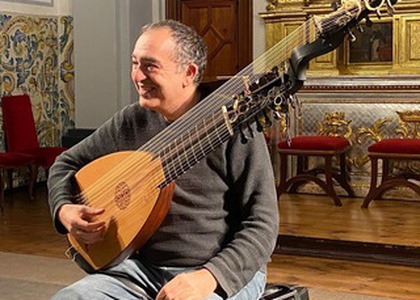
Interview with Xavier Diaz-Latorre
Xavier Diaz-Latorre will conduct the early music ensemble "Sempre" in their concert on March 21st, 2026, at the Romanian Athenaeum. The Catalan musician spoke with Ana Sireteanu about this event:
You are returning to Bucharest to perform a concert with the ensemble "Sempre", organized on the occasion of Early Music Day. What are your thoughts as you look forward to reconnecting with the Romanian audience?
This concert on March 21st will be my first opportunity to collaborate with the "Sempre" ensemble. They invited me to work together on a new project, which is a program based on 17th-century Italian Baroque music for violin or multiple violins and basso continuo. As for my relationship with the Romanian audience, I have already performed many times in your country, and I have always found a very attentive and receptive audience, highly sensitive and warm. It is wonderful to return and perform in Romania!
As you mentioned, the program features Italian Baroque music by composers who contributed to shaping the expressive potential of string and bow instruments. What are the particular characteristics of this 17th-century music?
The initial title was L'arco italiano, meaning "the Italian bow." In this concert, we focus on music from the early 17th century up to Arcangelo Corelli, where one can observe an interesting evolution in the way composers wrote for the violin and violin ensembles. We will perform in various formations: solo violin or two violins and basso continuo - which, at the time, referred to the accompaniment, here consisting of harpsichord, two lutes, cello, and double bass. We will also present pieces for two, three, or four violins and viola. Therefore, we have a wide variety of works covering the entire 17th century, and I believe there is no better way to celebrate the birthday of Johann Sebastian Bach - what we now call Early Music Day - than with this music and these musicians dedicated to early music and period instruments. For me, it is an extraordinary opportunity to work with this wonderful Romanian ensemble, "Sempre."
How would you describe the way contemporary audiences relate to or understand 17th-century music?
Baroque music, and early music in general, is very well received by audiences, and in recent years it has been approached from a fresh, new perspective, different from that of 50 years ago, when orchestras performed on modern instruments with a modern approach. However, since the so-called revival of this music - meaning the use of period instruments and the growing interest of artists in studying and interpreting this repertoire in its original manner - this has given the music a lighter, almost diaphanous sound, which I believe the audience truly appreciates.
Translated by Ioana Nicolescu,
University of Bucharest, Faculty of Foreign Languages and Literatures, MTTLC, year II
Corrected by Silvia Petrescu


