



> Interviews
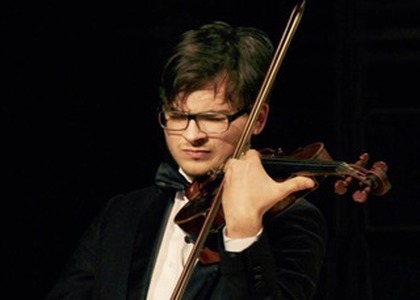
Interview with Dan Iulian Druțac
The Great Hall of the Romanian Athenaeum will host, on Monday, March 23rd, 2026, at 7:00 P.M., a recital by violinist Dan Iulian Druțac, cellist Constantin Borodin, and pianist Marcel Lazăr. In an inter view conducted by Cristina Cîrjan, the violinist from the Republic of Moldova spoke about the significance of this occasion.
The concert at the Romanian Athenaeum is dedicated to the Day of the Union of Bessarabia with Romania. What does this event mean to you?
It is an honor for us. This is the first time we are performing on the stage of the Romanian Athenaeum in this particular ensemble, and we are delighted to present a concert dedicated to the Day of the Union of Bessarabia with Romania. Of course, the program also includes a work by a Bessarabian composer, Boris Dubosarschi. We are especially pleased to bring this rarely performed music to the audience.
You will perform as a trio alongside cellist Constantin Borodin and pianist Marcel Lazăr, musicians with whom you share a long-standing artistic collaboration. How was this relationship built, and how do you feel it has evolved over time?
We have been colleagues for a long time. All three of us are part of the Moldo Crescendo Festival, which we founded together, and over the years we have gathered many shared memories. The experience of performing together connects us, helps us grow musically as an ensemble, and allows us to understand each other more deeply, supported by the strong bond of friendship we share.
The program brings together works by George Enescu and Boris Dubosarschi, representing both the Romanian cultural space and that of the Republic of Moldova. How did you envision this dialogue between the two musical identities?
First of all, we felt it would be fitting to perform a Romanian work on the stage of the Romanian Athenaeum. Moreover, this particular trio is very rarely performed. For a long time, the score was even considered lost, so we thought it would be especially meaningful to include it in the program. We will also perform a work by Boris Dubosarschi, a piece that is seldom heard and one we ourselves discovered only recently. We are eager to introduce it to the audience in Romania.
You will also perform Trio élégiaque No. 2 in D minor by Sergei Rachmaninoff, a work of profound emotional depth written in memory of Pyotr Ilyich Tchaikovsky. What led you to choose this piece?
It is the most powerful work in the program, a piece we believe the audience knows well, and we thought it would be important to include something familiar alongside the lesser known repertoire.
Where can audiences hear you in the near future, both in Romania and the Republic of Moldova, as well as internationally?
At the moment, we are very active in the Republic of Moldova, where we organize the Moldo Crescendo Festival, and this is where most of our activity takes place. That said, we would be very happy to perform more often in Romania as well.
Translated by Carmen Badea,
University of Bucharest, Faculty of Foreign Languages and Literatures, MTTLC, year II
Corrected by Silvia Petrescu


