


> Interviews
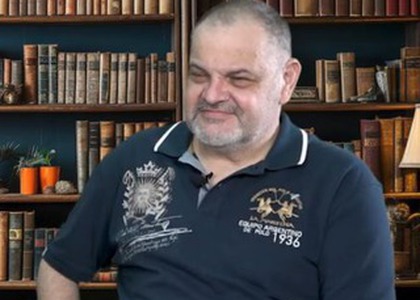
Interview with director Igor Bergler
On March 26th (preview), as well as on March 28th, 29th, and April 1st(premiere performances), the Bucharest National Opera presents The Barber of Seville by Gioachino Rossini, directed by Igor Bergler. About this new production and the directorial vision it proposes - Igor Bergler, in a dialogue with Ioana Țintea.
You are a successful writer, but also a film director. How was the transition to opera directing, and why did you choose to stage The Barber of Seville?
I love opera very much, and this is one of my favorite operas. From a director's point of view, I find it one of the most rewarding. Meaning, a comic opera allows you to play around more, so to speak. And in general, I've been very dissatisfied with productions of The Barber of Seville over the past many years, which have been, if I may coin a term, "de-buffonized", in other words, people no longer laugh at them. It has been turned into something serious, which only occasionally brings a smile, with the emphasis placed solely on the music, which is, of course, beautiful, as we know, but which completely drifts away from the original intentions of Sterbini and Rossini. I wanted to offer a version the way I feel it, the way I see it, and the way I believe the audience wants it.
From an opera lover's point of view, this work is highly singable and catchy. Every piece can stay with you, and you can hum it anywhere. Many of its arias are real hits, so to speak, hits within a single work. That's wonderful!
What interested you most when you began to build the concept of this production?
Someone said: a classical staging. And I contradicted them and said, no, it's not classical. It's precisely the classical staging that has ruined the comedy. It's, let's say, a pre-classical staging, although the term isn't historically accurate. It's a staging the way Rossini did it.
Back then, in those days, opera was for the aristocracy, and there were these lyric theatres where performances went on almost continuously, you could walk in at any time and there would be a series of operas being performed. People spent a large part of their lives there; everything happened in those spaces: people slept, ate, played cards, shouted, interacted with the singers, and occasionally even threw a tomato or two… A lively atmosphere, with people reveling in the joy of music, not a bow-tie affair where you sit and solemnly admire what's happening on stage, in reverent silence. When I saw that The Barber of Seville was being performed with such reverence, I was horrified.
I've seen hundreds of versions all over the world, including on specialized channels, on Blu-ray and DVD, maybe one out of twenty makes you laugh a little.
You mentioned in an interview your desire to bring authentic humor back into this opera. How does this idea translate into the production you are directing?
It's not just about humor. I believe I've also managed to do something that rarely happens in opera-I don't know why-especially in Romania. The characters rarely interact with each other-only very seldom. This is a problem that's quite typical in Romania. Abroad, it's not like this. Everyone stays in their own corner and sings, keeping a two-meter distance, without any kind of relationship.
Here, my characters, well, Rossini's characters-constantly interact with each other; they don't sing to the audience. We are simply witnesses to the adventures of these young lovers, who are trying to outsmart the old man who wants to marry Rosina-not because he loves her, but because he wants to inherit her fortune, as she will become the owner when she turns fifteen.
And so, there is a plot, so to speak, typical of commedia dell'arte - all the characters are inspired by commedia dell'arte.
Tell us about your collaboration with conductor Daniel Jinga and the artists of the Bucharest Opera.
I had a surprise. Having no experience in opera directing, I assumed that singers didn't have any acting talent, and I wondered why, so often, when a theatre director stages an opera, they bring in additional actors to perform, because they don't trust the singers. Well, I was wrong. The singers we initially welcomed, as well as those cast later, have remarkable acting talent. They perform very naturally and are happy to be asked to actually act, not just stand in a corner, rigid, or take a few mechanical steps while singing.
As performers, they are excellent, the best we have. They are the only tenori di grazia in Romania, which is quite significant, the only true Almavivas as they should be: Bogdan Mihai and Andrei Fermesanu. They will alternate, each performing two shows. Both are outstanding, and one of them already has a major international career. We also have famous Rosinas, Maria Sârbude from the Iași Opera will perform two of the four shows, as will Oana Șerban. And we'll have Martiniana in the final performance, an emerging international star who sings Rossini constantly at festivals. Iustinian Zetea, the man with a perfect ear, catches every mistake, every slip. We have a lot of fun at rehearsals, and their talents continue to impress me. And I discovered that they are also very friendly people, full of humor and good spirits, and very willing to perform, which, again, is great news. They are not bored, even though they act a lot, sing a lot, and are quite busy.
I believe Daniel Jinga is the right conductor for this opera, because you need a specific type of conductor for Rossini.
Now, Jinga, who is also making his debut with this opera, is exactly the conductor this work needs, someone who can lead with subtlety, speed up, or slow down when necessary.
Too often, a conductor pushes the singers too hard and ends up ruining the music. It's very difficult to maintain that Rossinian balance, especially in The Barber of Seville. So he's the ideal conductor for this, and it was a fortunate coincidence that I met him.
What would you say to those who read your books but may have never been to the opera?
I have many readers like that. I was even surprised that so many people are afraid of opera. I've convinced some of them to come, and they didn't regret it. They should come because it's something completely different from what they're used to - something entirely new.
I believe the challenge is to show people that anyone, just as in Rossini's time, can enjoy opera. Even without a higher education, even if they're not used to opera, anyone can come and have a good time at a performance. That's our goal.
Translated by Ruxandra Ioana Șerban,
University of Bucharest, Faculty of Foreign Languages and Literatures, MTTLC, year I
Corrected by Silvia Petrescu


