



> Interviews
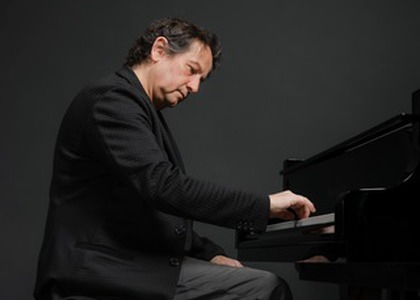
Interview with pianist Horia Mihail
The Union of Performers' Creation of Musicians in Romania (UCIMR) is organizing today, March 24th, 2026, the second edition of the Gala of Excellence in Performance Awards, an event that will take place in the Grand Hall of the Romanian Athenaeum. Among this year's laureates is pianist Horia Mihail. On this occasion, the musician spoke with Ioana Țintea.
Mr. Horia Mihail, at the Gala organized by the Union of Performers' Creation of Musicians in Romania, you will receive the Lifetime Achievement Award. What does this distinction represent for you, both professionally and personally?
It is an honor bestowed upon me by the Board of Directors of the Union of Performers' Creation of Musicians in Romania, and it reflects what I have accomplished so far, as I still have more to achieve in the future.
I am very happy that my efforts over more than twenty years here in Romania, during which I have created various projects that have been warmly received by audiences and by my fellow musicians, are now being recognized. I am referring in particular to the idea of a national tour-an idea that I initiated. It first happened in 2006, together with Alexandru Tomescu and Răzvan Suma, when, as a piano trio, we toured 12 cities across the country, performing Schumann at the time. From 2006 to 2026-there you have it-exactly 20 years have passed. During this time, many other musical stories have taken shape. In the end, I am very happy and proud that this idea of a tour has been taken up by other musicians. This model already existed in Western Europe, the United States, and Asia, and now, 20 years later, musical life in Romania is far more diverse and extensive.
Looking back, which have been the most important artistic encounters that have influenced your artistic development?
My encounters with Radu Lupu were pivotal for my development, both as a musician and as a person. Performing on stage with many other masters-unfortunately, some of whom are no longer with us-was also profoundly influential. I am thinking of conductors such as Iosif Conta and Emil Simon, as well as the violinist Roman Totenberg. Also, the violinist Peter Zazofski, along with other very important names on the international stage, left their mark on me. Even after more than 50 years of age and nearly 50 years of career, they influenced the way I now express myself on stage.
Over time, what has music offered you beyond the stage?
Practically, I am a cog in a larger mechanism when I perform-I transmit emotion, an emotion that the composers themselves once experienced, felt, and managed to capture on paper in a remarkably ingenious way. All I do is bring it back to life and pass it on to those who listen. Being part of this mechanism, the performer experiences only moments of immense satisfaction and joy.
You are involved in numerous educational projects and initiatives to promote classical music. How do you see the role of the artist in today's society?
It is an extremely difficult role, especially when some of the decision-makers-whether they are institution associates or budget authorities-have little understanding of what it means to be an artist. The discussions taking place in the public sphere lately only add to my concern. If we were to see ballerinas dancing eight hours a day, five days a week, or pianists playing eight hours a day, five days a week, it would be completely absurd. Preparation happens in a completely different way-not just in front of or next to the instrument or in rehearsal rooms. It happens by reading, by walking through the forest, or witnessing a sunset by the sea; it happens by going to the theater, for you as a musician, or attending a concert, for you as an actor. There is a symbiosis between artists and between different forms of musical creation and expression, which ultimately leads to the spreading of this universal emotion that we, as artists, play with. I would like to say that I believe the coming years will be decisive for the development of society. We, as artists, must stay close and remain very connected to the younger generations.
How important are recognitions from organizations such as the Union of Performers' Creation of Musicians in Romania for a performer?
They are extremely important and serve as a true encouragement to continue the work, effort, and daily artistic explorations we face.
Translated by Ruxandra Ioana Șerban,
University of Bucharest, Faculty of Foreign Languages and Literatures, MTTLC, year I
Corrected by Silvia Petrescu


