



> Interviews
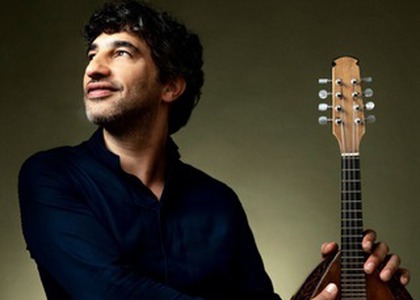
Interview with Avi Avital, the first mandolin soloist nominated for a classical music Grammy Award
Avi Avital, the first mandolin player nominated for a classical music Grammy, will be performing together with the Radio Chamber Orchestra on March 25th, 2026, both leading the ensemble and as a soloist. This interview by Ana Sireteanu will tell us more about the concert's program, as well as Avi Avital's artistic activity.
How do you think back on the concert you performed with the Radio Chamber Orchestra in 2024?
The first time I performed here, just two years ago, was incredible. I remember feeling great, it was a fully conducted program, with interesting pieces. It was simply wonderful, and this orchestra is truly lively, I enjoyed performing with them. I remember the audience's reaction clearly, and what a warm welcome we received. It was the first time I performed with a Romanian orchestra. I had performed here with my own ensemble before, but collaborating with the Radio Chamber Orchestra was, and continues to be, extraordinary.
What's the atmosphere like during rehearsals this time, and how do you share your interpretation of the pieces in the program with the musicians?
We started rehearsals and the atmosphere is very positive, focused on the music. This program doesn't need a conductor, so our musical relationship is based on trust and I think the members of the orchestra like this. It all comes down to giving them the confidence required to go from performing with a conductor, a type of collaboration they're used to, to truly feeling like we're making chamber music on a larger scale, to really offering them the opportunity to highlight their own personality and take the initiative. This is just a different way to make music and I really like the fact that I don't have to lead everyone, they can express themselves as a group and as individuals. It's wonderful.
What aspects did you have in mind when putting together the program for the Sala Radio concert?
Because it's the second time we're collaborating, one of the factors was to not repeat what we already performed two years ago, and surprise the audience again. I think the first time was probably a surprise for much of the audience. It's not every day that you hear a concert where the mandolin is the orchestra's solo instrument. I wanted to bring something new: I chose Baroque music, a contemporary piece I like, by Avner Dorman, an Israeli composer who is also active in the United States. He composed this piece for me 20 years ago, and I have performed it many times since then. Now, we'll be performing it in Romania for the first time. We also have an incredible piece by Hummel, a composer who lived around the same time as Beethoven and was his close friend at one point, a concerto written specifically for the mandolin. This time, we have an extended orchestra, not just a string ensemble. This is how we reached this mosaic-style program.
I'd like you to tell me how you would describe the contemporary composer Avner Dorman's piece from a stylistic perspective.
When you say "contemporary music", I think it's a much too generic term, because there are so many different languages in the world of contemporary music. I hope the audience doesn't have a preconceived view about what contemporary music is supposed to sound like. Avner Dorman's language is very eclectic, accessible for the audience, it's nothing like avant-garde music or experimental music or anything like that. It's close to the spirit of traditional music.
Before he started working on this piece, you asked Aven Dorman what the mandolin means to him, and he gave multiple answers.
He said that the mandolin makes him think of Middle Eastern music, Italian music (the soundtracks of Italian movies), Brazilian Choro music and American Bluegrass music. These are all things I associated with the sound of the mandolin, and, after I received the music sheet, I felt like I recognized all of these mandolin aspects in the piece's musical language. There are so many influences from different musical genres, it has a noticeable groove, it's very optimistic and captivating, and also has a lyrical, meditative note, that's very profound. So, whenever I play this piece, it's easy for the audience to connect with it, and I'm sure it'll be the same this time.
Your discography reflects your creativity, in CDs such as "Avi Avital Between Worlds" or "The Art of the Mandolin". What inspires you when you create the concepts your CDs are based on?
I always try to reinvent myself and surprise the audience, to challenge myself with new, fresh ideas. If you look closely at my discography and my concerts, you'll realize I'm not attached to a single music genre. I like music as a whole. For me, genres don't exist, the boundary between Baroque and contemporary music doesn't exist, and it's the same for Folk music and Jazz, so, every album is like a photo album, in which you focus on a single theme. So, yeah, some of my albums are Baroque, some are Folk, one is Jazz. I think that, if you look at this discography, it'll give you a picture of what I am. It's still open, you know, they still are, and I'll keep recording albums. I don't know how it will evolve because, again, I can always afford to let myself be surprised.
Over time, you ordered over 100 mandolin pieces from multiple composers. What effect do you think your initiative had on the intention to refresh this instrument's repertoire?
The mandolin wasn't considered a concerto instrument in the history of Classical music. Few of the great composers, whose names we all know, composed for the mandolin. Today, I see it as a concerto instrument and I feel that, to normalize the mandolin in Classical music again, there must be good music by living composers, so that a high quality mandolin repertoire will exist in the future. In a way, this is my mission in life: to create this corpus, or to encourage composers to write for the mandolin, thus reviving the mandolin as a concerto instrument in Classical music. I have performed over 100 pieces in premiere, not all of them concertos, but also chamber music, solo mandolin pieces and various ensemble pieces, but I think over 30 of them are concertos, as part of this repertoire I contributed to through the challenges I posed to composers. I'm overjoyed to be bringing one of these pieces to Bucharest, one of the most important mandolin concertos of the 21st century so far, by Avner Dorman.
Translated by Alexandra Teodora Ciolacu,
University of Bucharest, Faculty of Foreign Languages and Literatures, MTTLC, year II
Corrected by Silvia Petrescu


