



> Interviews
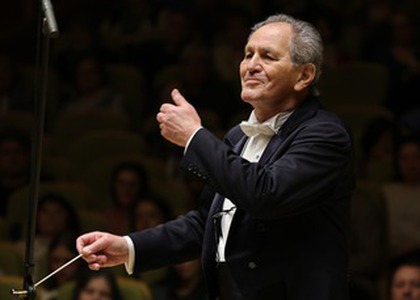
Interview with Cristian Mandeal
Between March 28th and April 3rd 2026, the 7th edition of the CHEI Festival, organized by the National University of Music Bucharest, will take place. The opening concert will be held at the Romanian Athenaeum, featuring the Concerto Orchestra and pianist Mihai Ritivoiu, under the baton of maestro Cristian Mandeal. The conductor gave an interview on this occasion:
Maestro Cristian Mandeal, this Saturday you will conduct the opening concert of the 7th edition of the CHEI Festival, an event that already has a tradition. How do you see the importance of this festival for the students of the university and, more broadly, for the classical music audience in Bucharest?
It is certainly an important event. For a university to have its own festival is significant. Many music universities organize festivals, usually in the summer, but it is a good idea to hold one during the academic year as well, it tends to attract a larger audience. Students are fully engaged in their studies during this period, so they are at their peak, and it is important for a university to showcase its potential to the public. For the students themselves, appearing on the stage of the Romanian Athenaeum is both a great honour and a challenge. As for the audience, they have the opportunity to discover the current state of musical education and the instrumental classes, in other words, the future of the country's musical life.
As a professor, how would you assess the level of the orchestras and conducting students trained at the National University of Music?
Conducting students vary, as is the case everywhere. Some are more gifted, others less so. There are promising talents for the future, just as there are disappointments. The instrumental level is equally variable. Ideally, it might have been better to form a selected orchestra made up of the best instrumentalists from all four university ensembles, in order to truly reflect the institution's highest level. As it stands, we are working with an orchestra of uneven value. There are very good students, and others less so, but we are trying to put together a very ambitious program, one from which they can learn a great deal. This is not just a concert; it is also something like a master's degree, which I take the opportunity to incorporate into the relatively short rehearsal time we have.
You will collaborate again with pianist Mihai Ritivoiu for this Saturday's concert. How would you describe him as a musician, given his notable success in Romania and the United Kingdom?
He is one of our leading figures, I wouldn't call him a "promise," as he has already reached artistic maturity. He is among the finest pianists in Romania today. He is extremely cultured, highly sensitive, and very gifted overall. I hope that this time as well we will have a very successful collaboration.
Please tell us about the program of the March 28thconcert at the Romanian Athenaeum.
I conceived the program as a French one, which is somewhat less typical for the students' training. It is French, but not impressionist, instead, it focuses on French classicism and romanticism: the First Suite from L'Arlésienne by Bizet, Saint-Saëns's Piano Concerto No. 2, which is very popular, and finally César Franck's Symphony. This last work, of course, poses significant challenges and requires a high level of musical maturity. It is a major undertaking. The instrumentalists must navigate a dense thicket of musical material, technical issues, and information contained in this symphony. However, I believe they will benefit greatly from the experience, as developing musicians, and I hope the audience will come away with a lasting and positive impression.
Translated by Oana-Elena Dragnea,
University of Bucharest, Faculty of Foreign Languages and Literatures, MTTLC, year II
Corrected by Silvia Petrescu


