



> Interviews
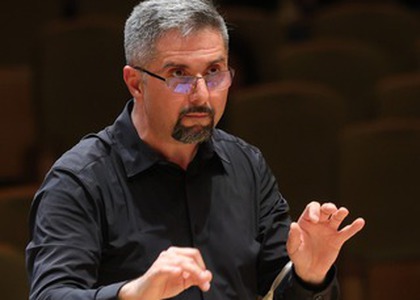
Interview with Ciprian Țuțu, conductor of the Radio Academic Choir
Sacru și Profan ("Sacred and Profane") is the name of the Radio Academic Choir's concert scheduled for April 1st, 2026. The conductor of the ensemble, Ciprian Țuțu, will be telling us more about the event that will be taking place at Sala Radio, in an interview conducted by Ioana Țintea.
Mr. Ciprian Țuțu, you mentioned in the press release that the Sacred and Profane concert builds on Mircea Eliade's idea about the coexistence of the sacred and profane in humans' lives. How did you adapt this vision into the musical program you created by bringing together 20th century pieces?
This is exactly where the novelty of this concert's structure lies. The audience's expectations of a concert preceding Easter might be that the repertoire would be a religious one, but I wanted to steer this expectation towards the idea of meditation on existence, on what humans are today. In other words, the concert is not inherently about the sacred and profane, but about humans, their existence and every aspect of their lives, if you will. It will start with a religious repertoire in the first part of the concert, then, in the second part, transition into a repertoire that brings together important pieces of choral music, from Britten to Alexandru Pașcanu, ending with a message of peace, kindness, good and beauty of the world, projected in a few fragments of the Flăcări și Roți ("Flames and Wheels") cycle by Corneliu Cezar.
What do you think are the greatest challenges of an a cappella concert, which lacks instrumental backing?
We're always bare, it's the living organism, the vocal choir, that must work at optimal parameters, but with the adaptability for suppleness and gentleness that a decently large choral apparatus must possess. So I would say the range of expression, of colours, is more refined when attempting an a cappella repertoire. At the same time, the difficulty of the program is a challenge and I won't hide the fact that in the April 1st program the level of difficulty is quiet high. The touchstone is actually Benjamin Britten's eight choir cycle, "Sacred and Profane", which wasn't selected randomly, but because we wanted to honour this exceptional British composer, especially in what it means to treat the voice and the choir. So we chose his last choral cycle, "Sacred and Profane."
Tell us more about the evening's soloists, who are part of the choir itself, which is something you keep in mind for all of the ensemble's concerts.
Well said! This is how I always want the audience to see this valuable group in which I have the honour of manifesting as a musician. I'd like to read the names of some of our colleagues who I invited to perform as soloist in the two-part program: soprano Valentina Verlan, altos Camelia Cuzub and Simina Dragomirescu, tenors Cristian Paraschiv and Mina Stavără, basses Cristian Ruja and Mihai Cârstea. The program is vivid, especially in the second part, if I were to mention the second to last piece in the program, Alexandru Pașcanu's Bocete străbune ("Ancestral Wails"), a piece that includes a few percussion instruments and the semantron, played by our colleagues Liviu Ofițeru, Ștefan Voicu and Cristian Paraschiv. And because of the challenge Pașcanu's work poses, on our posters you'll see some other names I thought were important enough to point out, because those names, in the context of the piece, strengthen the message of Ancestral Wails. I'm talking about cries, some earth-shattering solo interventions performed by Ionica Iorgulescu, Gabriel Bănică, Cristian Coandă and Sergiu Stana.
What's next for the Radio Academic Choir after the Wednesday concert at Sala Radio?
The next day, we'll be resuming rehearsals for Mozart's "Great Mass in C minor", which we'll be performing during the Holy Week, together with the National Radio Orchestra. After that, we'll take a small break, then we'll start preparing for a piece that's inspired and very tonic, a cycle of Four Coronation Anthems by Händel, which we'll have the pleasure of performing towards the end of April, together with the Radio Chamber Orchestra.
Translated by Alexandra Teodora Ciolacu,
University of Bucharest, Faculty of Foreign Languages and Literatures, MTTLC, year II
Corrected by Silvia Petrescu


