



> Interviews
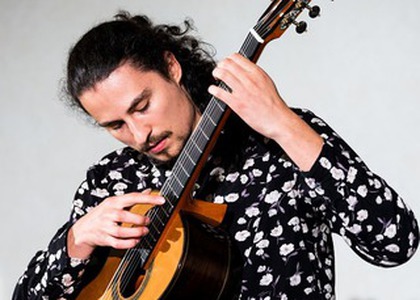
Interview with guitarist Dragoș Ilie
On the 10th of April, the exceptional guitarist Dragoș Ilie released an album at the Naxos record label featuring sonatas by Wenzel Thomas Matiegka, a nowadays less-known Czech composer and guitarist from the Classical period. This disc is the first in a series that Dragoș Ilie is dedicating to the complete sonatas for solo guitar by Thomas Matiegka, a collection for which the Romanian musician collaborated with the legendary guitarist Norbert Kraft. The Canadian artist was a producer for the album that was recorded in January, 2025 at St. Paul's Anglican Church in Newmarket, Ontario.
The guitarist Dragoș Ilie told us some details about this album, which we will be featuring on CD Review on 20th and 21st of April at 11:30 a.m.
Dragoș Ilie, congratulations on the release of this big recording project, the complete recording of Thomas Matiegka's sonatas for solo guitar. Please tell us how this project came about?
First of all, this project came about when I was put in touch with Norbert Kraft, the legendary audio engineer which produced all the classical guitar recordings, for Naxos Record. My teacher, back when I was studying in Austin, Texas, was really the first guitar player who recorded for Naxos and, at that time, I was very passionate about Thomas Matiegka's works, a composer whom few people play. My teacher, seeing that I really loved it and that I was connecting successfully with that particular music spirit, recommended to Norbert Kraft, asking if he would be interest in working together. He said yes immediately and the rest is history. I just finished recording the second album this year. The first one will be released this April.
Please, describe in detail how your collaboration with Norbert Kraft went during the recording session?
It was very interesting, it was a humbling experience. First of all, we recorded in a Anglican church that also serves as a Romanian Orthodox church, so it was kind of funny, thousands of kilometres away from Romania in Newmarket, Ontario, Canada. It was our first recording session. It happened in January of last year. First of all, it was freezing cold and I had to concentrate incredibly hard to keep my strength up, but Norbert has such vast experience, he was like a wall to me, because recording is a different experience than the process of performing on a stage or in a concert, in a recital. A lot of negative thoughts come up; there's this pressure to play everything perfectly because it's being recorded on a disc for eternity. But working with someone like Norbert, who has so much experience and is such a calm, helped enormously because he always brought me back to a place of reality and simplicity and we focused on the music and the phrasing. I think it also helped that I had the opportunity to record the second album with him, because I believe that on the second album we connected even better, having already had the previous experience.
Since you mentioned Thomas Matiegka's music earlier, it is indeed not very well known to the general public, so please tell us a few words about this composer.
Matiegka was a composer born in Bohemia, roughly in what is now the Czech Republic, who moved to Vienna, at that time the capital of guitar music, where he taught guitar alongside the greatest guitar players of that era, Matiegka seems to have loved the sonata form; he wrote the most guitar sonatas, a total of 210. He has a very interesting style because, unlike most virtuoso guitar players of the 19th century, who tried more or less to imitate, to actually bring the full scope of an Italian opera to the guitar, talking about a great deal of virtuosity, Matiegka always leans toward the more playful side of the instrument. All of his sonatas actually end not very dramatically, but playfully. He is a very interesting composer, a mix of artistic creativity and playfulness, he uses somewhat different techniques, inspired by the folk music of Tyrol region in Austria. He is a very, very interesting composer and his sonatas develop, for example, on the first disc, we recorded two grand sonatas, that is, sonatas in larger concert forms, a sonata that is a tribute to Haydn, which is actually a rearrangement, a reinterpretation of the famous Sonata in B minor, and a progressive sonata, that's actually the title he gives to that sonata, "Progressive", a term quite uncommon at the time. Matiegka was a very, very creative composer for his time. I first came across Matiegka through my teachers. My first teacher in the United States, Andrew Zone, taught an intensive course on the history of the guitar and actually had us listen to at least on piece by every composer we knew who wrote for the instrument. And when we got to Thomas Matiegka, a name I hadn't even heard of, I listened to his famous Sonata in B minor, the sonata that was a reinterpretation of Haydn's sonata, and I liked so much that I started playing it right away. I remember that I was quite young back then, just starting my undergraduate studies, I struggled a bit with that sonata, but it became one of my signature pieces, I've performed it all over the world, in China, Japan, in competition, in the U.S.A and in Europe. It was a piece I carried with me everywhere and it sparked my interest in this composer.
Could you also tell us about your next projects, concerts, or any upcoming recording projects and teaching activity?
This year is going to be a very busy one. I'm working with the violin player Alexandru Tomescu and the bandoneon player Omar Massa to prepare the Stradivarius tour, where we'll perform 20 concerts. I'm not sure how much I am allowed to tell you about it because we didn't officially announce the event yet, but it's going to be a spectacular event and I'm sure the audience will enjoy it, just as they do every other year with the successful Stradivarius tour. After this tour, together with the guitar players Dan Alexandru Arhire and Cosmin Soare, who is also the artistic director of the Khitaralogos Association in Bucharest, plan to form, if you will, a new guitar quartet, The Romanian Guitar Quartet. We will perform all over Romania. We will have a tour at the beginning of August, if I'm not mistaken and we will perform Vivaldi's Four Seasons, of course arranged for guitar, along with four new compositions written for guitar by Romanian composers. A project that will certainly be very interesting, both for the audience and for us. As for the teaching projects, aside from my on-going work at the Iași University of Music where I prepare my students to become the next generation of great guitar players, I will teach at the Icon Arts Summer Camp, in Biertan, which will take place at the end of July. And then I will teach again alongside the violin player Alexandru Tomescu. We are holding the fourth edition of the "High-altitude" Masterclass, guitar and violin courses at the Caraiman cabin.
Since you were talking about you teaching activity, I'd like to ask you what do you think of current state of the guitar courses in Romania?
It's interesting because classical guitar in Romania has a relatively recent history. We are talking about just three generations of guitar payers which come from universities. On the other hand, I am very optimistic about the future of the Romanian classic guitar because we have many talented young people. We have many guitar events, as I said before, and Khitaralogos, which aims to bring world-class artists in our country for young people to interact with. We have master-classes, guitar festivals. I believe that the Romanian guitar school is not necessarily far behind the European or American ones. Maybe what we lack is an optimistic spirit. That's what I'm trying to bring in my relationship with my students and in all the master-classes that I teach. I can help them discover their own voice and to understand that, yes, it is possible to have a career in classical guitar and music, you only need to work hard and be committed to building your own career.
Translated by Cosmin Șerban,
University of Bucharest, Faculty of Foreign Languages and Literatures, MTTLC, year I
Corrected by Silvia Petrescu


