


> Interviews
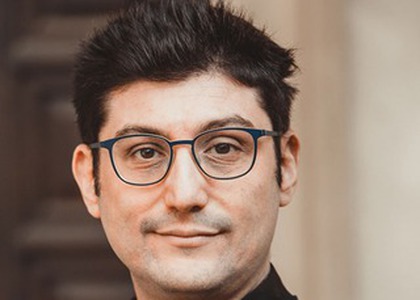
Interview with conductor Giulio Prandi
Conductor Giulio Prandi, an artist featured on some of the most important stages in the world, who was recognized in the Choral Music category of the 2022 International Classical Music Awards, will be returning to the stage of the Sala Radio tomorrow evening, on April 22nd, 2026. Together with the Radio Chamber Orchestra, he'll be performing a unique program, shaped by his constant research activity: Niccolo Jommelli's "Periodical Overture" no. 8, Wolfgang Amadeus Mozart's Kirchensonateno.7 K.224 in F major and Exsultate, jubilate K.165 for soprano and orchestra, as well as Joseph Haydn's famous Symphony no. 104 in D major, the "London Symphony".
The program you're about to conduct at Sala Radio reflects your interest in lesser known works, but also includes famous pieces. Could you tell us a few things about the mysterious piece that opens the program, Niccolo Jommelli's "Periodical Overture" No. 8?
Well, by my standards, it's not really that unknown. In this case there are others that perform it, I'm not the only one! It's part of a collection of overtures and is made up of a little allegro and a chaconne. There is an element of mystery, because it's a chaconne, but in a typical French style. Basically, a chaconne with a symphonic character.
We start with an allegro specific to Jommelli, with the three forte notes, then the piano response, and then the three forte notes again, using the wind instruments idiomatically, a festive discus, full of joy, but also very short. This is also characteristic of Jommelli.
Following it is the chaconne, which is extraordinary because it's a dance, but in a profoundly French style, composed by an Italian, which is special. Here, we identify acoustic colors specific to the French style. But it is, in essence, a festive dance, with a touch of grace and refinement. I like it very much and I conduct it often. I'm about to debut at the Teatro di San Carlo in Naples in a few weeks and I'll be performing it there, too. I presented it in many places and it's always a satisfying experience, for the orchestra, as well as the audience. It's a wonderful way to start the concert.
Then, we reach Mozart's Exsultate, jubilate, a piece written in Milan. I myself am from Pavia, which is very close to Milan.
I recorded this piece to celebrate 250 years since it was composed and I performed it with my ensemble in the very place where it was created, on the day of the anniversary. It was a truly special moment and I could feel the connection to Mozart's era.
It's interesting that Exsultate, jubilate isn't just a motet composed by Mozart in Milan, but a Milanese motet composed by Mozart, because motets were specific to Milan, just like Milanese schnitzel, which is a Milanese dish. The motet was the main shape sacred Milanese music took in that time. When Mozart got there, he composed two pieces: Quaere superna and Exsultate, jubilate, which I consider his first great sacred masterpiece. It had a powerful impact, and after it followed motets by Milanese composers which reused themes from this piece.
I'm overjoyed to be performing it here alongside Eleonora Bellocci, an extraordinary Italian soprano who I collaborated with many times. I'm glad to have her alongside the very special Radio Chamber Orchestra.
How would you describe the collaboration with the Radio Chamber Orchestra?
It's a very good orchestra. They're wonderfully reactive, so it's a great pleasure to work with them. I think it's the second time I'm here and I'm very glad, because I feel like there's a degree of understanding, a certain "complicity" that is essential, especially for this kind of subtle music. It's not easy, as it is Galant music.
At the time, no one defined themselves as being Baroque or Classical, but rather "gallant", and Galant music was part of a culture of gallantry, a culture of refinement and cultured conversation, a nuanced conversation with double and triple meanings. It's the same with music.
As a result, it's a detailed, refined music and it demands a deep bond between musicians, but also a certain enjoyment of the game, because, from time to time, it's also ludic. I find all of these qualities in this orchestra, which is why I'm very, very glad to be here.
I must say, Bucharest is a special place for me, because the Enescu Festival gave me the confidence I needed to perform in a concert in the first stages of my career, which mattered a lot. Then, I returned for a project at the National University of Music, and this is my second collaboration with the Radio Chamber Orchestra.
Bucharest is a city with a long history, which you can almost feel while strolling through the streets. I like seeing the city transform every time I come back. I think this is my twelfth year visiting Bucharest.
I also brought my daughter, because I wanted her to see the city and feel its ambiance. It's a special place for me and I enjoy being here.
Coming back to what you said earlier, during rehearsals, I heard you demanding a lot of precision, so that the performance's energy can stand out. Do you think this is how things work, generally? Are rigor and precision needed to reach freedom?
Yes, of course, I think you captured the essence of it. Everything technical and performance decision must be very precise - how the bow is used, the method of attack, the energy and many other aspects - but, naturally, the orchestra shouldn't become a machine. The performance must be alive, free.
The deeper you delve into the composer's choices - because music is a form of speech, and the composer makes choices to lead this speech into a certain direction - the more you understand the music and, implicitly, gain more freedom of interpretation, because you gain a deeper understanding of the reasons for these choices.
So, it's about a mix of great precision, which, paradoxically, demands a lot of freedom. Because if the balance doesn't exist, the performance becomes just a mechanism, and that's not our goal.
Really going back in time, I know you studied Math before becoming a conductor…
Well, actually, I was never a real mathematician. I had a traditional career path, because I had my first job at 18. I worked in the opera choir of Lombardy's regional system, which is a great system. Next year I'll be conducting Mozart's Idomeneo in that circuit. They coproduce operas - every theater produces an opera, which then runs in every theatre in the region. Thus, every city has access to four operas, and each production reaches eight, ten, even twelve performances. It works very well.
So, I was hired into the choir at 18, and I also graduated from the canto department. Let's just say I wasn't a great singer, I was hired because I had a strong voice. I sang in the choir, then I sang small roles, then I became a rehearsal accompanist, because that's the natural progression. I conducted choirs, then I was an assistant conductor, and the opera system sent me to smaller theatres to conduct pieces like L'elisir d'amore, Don Giovanni.
So, I gradually went through every stage and role you need to know in this line of work. When you become a conductor, you've already been through almost every possible situation, which is an advantage. During all this, I was studying math. This is what my life looked like: I'd go to university, then run to rehearsals in another city, come back, while also studying composition and choir conducting at the Milan Conservatory. It was a very intense life. I think that between 18 and 24, the brain works in an amazing way. I'm not saying that it stops after that, but that's when it truly worked at an incredible speed. Maybe now it reaches other depths, but that's when it worked very fast and I used that to study as much as possible.
I was never a real mathematician. I remember a funny moment: during my last exam, the professor knew of me as a composer. When I walked into the room, he thought it was a joke. He asked me: "What are you doing here?" I told him I was there for the exam. "Very funny.", he said. I answered him: "I'm a Math student." "That can't be." Then I showed him my papers, and he said: "My God, you really are a student!" I took the exam and graduated with a top grade, not cum laude, but with the highest score. But they made me promise I'd become a musician, not a mathematician, which was very funny.
Math taught me many things. One of them was to read what's actually written in the score, not what I wish was written. It also taught me that, in music, every place, every era and every composer is tied to a specific way to write things. So, when you see something, you need to look it up to understand what, exactly, it means, because it can depend on context.
Math taught me to read music in-depth, but also freedom, because when you truly understand what's in the score, the way you choose to perform it can be very personal.
My way of working with the orchestra isn't simulating the concert during rehearsals. We rehearse, we experiment, but every concert needs to have its own life. We need to listen to each other and make music alive in that moment, based on what we studied, but without making that a barrier.
So, there's a balance between study, culture, research, but all of these must feed your sensibility. And then, you need to trust your own sensibility, because music means sharing at the highest level. You don't play because there's a treaty on how you must hold your bow - you need to know these things, certainly, to feed your sensibility, but you must, then, also trust this sensibility.
This is another thing I learned from math: to study, but also trust - sensibility and people. Because this aspect is essential. Orchestra conducting changed a lot. I have the opportunity to work in bug theatres, with major orchestras - La Maggio Musicale, La San Carlo, La Scala - but today's orchestras are extremely well-trained. So, it's about being part of a team, about connecting with the players and listening to them. Just like here there's a great concertmaster, an excellent first cellist, remarkable singers etc., you need to come up with ideas, but to also pay attention to what the musicians can offer, because they have experience and valuable ideas.
So, yes, math teaches you freedom, which may seem like a paradoxical concept, but I think it's very true. True freedom doesn't mean doing whatever you want, but delving deep into what you do.
In 2003, you established the Ghislieri Choir and Orchestra, and for decades you've been carrying out a significant conducting career on concert stages, as well as lyric theatres. I have also noticed that, even now, during rehearsals, you have an extraordinary energy, overwhelming. What do you think is the source of this energy? What motivates you?
Honestly, I can't really say. I do this job because I like music. I really like music. It may sound boring, but this is the real reason. I like music, I like musicians.
My goal, when I'm directing an orchestra, and I also mean opera theatre orchestras, because I conduct a lot of opera, is this: in opera, everyone focuses on the lyric artists, all the attention is on them. But my goal is for people to go home and say: "It was amazing. Did you see the singers, the set, the direction? But did you hear the orchestra? It was magnificent."
This is what I truly want: for the audience to leave saying that the orchestra played incredibly well. Because I love music and I love musicians and I want everything to sound beautiful and I want people to go home with something, a certain experience or feeling.
It may sound boring, but I remember that when I started conducting in large halls, my debut at Concertgebouw in 2018, for example, what Impressed me was the fact that, even though you think of these occasions as important moments in your career, the real magic lies in the way the music sounds.
I think this is where the energy comes from: from the fact that I love music and I want everyone - the orchestra, the singers, the audience - to love the music we share together.
Translated by Alexandra Teodora Ciolacu,
University of Bucharest, Faculty of Foreign Languages and Literatures, MTTLC, year II
Corrected by Silvia Petrescu


