



> Interviews
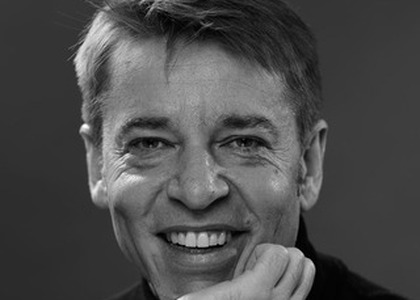
Interview with conductor Stefan Geiger
The Radio musical season continues Friday, April 24th, 2026, with a concert proposed by the Radio National Orchestra led by Stefan Geiger. On this occasion, the German musician had a discussion with our colleague, Ioana Țintea.
The program at the Radio Hall will open with a page from the early romanticism: Trompeten Overture in C major by Felix Mendelssohn. Considering that Mendelssohn composed this piece when he was just 17 years old, how would you describe this opus?
I admire Mendelssohn very much. The fact that he composed this work of such maturity at such an early stage in his life seems simply incredible to me. Whenever I have the opportunity or am invited to build a program, I try to include at least one of his wonderful overtures. This time, the choice came quite naturally. When discussing this week's concert, it was already decided that we would perform the Trumpet Concerto by Hummel. Then I said to myself: why not complete the program with the Trumpet Overture by Mendelssohn? What a wonderful work for an opening.
We could say that Johann Nepomuk Hummel's Trumpet and orchestra Concerto is at the center of this program. What does the ideal balance between the soloist and orchestra mean for a conductor in the context of this kind of piece?
I think this work may seem at first glance "easier" for a conductor, but that does not mean it is simple. I say this because sometimes there is a tendency to see the trumpet as a predominantly shrill instrument associated mainly with powerful passages. In reality, this is only half the truth. Brass instruments can indeed produce a very intense sound, but they also have the ability to play extremely delicately. Of course, our soloist certainly has this versatility, with a very wide dynamic palette, which gives him a lot of expressive flexibility. Also, for the Hummel concerto, we chose to reduce the size of the orchestra to a formula closer to that specific to the classical era as practiced, for example, during the time of Joseph Haydn at the Esterházy court. In this way, we hope that the sound balance will be as good as possible.
Have you collaborated with Andrei Kavalinski before?
No, this will be our first artistic meeting and I am very excited. Honestly, this is also the first time I conducted this concert by Hummel. Being a trombonist by birth, I am very familiar with this concerto. I already knew it very well even before studying the score in detail, but, nevertheless, this is the first time I have conducted it and I am very much looking forward to this experience. It is a lively work.
Symphony No. V by Beethoven is one of the most renowned pieces in the world. How would you describe the spirit of this symphony in a couple of words?
If I were to describe it in a couple of words, I would say that it embodies very well the idea of per aspera ad astra (through arduous roads you reach the stars). I think Beethoven renders this image exceptionally well. The way in which the transition from the third part to the end is made is astonishing - that moment of transformation towards the luminous tonality of C major, as if we had stepped into another space, almost into a sound paradise. It is a masterpiece about transformation and hope. This idea of per aspera ad astra can perhaps also be found in Johannes Brahms's Symphony No. 1, but there are few symphonic works in which it is expressed as convincingly. I think that this is precisely one of the great secrets of the success of this symphony.
You are one of the cofounders of the German Games Music Award. Do you believe that video game music can become the "new classical music" for the younger generations?
Yes, I am sure that there are two main reasons why I continue to organize this competition, even after almost a decade or even more. First of all, it is my desire to encourage talented young composers to write quality music for video games. Then, I want to bring this good music to the stage, to the concert hall. And there is another very important aspect: the hope of attracting an audience to the hall that, usually, does not attend classical music concerts. I have often spoken to people who were coming to a concert for the first time and they said that the experience is completely different, it is much more intense and authentic when it is performed by an orchestra. I think this is a real win for us, musicians: to remain open to those who may not have had the opportunity to live this experience before and to meet them through such projects, in the hope that they will return in other contexts.
You are a frequent guest of the Radio Orchestra and the philharmonics throughout the country. Would you say that you feel a special connection with the Romanian musicians?
Yes. I have never thought about building a career in Romania or something similar. The first time I came here, I think in Bucharest, I'm not quite sure, I had a very strong feeling of closeness. Maybe it's also because, coming from south Germany, there are certain similarities even in simple things, like culinary preferences. The Romanian orchestras are well known, but maybe, they deserve to be appreciated even more. Because they have an extraordinary tradition, especially when it comes to string instruments - the musicians are very well prepared.
How do you see the Romanian orchestras fitting in today's European music scene?
What I feel is that more and more responsible people understand that Romania has an extraordinary tradition of valuable musicians and quality music. I conduct George Enescu's music more and more often, by the way, and this is truly a treasure that deserves to be presented internationally. We don't even need to talk about the Enescu Festival - it is, without a doubt, one of the most important festivals in the world. At the same time, I think that even the smaller Romanian orchestras are evolving very well. Honestly, I hope that this evolution continues. Because, in my opinion, and, of course, I'm talking from the perspective of a musician, the culture should benefit from greater support from everywhere. I wish, from the bottom of my heart, for Romania to continue to evolve, because it offers a beautiful image of its culture in the world.
Translated by Elisabeta Cristina Ungureanu,
University of Bucharest, Faculty of Foreign Languages and Literatures, MTTLC, year II
Corrected by Silvia Petrescu


