


> Interviews
Interview with conductor Leonard Slatkin
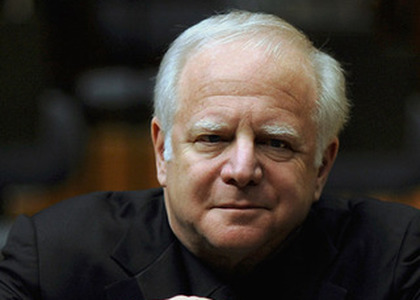
Leonard Slotki one of America's prominent conductors, will lead the George Enescu Philharmonic Orchestra in two concerts scheduled for Thursday, 23rd of April and Friday, 24th of April, 2026 at the Romanian Athenaeum. The renowned artist spoke with Ioana Țintea about his return on the Bucharest stage.
You are returning to the Romanian Athenaeum with a program that spans a wide range of stylistic genres, offering an intriguing blend of modernity and romanticism. In fact, you are also a devoted advocate of 20th-century American composers. What can the audience discover in Cindy McTee's piece Circuits?
It's very difficult to define what American music is, because we're a nation made up from people from all corners of the world. As a result, our music is, in fact, a blend of different ideas, languages and cultures. As a result, our music represents, actually, a combination of ideas, languages and different cultures. The Cindy McTee's song Circuits has its roots in the rhythm. It is a work with a mechanical character that never stops until the never end. It is rich in percussion and strongly influenced by jazz. I think the audience should pay attention to the timbres because many of them are unusual: they appear quickly, disappear and return, so you never really known what's coming text. The term "circuits" has multiple meanings: it can mean circles, connections, or it can refer to electricity and computers. It is a key word, but above all, the piece is about energy. And that is, in essence, "Circuits": five minutes of continuous and uninterrupted energy.
Collaborating with young musicians is constant in your activity. In the case of Kian Soltani, whatattracted you in particular?
The first time when I worked with him was right here and I immediately realized he was an extraordinary musician. It's really great to meet an artist who allows himself to be free on stage. Today, there are many soloists who perform music by strictly adhering to what's written in the score. And that, of course, is perfectly valid. But Kian brings something extra, he plays beyond the notes, adding a personal dimension, almost as if he were in direct contact with the composer's mind. This kind of sensitivity makes him ideal for Schumann's Concerto, a deeply romantic work that is very free in its expression. His style fits perfectly with this sonic universe. Moreover, he possesses an impressive dynamic rage, able to move effortlessly from extremely delicate nuances to moments of great intensity. I am convinced that the result will be a remarkable interpretation of such a beautiful work from Romantic repertoire.
Rachmaninoff's Symphony No. 2 is the piece you have conducted most often over the years. What has made this score a constant feature of you repertoire?
First of all, there is a personal bond with my family. My grandfather's brother was a conductor and founded, in 1903, an Orchestra in New York, named Symphony Orchestra of New York. This orchestra premiered numerous works from the Russian repertoire in the United States, including this symphony. So, my connection to this music is a long-standing and a deep-one. For a long time, the work was not performed very often, but today we find it more and more frequently in performances very often which I think is wonderful. It gives me great pleasure to conduct it. Although it was composed at the beginning of the 20th century, its sonic universe takes us back to the world of Tchaikovsky. It is serious, profound music, yet it also contains one of the most beautiful slow movements ever written. It is moment we all look forward: the clarinet theme unfolding over the warm accompaniment of the strings. It is one of my favorite works.
You come from a family with a rich artistic heritage and musical tradition. In a previous interview, you mentioned that his heritage has profoundly influenced the way you build a relationship with an orchestra. How does this personal experience specifically manifest itself in your collaboration with musicians?
Almost everyone in my family was a musician, and this taught me from a very early age to respect what I do. I used to watch my parents rehearsing and studying and I'd see them exchanging ideas with their colleagues when they were performing quartets, other chamber music pieces, or even as part of an orchestra. This led me to the conviction that, as a conductor, it is more appropriate to consider myself part of the ensemble. Of course, my role is to conduct, but I constantly try to respond to what the orchestra is doing. This creates a genuine musical dialogue: the musicians follow the direction I propose, but at the same time, I am attentive to their ideas. As my teacher used to say, sometimes musicians can have even better ideas than the conductor. And when that happens, I choose to go in the direction they suggest.
Are there differences in the way you communicate today with an orchestra compared to the early days of your career?
Certainly, today I have much more experience. I almost stay before the orchestra with works I know very well, ones I've conducted throughout my life. The majority of musicians respect this kind of experience and this thing also changes how we communicate. I no longer feel to dwell on the technical details or to "teach" the score's notes. Instead, I try to talk about what I would call then essence of music: what is beyond the notes, what is their meaning, what kind of story they tell. I no longer concern correcting every little imperfection or wasting time on remarks such as "that's not connected" or "there are wrong notes here". Maybe these things were more important for me at the beginning of my career. Today my role is to give a vision, to share as much of my own experience as possible and to create an environment where music can come to life on a deeper level. At the same time, I continue to learn from every orchestra I work with.
How would you describe the current conducting scene? What is the conductor's role in today's society?
The role of the conductor has changed significantly since I began my career, nearly 60 years ago. First of all, the repertoire is much broader. Today, the conductors also tackle film music, pop concerts, there is a larger diversity and of course, much more music than in the past. Under these circumstances, it's not possible for a single person to do it all, simply, it's not possible. That's why, I believe the conductor's role is to discover the music that has a special meaning for them and bring it to the orchestra. At the beginning of my career, the idea was to conduct as much as possible. And maybe this thing remains true for a very young conductor. However, as you gain experience, it's important to become more selective and not try to do everything. We can't do everything equally well. The sooner you learn what doesn't suit you, the more success you will have.
Of all the Hollywood stories involving the Slatkin family, the most fascinating one remains the close relationship with Frank Sinatra. How do you remember those meetings?
Frank Sinatra was a person who became very close to my parents. They worked together in studious, especially on recordings. My father, in particular, was helping him to understand better the structure and expression of music. Not many know that Frank Sinatra was a conductor too, and for this he was frequently turned to my father, from whom he took lessons and collaborated closely. So, I saw him quite often. My brother and I were calling him "uncle Frank", because he would come to our house when we were young. After dinner, he used to take us to our room, put us to bed and sings us lullabies until we fell asleep. It was a privilege to be able to call Frank Sinatra a friend, especially since, as they say, he was definitely not someone you'd want to have as an adversary.
On your personal website there is a blog section where you write stories about your activity, concerts, tours and professional reflections. What initially inspired you to translate your experience from the stage to the written form?
I've always loved writing, whether it was lyrics or music. In high-school I was writing short stories, mostly science fiction and I was really enjoyed it. As music become more and more important in my life, I no longer had the time to continue writing. Then, about 13 or 14 years ago, I began to work on my personal website publishing texts there. Gradually, I think my writing has improved too. This journey eventually led me to publish five books. Currently, I write magazine articles and even speeches for other people. I've often wondered myself if I would have become a writer had I not chosen the music. It's possible; maybe I would have followed that path as well. One thing I haven't done yet is writing about my own beginnings in a more expansive form. I'd love to write a novel, a work of fiction, maybe inspired by the world of music. I'm not yet sure in what shape will this project come to be and of course, I also need to find the time to make it happen.
Have you ever thought that these texts might, at some point, turn into an autobiographical volume?
The first two books I wrote are, in a way, autobiographical. The first one is called Conducting Business and the second one Leading Tones. Both of them say a lot about my life and the world of music. In them, I talk about the people I have met and with whom I have grown professionally, about my experience in this artistic world. So, I've already written a sort of autobiography, even though I haven't called it that, because these books also include other types of reflections and themes. Right now, I know there is someone making a documentary about me. Maybe that will become, in a way, my true autobiography, or maybe not. I don't know yet.
Translated by Cosmin Șerban,
University of Bucharest, Faculty of Foreign Languages and Literatures, MTTLC, year I
Corrected by Silvia Petrescu


