



> Interviews
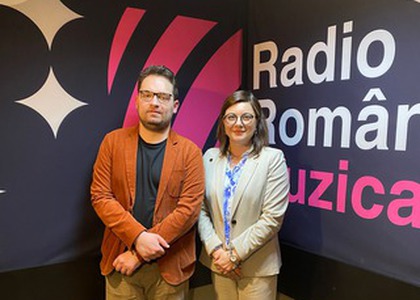
Cristina Uruc, Manager of Artexim – Guest of the Week at Perpetuum Mobile
May 10th is the registration deadline for violinists, cellists, and pianists for this year's edition of the George Enescu International Competition. As for composers, they can register until June 30th. In the next few minutes, we'll be discussing this year's edition of the competition with my guest, Cristina Uruc - the manager of Artexim. Good evening!
Good evening! Thank you for the invitation!
To start with, I would like us to discuss about a completely different topic, as a sort of introduction. This job as a manager is certainly not easy, and it might be good for our listeners to know that. We're talking about the Classical Next project. A meeting that had already taken place, but I still think it's important to mention this. What exactly does this project entail?
Thank you very much for this question. It is extremely important to discuss how we can establish our presence on the international level and how we can promote both Romania's projects carried out by the state and the private ones at major international classical music fairs. Classical Next is a fair that is currently at its 13th edition. It is held annually in different cities. Our first two participations were in Berlin, in 2024 and 2025, and our third participation this year was in Budapest with the Romanian Music Expo booth, which we shared with other partner projects such as the Romanian Chamber Symphony Orchestra and the Romanian String Quartet, along with the UCIMR Icon Arts Transylvania and Icon Arts Island projects with New Hope - the New Hope Orchestra and the projects they are carrying out with the Sonoro Festival. And I hope I haven't missed anything, because we were, in a way, a sort of representative delegation of Romania's musical scene - the people we managed to bring together with Ovidiu Andriș, and here I would also like to thank the Romanian Cultural Institute in Budapest and the Ministry of Culture for supporting Romania's participation in Classical Next. It is a fair showcasing musical projects, musical projects of the future, and this year I had the honor of being part of the international jury that selected the showcase projects and the discussion panels organized over the course of those three days in Budapest, and I was delighted to launch a pilot project at the invitation of Classical Next, with director Fabienne Krause - a closed-door meeting among concert organizers - including festival and project organizers as well as concert hall directors - where we discussed, and fortunately for me I was the coordinator of this discussion, so I didn't necessarily have to answer, but rather stimulate those present with questions, we discussed the risks involved in the artistic programming of concert seasons and festivals.
These are topics we also discuss at a certain level in Romania, but when we place ourselves in an international context, we realize that we're not quite as anachronistic as we might think compared to what's happening abroad, and that we can come up with solutions, we can come up with ideas that our colleagues can use. There were representatives from the Southbank Centre, a major concert organization in London, right? And those from the Innsbruck Festival, and so on.
What made me very happy was that, together with my colleagues, with Ovidiu Andrei, Octavian Lup, Manuela from Icon Arts, and Otniel from the Romanian Chamber Orchestra, we were able to talk about these projects and about the partners who were not with us at the booth. And, somehow, the fact that we're able to talk about what we do in Romania and what we can export abroad is becoming increasingly productive.
These types of events can somehow be seen as a kind of marketplace, after all, because all these gatherings are based on an exchange of artistic products, cultural projects, and artists who are sometimes viewed as human beings but at other times as objects, and it was very interesting to see these two approaches at Classical Next. I encourage all Romanian artists who have innovative projects to apply to this project so they can participate in the showcase selection process. Next year, this international fair will take place in Katowice, a city in Poland that's experiencing extraordinary cultural growth, with an amazing radio concert hall. I went there and visited it in March. It's a unique opportunity for us to participate, especially since it will take place in Eastern Europe, where the focus will be on musicians from Eastern Europe.
That was Classical Next. It took place between 8 and 11 April in Budapest. Then Easter, of course, two or three days to catch our breath, and from April 13th… and let me add something, I hope I can do this, it's very important - from April 13th to April 16th, together with my colleague Grațiela Duma, agent at Artexim and also producer at the Radio Chamber Orchestra, I attended the International Artist Managers Association Conference. It is a conference for artist managers, orchestras, and agents at the international level, a conference where there was considerable interest in our presence as representatives of Romania and, above all, of the George Enescu International Festival and Competition. I mean, for three days we had meetings every half hour, with, I think, less than a 10-minute break between them, from 9:30 in the morning until 5:30 in the afternoon. Once again, it was a much more transactional exchange than at Classical Next, a much more transactional exchange of ideas, artists, and projects. It's nice and useful to attend such conferences because, first, you get to give a face to that name or voice with which you correspond and talk on the phone for years in order to organize projects in Romania and abroad. It's wonderful to be able to talk about the Romanian artists you represent, about the winners of the George Enescu International Competition whom we're trying to promote at the international level, because at the national level we benefit from partnerships with philharmonic orchestras, cultural centers, and cultural associations across the country that provide dates for seasons as well as recitals and concerts in Romania's major cities. The IAMA Conference, once again, is a place where Romania needs to have a stronger presence, where Romania needs to act as an export agent rather than just as an import agent, and this is our goal at Artexim. It is a goal I set for myself back in 2022, it is a lot of work, but work is not something we turn away from.
I would like to continue our discussion, however, about what it means to be not an artist, but an agent in Romania. I understand that an AEAA conference is coming up on May 9th and 10th. I'd like to talk a little about that. What is this organization?
This organization is the European Association of Artist Managers; it is basically an association of agents and boutique agencies, founded in 1947 in France. It is the oldest European association of agents. IAMA, which I mentioned earlier, the International Artist Managers Association, was established later and expanded to the international level, whereas the European association is the one that brings together European managers, European agencies, and, more recently, those agencies that wear two hats, so to speak, acting as both agents or managers for artists and concert organizers. And here it is very important to mention that more than 30 years ago, if I'm not mistaken in 1994, Mihai Constantinescu made a breakthrough within the European Association. He managed to register Artexim as Romania's sole representative in this association, Artexim being the only entity at the time, and staying so for a long time afterward, that wore both hats, as I said - both as an event organizer, yes, a concert and festival organizer, and as an agent. What Mihai Constantinescu has achieved is truly remarkable, and we are very pleased to take forward what he has built so far, namely Romania's image on the international level, and I am very pleased that this year, on May 9th and 10th, as you mentioned, we will be holding the association's first general meeting, which will take place in Bucharest for the first time in the association's history. It is an important moment, a wonderful moment, because it is happening on Europe Day, on May 9th.
Most AEAA members will be coming to Bucharest on May 8th, so they will be attending and I would like to take this opportunity to thank Ms. Liliana Staicu and Radio Romania for giving them the chance to hear the National Radio Orchestra. We will be at the National Radio Orchestra concert on May 8th, and on May 9th there will be a special session in addition to the work of the association that we carry out every year at the general meeting, a special session in which Ms. Liliana Staicu, Mr. Marin Cazacu, and Mr. Daniel Jinga will come to present the activities of the radio ensembles, the George Enescu Philharmonic Orchestra, and the ensembles of the Bucharest National Opera in front of these agents, in order to slightly open up the Romanian market to artists from abroad, as well as to spark the agents' interest in organizing projects and tours with Romanian ensembles.
What makes me happy is that during this dedicated session, I received a lot of confirmations from the managers of philharmonic orchestras and opera houses in Romania, because, together with the AEAA board, in my capacity as president, I extended these invitations to the directors of philharmonic orchestras and opera houses, as well as to the main institutions for performances and concerts in Chișinău, Republic of Moldova. We have received confirmation from Ms. Larisa Zubcu from the National Chamber Orchestra of Moldova, the Organ Hall, which makes me extremely happy.
And of course, it makes us and our listeners happy as well. What does this conference mean for Romanian musicians and for the future projects they might undertake? What opportunities are there for Romanian musicians when it comes to the international scene, and for potential agents or concert organizers in Europe regarding artists from Romania?
What is very important is to realize that an alliance with partners who are on a similar level, with whom we can undertake projects of a similar level, can be much more productive than an unequal alliance, perhaps with an extremely large agency. Why do I say this? Because the agencies and agents represented in the AEAA are boutique agencies; these are agents who have a limited number of artists who can be integrated into the seasons of Romanian orchestras, artists who can work with Romanian orchestras and carry out projects in their home countries.
This association's focus is gradually shifting toward Eastern Europe and the development of this market because it is extremely rich in talent, talent that is sometimes undiscovered, and because it is much easier for us to hear a Western European name or one with an international resonance, so to speak, and to have much more confidence in their artistic quality, even though no one guarantees it, than in a name that is perhaps less heard on the international stages. And here I am not referring to those stages we rent to have a concert on, but to organic invitations to major concert seasons.
I believe that this opportunity to communicate, exchange ideas and network between the directors of Romania's philharmonic orchestras and opera houses and the agents who represent artists internationally could generate new work opportunities for both agents and orchestras. As for Romanian artists, at least what we are trying to do is to promote them with all the instruments we have and with all the goodwill and desire to emerge more and more on the international market. Not only through the Enescu Festival, not only through the Philharmonic Orchestra and the Radio Orchestra, which are internationally renowned orchestras.
How might we describe the opportunities that agents would have in relation to Romanian artists, in a direct manner? That is, if I were an agent from Western Europe and came here and noticed 1, 2, 3, 5, or 10 musicians whom I consider to be of high artistic quality, how could I bring them in for seasons or provide them with...
Ideally, they should contact us, Artexim, since we are the national representatives of the association, and establish a collaboration. This is standard practice. An artist may have a general manager who manages their career globally, or they may have regional managers; for example, a Romanian artist may have exclusivity in Romania with Artexim, and then a manager from another country who wishes to represent them in Germany must contact Artexim and collaborate to organize this… that's pretty much how it works. Well, there are also situations where a manager - and there are Romanian artists represented internationally - goes directly to the artist in question; maybe the artist doesn't have a manager, signs with them, and then they build their career or not, because there are also those (and it's good to talk about this, such situations do exist) situations in which artists who end up at a certain well-known agency remain somewhere in the basements of those agencies. First, because even if it's a big agency, it's always good to have artists who are initially well-regarded; it's good to have artists who are always available and who deliver at a crazy pace, because today everything is delivered at a crazy pace, and that's why I'm coming back to what I was saying earlier, that sometimes artists are seen as more than human being, as objects that need to be traded. There are examples of artists who had spectacular careers, starting at a crazy pace, and then that pace slowed down so much that… these artists suffered in terms of their health as well. What we want to do is to somehow create a way and an instrument of representation for the artist, putting the artist's health first, their well-being, and we'll be discussing this at the George Enescu International Competition as well, because it's an important part that we've added since 2024, and so that we can collaborate with more agencies that put the musician's interests first and, on the same level or perhaps on a second level, the agency's interests.
That's exactly why I asked this question, because I imagine that there are many young Romanian musicians who might hear about this opportunity and immediately think, "Oh, that's it, I'm going there - someone will sign with me and I'll be gone" - and maybe it's not quite that simple.
It's not that simple, and I'm sorry to say this, but it's a problem on an international level, and here in Romania even more so, because at the level of management in the classical music sector and from our perspective, that of Artexim, we've had extremely low activity, but also because it's very difficult to train agents, it's very difficult to train them to a certain level, and I currently have two certified agents in the institution who are extremely good at their jobs…And why is that? Because at Artexim, we taught them how to work as agents and how to negotiate while they were actually doing it. Or they developed their skills at Artexim, as in the case of Grațiela Duma, who handles negotiations and does that from her position as a producer for radio orchestras. She came and expanded the international sector even further here. There are people who have a natural talent for this, but there must also be a structure behind it, and this structure is somehow found in Romania through the courses offered by INCFC - The National Institute for Cultural Research and Training, courses on artistic management. However, what happens in real life and on the international stage is much more difficult. It's hard to find a manager, it's hard to find a good manager, and it's easy to fall into the hands of a manager who won't do anything for your career, but will actually slow it down. I've had more and more conversations with young artists, not from Romania - in Romania, this is a daily occurrence: to talk and try to offer consultation, because right now we have no way to offer official representation, partly due to a lack of human resources, as I mentioned, but we do offer consultation; we talk, more and more lately, with artists who are experiencing all kinds of problems with the agents they work with. And the most important thing is that when you sign a contract with an agency, there should be a performance clause, and that's something we need to pay attention to, because if the agent isn't getting any results for you, then it means that you must have the option to withdraw from that contract, to free yourself, and to go to someone else who can help you, or maybe you can even do a better job for yourself than the agent could.
Let's return to our discussion about the Enescu Competition. I'd like to touch on something I heard a little earlier: in 2024, you mentioned a new initiative. I'd like to know what the results were at that time, what happened immediately afterward, and, if possible, what you plan to do next.
Yes. In 2024, at the George Enescu International Competition, so two years ago, Maestro Cristian Măcelaru and Artexim introduced these well-being sessions for musicians, for competitors. We basically offered the competitors some time during which they could receive counseling from Angelica Postu, a music therapist and pianist. So, she is exactly the person who could understand best what is going on in the mind of a musician who takes part in an extremely stressful competition. These well-being sessions are offered and will continue to be offered after the end of the first round of each instrumental section, as well as during the masterclass for conductors.
Why? Because during this day off, between the stages, perhaps those who have suffered from the disappointment of not advancing further would like to talk and see how they can cope with that failure and that sense of guilt. Or perhaps, though less often, as I observed after the 2024 edition, those who advanced to the second stage or the next stage are less likely to come and spend their time talking about ways to manage stress during a competition.
Well, also in 2024, we had a section dedicated to physical well-being. Anca Cristescu, who studied Music Physiology at the University of Vienna, offered her time to those who wanted to come and relax through breathing exercises, stretching, and posture exercises designed specifically for musicians, she herself being a flutist.
We realized that we needed to rethink these well-being programs for the competitors. Based on the feedback we received, we implemented changes in this edition, and in 2026, we will offer individual well-being sessions. We had proposed group sessions in 2024. It didn't work. But from the feedback, we realized that we would have to allocate much more time to them through time-limited sessions, obviously, these won't be therapy sessions. But there will be moments when they can individually go and address the topics they want to discuss with Angelica Postu. This year we didn't include Music Physiology; we're trying to find a different format that will attract participants in future editions. I believe we were the first international competition to introduce well-being sessions in 2024 for musicians and competitors.
I suppose these young people, who were, I imagine, excited by the opportunity, had never encountered anything like this before, which is probably why they were so eager.
From our findings, the George Enescu International Competition is the first to introduce well-being sessions into its stages. We are still analyzing this. We are trying to see if the formula proposed this year, and with much more promotion aimed at those who will participate, will be more successful, if it is tailored to their needs, because ultimately it is not just something we should be proud of, but an initiative we must adapt to the needs of the competitors, because otherwise there is no point in doing it. And I hope that this year we will have many more beneficiaries.
The George Enescu International Competition will take place this year from August 23rd to September 19th. It will begin, of course, with the opening concert - the National Radio Orchestra conducted by Maestro Cristian Măcelaru, with the three winners of the 2024 edition: violinist Mayumi Kanagawa, cellist Yo Kitamura, and Ukrainian pianist Roman Lopatinsky. They will perform Brahmsodia - a Triple Concerto specially written for the competitors by Dan Dediu, himself a member of the jury and a winner of the Enescu Competition. I believe this is the second time Brahmsodia has been performed. The first time, Brahmsodia was performed also at the opening of an Enescu Competition during the pandemic, in a scaled-down version. Now we have a full orchestra, exactly as Mr. Dediu wrote it, so we are very happy.
We will be welcoming Marin Alsop to Romania for the first time as part of the George Enescu International Competition, where she will conduct the National Radio Orchestra in a new concert we've added to the program, a concert dedicated to the Composition Section. We very much want this section to become increasingly visible, and I think we will, how should I put it… I think we're continuing the efforts that the previous management made by inviting renowned composers such as the multiple Grammy Award winner Gabriela Ortiz; we can't wait to have her in Bucharest.
There are many concerts and many recitals. It's a micro-festival we're organizing as part of the competition - six symphonic concerts and six chamber recitals, two for each section. One of them is performed by the masterful Nemanja Radulovic, and what's new and also involves a radio ensemble is the second part, the second half of the instrumental semifinals, in which the six semifinalists will perform concerts by Mozart or Haydn on the stage of the Athenaeum, depending on their section, in a Play Conduct format.
I'd like to know what kind of reactions they had, or if you've already received any feedback from the musicians regarding this idea.
This is a format we didn't create ourselves; we adopted it from major international competitions that already use this format. The feedback has been positive. There are questions coming from the competitors, and we provide them with all the materials and information they need. We have a competition team - each section has its own dedicated team, coordinated by Grațiela Duma - that answers every question received. This is an extremely intense period in terms of emails received from potential competitors, because we're getting close to the deadline for the instrumental section - May 10th, as you mentioned earlier - and we have a number of registered candidates in each section, which makes us happy. We'd like to have more, but as we know from our experience in previous years, more than 50% of the competitors register in the last two days, and I won't even mention what happens in the final hours because we have a software that shows us the number of competitors registering in real time. It's incredible, yes.
Could I ask, at this point, roughly what is the current number of instrumentalists?
It's small, a small number. It's irrelevant compared to the expected number of entries for the Enescu Competition. In 2024, we had a total of 667 applicants, including the masterclass and the instrumental and composition sections.
We're waiting for May 10th. Until then, I don't want to say how many there are because I don't want to be too optimistic, but neither do I want to… We expect to reach this number of entries, especially given the promotional campaign we ran and the feedback we've received recently.
We are eagerly looking forward to the end of August and the beginning of September for this year's edition of the Enescu Competition. Cristina Uruc, thank you very much for your presence in the Radio România Muzical studio!
Thank you very much, and I'd like to mention that the schedule for the concerts and recitals of the Enescu Competition was released yesterday. Tickets are available on eventim.ro. We invite you to come and listen to the National Radio Orchestra, the George Enescu Philharmonic Orchestra, the Radio Chamber Orchestra, and the Romanian Youth Orchestra in exceptional concerts and recitals. We invite you to the finals and semifinals to support the competitors and, why not, to pick your favorite and vote for them in the finals, because there will also be an audience award. So, keep an eye on our website www.festivalenescu.ro, on all our communication channels, Tickets on eventim.ro… We hope to see you there!
Translated by Diana Sitaru,
University of Bucharest, Faculty of Foreign Languages and Literatures, MTTLC, year II
Corrected by Silvia Petrescu


