



> Interviews
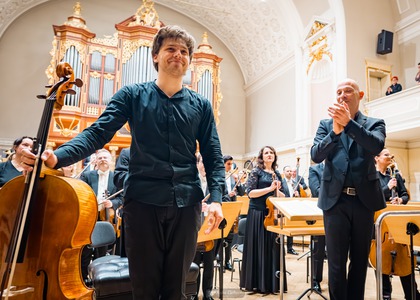
ICMA - Classeek winner Ettore Pagano successful with the Poznań Philharmonic
Jacqueline du Pré was only twenty when she recorded Edward Elgar's Cello Concerto with the London Symphony Orchestra. Until then, the concerto had often been treated as something of a curiosity, but du Pré's interpretation firmly secured its place in the canon of cello literature while also setting a daunting benchmark for the young musicians who would later attempt it. The Italian cellist Ettore Pagano, winner of the 2025 ICMA-Classeek Award, recently played it with the Poznań Philharmonic and emerged from that challenge with ease. Iga Batog reports.
Rather than following the traditional three-movement structure, Elgar's concerto leans toward a symphonic poem: its sections flow seamlessly into one another, recurring motifs bind the work together, and virtuosic passages alternate with moments of lyrical introspection, creating an emotional narrative. The real challenge, then, lies in shaping the work's dramatic arc. After the concerto's dramatic opening, the soloist quickly withdrew, significantly slowing the tempo and skillfully guiding the Poznań Philharmonic Orchestra, conducted by Ariel Zuckermann, toward the lyrical theme.
His confident phrasing and nuanced handling of contrasts were particularly striking. In the faster passages, he impressed with his lightness and agility; his spiccato acquired a playful, almost mischievous quality, subtly foreshadowing Mendelssohn's Symphony No. 4, performed after the interval. For me, however, the third movement was the highlight of the performance. With restrained tempos and naturally unfolding phrasing, Pagano revealed the music's introspective, almost meditative character. In those moments, Elgar sounded distant and intimate at once, as though recalled through memory.
Ettore Pagano's performance concluded with two encores - Julie-O by Mark Summer and Lamento by Giovanni Sollima. While both showcased Pagano's versatility, it was Lamento that proved especially memorable, with the combination of playing and singing offering a compelling glimpse of his potential in contemporary repertoire.


