



> Interviews
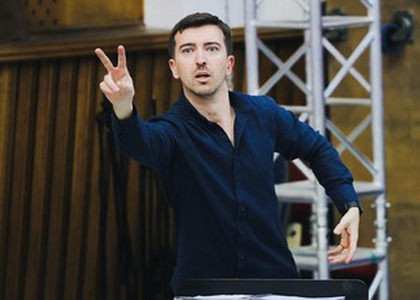
Interview with Răzvan Rădos, conductor of the Radio Children’s Choir
The Radio Children's Choir will present on Saturday, April 25th, 2026, on the stage of the Radio Hall, the performance "Great Passages", dedicated to archaic Romanian music illustrating the major events of human life. We learn more about this event from an interview with Răzvan Rădos, the ensemble's conductor, conducted by Ana Sireteanu.
Mr. Răzvan Rădos, I would like to begin our discussion with a look back at 2025, when the Radio Children's Choir celebrated 80 years of existence. How did you mark this anniversary and what did it mean for the audience and for the children in the choir?
It was a full year, and we greatly enjoyed meeting both audiences in Romania and European audiences, as we had two anniversary concerts at the Radio Hall and other invitations across the country as an anniversary ensemble. We also took part in several major European festivals, and I would like to mention here the Religious Music Festival in Bulgaria and the European Youth Festival in Basel.
The first concert of the Radio Children's Choir this year is built around archaic Romanian music, illustrating events such as birth, marriage, and death. How did you choose to represent these life moments so present in Romanian folklore in the multimedia performance "Great Passages"?
This phrase, "great passages," is borrowed from two major personalities of Romanian folklore whom I had the joy of knowing. I am referring to Mrs. Marioara Murărescu, who produced an important program of this kind, and Maestro Gheorghe Oprea, who was my folklore professor at the Conservatory. They used this phrase, "great passages," when classifying the folklore that Maestro Oprea taught me and that Mrs. Murărescu presented in her programs. Thus, this direction of customs related to major life events remained deeply imprinted in my mind.
At the same time, I grew up in the countryside, in Hunedoara County, and I was able to see in my grandparents' village some of these traditions still alive. In my childhood, I sang Romanian traditional music. Later on, I collected many scores-choral arrangements of folk material-and for nearly a year I set aside scores, sorted them, thought about which would fit, and tried to build this concept.
Then, my younger colleagues in the choir and my colleague Magdalena Faur took this information and added part of their own soul to it, shaping it into a complex concept, as they do with every idea I propose to them.
I noticed that several instruments are mentioned on the poster. Will there also be soloists in this concert?
Of course, we have several soloists, including from within the choir, but I would first like to mention my colleague Magdalena Faur at the piano, as always. Delia Nartea, who usually presents the Radio Children's Choir concerts, is this time behind the scenes and has organized the stage movement for a large part of the performance. On the cimbalom, we will have guest Ianis Pîrșe, who will take part in a very beautiful moment of authentic Romanian hora that we have prepared.
At the same time, we present complex works, such as fragments from Ritual for the Thirst of the Earth by Myriam Marbé, which place many of our colleagues in solo roles. I am thinking here of Chirina Arnăutu, Cristina Mihăilă, Daria Stănculescu, Șerban Șușnea, Andrei Norbert Ancucianu, Xander Coceaș, Bogdan Dinu, Sebastian Chiriac, and Andrei Dima. There are many others as well who have short solo roles within the choir. This is quite a challenge for our children and young performers, because it is no small thing to gather your courage and shout or sing exactly at the right moment.
We believe the audience will enjoy this.
Do you think multimedia elements enhance the musical experience? From your experience, how does the audience react to this type of event?
The Radio Children's Choir has developed endurance over time. We try to connect the pieces seamlessly. The choir sings a lot, without interruption-about 25-30 minutes of continuous music. This encourages the audience to imagine a story. This concert truly is an experience, illustrating a person's life through song and music. The lighting will be slightly dimmer than in other Radio Children's Choir concerts. At the same time, sounds such as wind, sheep bells, the wooden toaca, and church bells will invite the audience to imagine.
I will communicate to the audience at the beginning, perhaps even before the choir enters the stage, that they may applaud whenever they feel like it. But if they notice that we are trying to continue, they may allow us to proceed, because there will be a continuous flow, and each member of the audience will be able to create their own unique story in relation to the music we offer.
Translated by Darius Baciu,
University of Bucharest, Faculty of Foreign Languages and Literatures, MTTLC, year II
Corrected by Silvia Petrescu


