



> Interviews
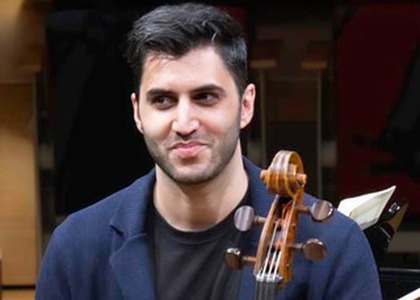
Interview with cellist Kian Soltani
Cellist Kian Soltani and conductor Leonard Slatkin are once again, today, April 24th, 2026, for the second consecutive evening, the stars of the George Enescu Philharmonic Orchestra's concert. Kian Soltani spoke with Ioana Țintea about his return to the stage of the Romanian Athenaeum.
You are performing Robert Schumann's Concerto for Cello and Orchestra on the stage of the Romanian Athenaeum. What is your history with this piece?
I started this piece quite late in my life. I was already well over twenty when I began studying it and performing it for the first time. Then I played it many, many times - for several years, it was one of the works I performed most often. After that, however, I took a two-year break during which I didn't play it at all, and at the Romanian Athenaeum, this is the first time I'm performing it again after that period. So, I have a long history with this piece, with its ups and downs.
Do you think a certain degree of artistic maturity and technical stability is needed to tackle it?
Yes, definitely. From a technical point of view, it's already quite challenging, but that's just one aspect - there are many technically difficult pieces. This one, however, is also challenging from an emotional and, in a way, intellectual perspective, because it's not a cello concerto in the traditional sense, where the solist is always in the spotlight. In reality, it is more like chamber music with an orchestra. It is an extremely lyrical work, especially in the first and second part. In the third movement, the music intensifies in terms of virtuosity and requires a certain level of experience. This is probably also why my teacher didn't allow me to study it while I was a student - I didn't learn it at all back then, because, in fact, it isn't a "student" piece. And, honestly, I'm glad about that. There are pieces you have to learn during your studies that are part of what we call the student repertoire. But this isn't one of them, nor should it be. You have to truly mature as a cellist and cover as much repertoire as possible before tackling this piece. That's why I'm glad I waited so long.
In an interview, you spoke about the difficulty of reaching a shared vision with the conductor in the case of this work. In this context, how would you describe your collaboration with Leonard Slatkin?
This isn't the first time we've collaborated. We've performed together here in Bucharest before, I think about two years ago. This is already our second collaboration, and everything is going very smoothly. At the same time, it's also very pleasant that, after two years of not performing this piece, I'm now returning to it with a different perspective. After playing it for so long, I had become increasingly focused on my own vision; I had become very specific in the way I thought it should be interpreted. Now, however, I'm glad I've taken some distance. I'm returning to the piece with a new perspective. And it's wonderful that the first conductor with whom I'm doing this is Leonard Slatkin.
You are constantly involved in chamber music projects with artists such as Daniel Barenboim, Renaud Capuçon, and Lahav Shani. What does this kind of dialogue bring to your development as a musician?
Yes, chamber music is probably the most important genre in classical music. I truly believe it is essential for any musician to perform chamber music. It is the most direct way of making music. Playing solo is a unique experience - it's just you, your thoughts, and your instrument. It's an intense and fascinating experience. On the other hand, playing with a large orchestra is wonderful in its grandeur: It is grand, epic, and highly theatrical. Between these two extremes, however, lies the beauty of chamber music. In chamber music, the horizon of possibilities broadens considerably: it is no longer about the prominence of a single instrument, but about the music itself - about what best supports the musical discourse. That is precisely why many of the composers' most valuable works belong to this genre. Moreover, chamber music offers the opportunity to experience something almost symphonic, but in an intimate setting, where each musician has a huge responsibility. Every voice matters- there is only one cellist, one violinist and communication is direct, immediate, without the mediation of a conductor. And this is, perhaps, the most fascinating aspect: in a chamber music ensemble, each musician becomes, in a way, their own conductor. There are, in fact, several "conductors" on stage, who listen, react, and lead all at once. It is a continuous dialogue - a true musical dance. For this reason, I believe chamber music is fundamental to a musician's development. And when you perform it alongside inspired partners, it becomes a profound experience that is then reflected in everything you do on stage, whether it's concert or symphonic repertoire.
What is your artistic philosophy? What do you believe in when you step onto the stage?
I think things have changed quite a bit. If you had asked me ten or fifteen years ago, I would have said that I wanted to play every note as accurately as possible, with as few mistakes as possible - I essentially wanted to impress. I've always had this desire to impress. I realized later that this was my main motivation as a child; that's why I practiced so much. I don't think there's anything wrong with that - and I still want to impress today - but the stakes have changed. What I truly want is for the audience to join me on an emotional journey, right in that moment. That's how I see things when I step on stage: as an authentic act of communication. It's a word we use often, but essentially that's what it means making the music intelligible and alive for those who listen to it. Sometimes, even more clearly than you might think is necessary, precisely because you have to look at everything from their perspective. Ultimately, how the music reaches the audience matters more than how you perceive it as a performer. These are the things I'm thinking about most these days.
Translated by Gina-Aurelia Iordache,
University of Bucharest, Faculty of Foreign Languages and Literatures, MTTLC, year I
Corrected by Silvia Petrescu


