


> Interviews
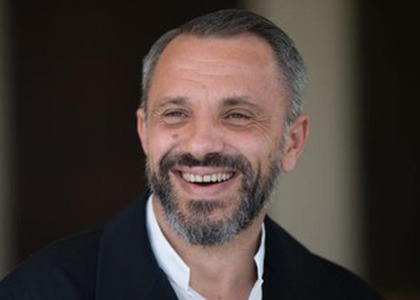
Interview with conductor Fayçal Karoui
The Radio music season continues on Wednesday, 29th of April, 2026 with a concert performed by the Radio Chamber Orchestra and the Radio Academic Choir, prepared by Ciprian Țuțu, in a program dedicated entirely to Baroque music. Fayçal Karoui will conduct the performance, with this occasion marking his return on the Radio Hall's stage. We will learn more from the French musician of Tunisian origins in an interview given to our colleague, Ioana Țintea.
This is not your first meeting with The Radio Chamber Orchestra. How was the reunion with the musicians and how are the rehearsals going?
I like this orchestra. Now that I know the members, I know they're fast about resolving certain problems. At first, there might be some difficulties, but they say "Don' worry, Maestro, don't worry, everything is going to be alright." Because I know them, I trust them, they play wonderfully. So it's truly a joy to be here.
The program on Wednesday, 26th of April, 2026, at the Radio Hall spotlights the Baroque - Johann Sebastian Bach and Georg Friedrich Handäl. What is your vision on this repertoire and what do you think young people should discover in Baroque music today?
Baroque music has long been performed primarily by specialized musicians using Baroque instruments. For us, musicians like me or the ones playing on various modern instruments, there was always a certain hesitation: we didn't know if we could tackle this kind of music because we weren't specialists in performing it. But, you know… who cares? Music is extraordinary and can be performed in so many ways. It's very simple at first glance, but extremely complex at the same time. So, for young audiences, this music is accessible, easy to listen to and often cheerful and relaxing. Whether you're young or older, you'll discover something truly extraordinary in this repertoire.
For Bach's Violin Concerto in E Major, you will be collaborating with the violinist Alexandru Tomescu. What do you know about this Romanian musician?
I don't know him yet, but I can't wait to meet him. It's a really beautiful Baroque program; all the pieces are fairly short. I didn't choose them by myself, but I'm thrilled with the program. That's how I discovered a lot of new music, especially for myself, especially Händel's four "Coronation Anthems" for Choir and Orchestra. And I cannot wait to revisit and conduct them on another occasion too.
Today you are recognized as one of the most highly regarded ballet conductors. How did you first become involved in the world of choreography?
When I was young, I was the assistant to the great French conductor Michel Plasson and I had to be given something to do. Back then, things were different, now they've changed and they're still changing. Back then, ballet wasn't considered very important. So they said, "Okay, we have to give him something do do, otherwise he'll get bored". I wanted to work, to be active. And they decided, "Let's give him a ballet." And I simply fell in love with the dancers and the art of choreography. Then I become music director at the New York City Ballet for seven years and conducted ballet music everywhere. I don't know if you become a ballet conductor, but the more you work in this field, the more deeply you get involved. It's a very different world. Ballet dancers deserve the same respect - even more than musicians or singers. They're extraordinary, they work incredibly hard, they're true musicians in their bodies. It all starts with rhythm. In opera, you share the music with the stage and the soloists, but in ballet everything becomes a single flow: the orchestra and the movement together. It's like a symphony concert, except that people are dancing to the music. That's why I love ballet so much. And I always tell young conductors to try conducting ballet. Because once you start, you can't stop.
Does your rich experience in stage music also influence the way you choose the repertoire for a symphonic concert? What do the dances from a Bach suite mean to you, from this perspective?
Not necessarily, but now, when I study a score like Bach's Suite No. 2, I always picture the dance. Perhaps even before I became a ballet conductor, I Instinctively thought about movement, about dance. Maybe also because I move around a lot on the rostrum. Suite No. 2 is a sequence of dances; I think about what movement means in this context and I can imagine the steps, even though I'm not a dancer. In general, I think a lot about dance when I conduct.
From your perspective, what responsibilities does a conductor have today beyond the stage?
What I love about my job is that I try to make people happier than they already are. I mean, I hope to bring happiness through music. Especially in our days, when you go to a concert, you just simply want to forget about everything. For an hour, you're somewhere else - like in a some sort of magical garden, where you are enjoying the moment. It's incredible how powerful music is. People come to a concert to experience a moment of peace and joy. Maybe that's my role: to use music, this fantastic instrument, to bring happiness to those who listen to it. Life without music would be a terrible mistake.
Translated by Cosmin Șerban,
University of Bucharest, Faculty of Foreign Languages and Literatures, MTTLC, year I
Corrected by Silvia Petrescu


