



> Interviews
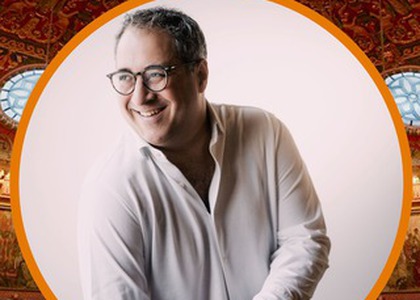
Interview with conductor Leo Hussain
Conductor Leo Hussain returns to lead the orchestra and choir of the George Enescu Philharmonic in two concerts scheduled for Wednesday, April 29th and Thursday, April 30th, at 7:00 PM, in the Grand Hall of the Romanian Athenaeum. Our colleague Cristina Cîrjan spoke with the British musician about these events.
This week you are reuniting with the orchestra and choir of the George Enescu Philharmonic. How have rehearsals gone so far?
As always, rehearsals are enjoyable, full of energy and personality. The programme is an extremely demanding one. The orchestra hasn't played this symphony by George Enescu for a very, very long time. So I think they are performing this music somewhat as if rediscovering their ancestors, which is very beautiful. The musicians of this orchestra always bring a great deal of personality and commitment, which is wonderful.
The concert opens with "Valse triste"(Sad Waltz) by Jean Sibelius, a work you have conducted here in Romania before, in 2023. What draws you to this piece and how has your perspective on it evolved over time?
I think the best person to answer how my perspective has evolved would be someone who listens to it. It is an exceptionally simple, beautiful, melancholic piece that stirs strong feelings. One of the main reasons I chose it for this programme is that we are also performing the Violin Concerto by Jean Sibelius. I wanted to include a shorter work, also by Sibelius, in the programme. The final texture of the waltz is very similar to the opening of the Violin Concerto, so the two works almost seem to flow into one another.
As you mentioned, you will also be conducting the Violin Concerto in D minor by Jean Sibelius, with Karen Gomyo as soloist. Is this your first collaboration?
Yes, it is our first collaboration, although, amusingly, I was at home in Salzburg last week and she was playing the same Sibelius concerto there. So I managed to listen to a bit of her rehearsals and I'm now very much looking forward to working together. She is, of course, a wonderful violinist. I have followed her many times, but this is the first time we are working together.
The concert closes with a work by George Enescu. How do you approach his musical language and what does it mean to you to conduct this symphony here, in Romania?
I think, first and foremost, it is incredibly important for Enescu, for the orchestra that bears his name, for this hall and for Romania, that these works are performed again. For many reasons, these symphonies have barely been played in the last 5, 10, 15 years. They are performed very rarely. He is, of course, the central figure of Romanian music and it is entirely natural that his music should resound in this hall once more. As for how I approach it - for me, this symphony is one of the great achievements of 20th century symphonic music. In a way, it is similar to Mahler, but "a Mahler taken to the extreme." It contains all the philosophical, humanist, universal truths that Enescu pursued. It is one of the most profound works I have ever conducted. And studying it has revealed a depth I did not expect to find - not because I don't respect Enescu as a composer, but because this particular piece seems like a synthesis of his entire philosophy. It was written during a period of great suffering in Europe and of personal tragedies for Enescu, and yet at the same time it leads us towards something incredibly beautiful, profound and mysterious - as though it were opening a door to the afterlife and inviting us to step through, without showing us exactly what lies beyond. It is an extraordinary work and I sincerely hope it will be performed more often. It is hard to put into words how profound the experience of performing it is.
In an interview given here in Romania ten years ago, you said that art and music are the ways in which we express our humanity and that you couldn't imagine life without music. What does your philosophy about music look like today?
I think that, unfortunately, I can now imagine a life without music - but that is because I can also imagine a life without humanity, given the state of the world at present. But that is precisely why I believe it is all the more important to affirm our humanity. And perhaps back then I was being slightly self-centred - it is not just music, but culture in general that is the way we express our humanity. That is why it is essential to fight to preserve this cultural wealth and these values that we hold. An orchestra, or any cultural organisation, represents an extraordinarily important asset - locally, for a city; nationally, for a country; and on a human level, for all of humanity. These are things we must fight for, so that they may survive and flourish.
Translated by Darius Baciu,
University of Bucharest, Faculty of Foreign Languages and Literatures, MTTLC, year II
Corrected by Silvia Petrescu


