



> Interviews
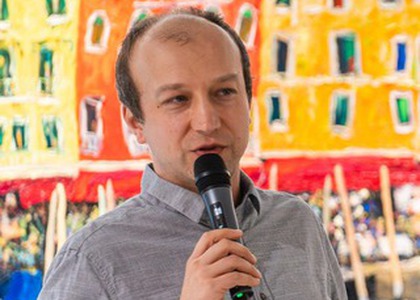
Interview with pianist Bogdan Vaida, initiator of the Classic for Kids project
During this period, the third edition of the educational project Classic for Kids, initiated by pianist Bogdan Vaida, is taking place. The 2026 program includes 22 free concerts and music workshops organized throughout April and May, aimed especially at children from rural communities and small towns across seven counties in Romania. For more details, pianist Bogdan Vaida speaks in conversation with Ioana Țintea.
Mr. Bogdan Vaida, Classic for Kids is a project through which children are introduced to classical music in a way they can understand. How do you remember the beginnings of this initiative?
The beginnings were full of all kinds of challenges, but also rich in lessons for us. Every concert we've given since starting this project has been a lesson in how things can be done better, and at the same time, a lesson in just how open and musical children really are.
Looking back, to what extent do you feel you have achieved your initial goals?
We're trying to bring music closer and closer to children, and personally, I would love to show them what it truly means to listen to music. Of course, this isn't something with a clearly defined end point, because educating children cannot be achieved through a single event or a concert lasting an hour and a half or two. It depends a lot on parents, educators, the education system, and so on. Still, I've often seen on children's faces that music does them good and that it can be a very important lesson.
I believe that, in our system or in our general mindset regarding education, music plays a far less important role than it should. And I've noticed that in the places we've visited before, where we return again, our project and the children's contact with music have left a mark, fortunately.
The theme of this edition is Mozart at the Animal Farm. Why do you think the music of Wolfgang Amadeus Mozart remains such an effective starting point in connecting with young audiences?
Mozart's music is a wonder a mystery even for musicians. It has a luminous quality, a simplicity, a sincerity, and an impact that continues to surprise me, again and again, especially on children. And it's not just primary school children, who are the main audience of Classic for Kids, but even babies. We also have a project called Classic for Babies, and I was truly amazed to see how a room full of babies suddenly grows quiet when Mozart's music begins.
This year's concert program is an imaginary journey of Mozart through an animal farm, and although Mozart's own music is included, the main pieces were actually written by five contemporary composers from Cluj. Ana Maria Meza, who is also my colleague in this project and the conductor working with the children in the second part of the events guiding them, showing them what to do so we can all perform together, essentially forming an orchestra. Then there's Ciprian Gabriel Pop, a composer who has already written many pieces both for this project and for other projects of mine. Șerban Marcu, another composer we collaborate very well with, who writes wonderful music. Aurelian Băcan composed a piece that feels like a cartoon. And we also have Alexandru Murariu for the first time, who wrote a piece about Bugs Bunny. So it's a really lovely program both for children and for the child within all of us.
The 2026 edition of Classic for Kids opened on April 16th in Cluj-Napoca. What reactions from the children have surprised you the most?
For me, it's a great satisfaction to see that children lack many of the prejudices adults have for example, when it comes to contemporary music. Children have no problem with it. For them, there's no such thing as classical music, contemporary music, early music, or anything like that. There is simply music. And if they can connect it to a story, a character, a feeling, then they truly enjoy it and become completely absorbed. As I said, for us and for me personally every concert is a lesson and a reminder of just how beautiful and engaging music can be.
What are the next stops on your tour map?
Right now we are in Ipotești, at the Ipotești Memorial, where we are about to hold an event for the children from the local school. We still have two more stops here in Moldova - Rădăuți and Siret. After that, we'll travel to Maramureș, to Suciu de Jos.
In general, all the places we go to are smaller communities small towns and villages where children have fewer opportunities to take part in cultural events. That's why they are all the more joyful and grateful, and we hope to leave an even stronger impression perhaps even to become a starting point for some children in their relationship with music.
Translated by Adina Gabriela Văcărelu,
University of Bucharest, Faculty of Foreign Languages and Literatures, MTTLC, year II
Corrected by Silvia Petrescu


