


> Interviews
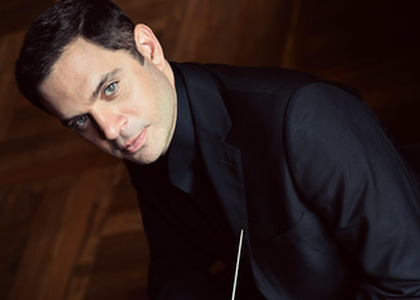
Interview with conductor Christopher Ward
The National Radio Orchestra will perform on Thursday, April 30th, in a concert alongside pianist Daniel Ciobanu, under the baton of conductor Christopher Ward. More information about the event scheduled for 7:00 PM at the Radio Hall comes from an interview with the British musician, conducted by our colleague Cristina Cîrjan.
You are returning to Romania for your second concert at the Radio Hall. How does it feel to be back on this stage?
I greatly appreciate the orchestra here. Its members are wonderful people, and the previous occasion when we worked together last year was a very pleasant collaboration. The concert was a great success. So I'm very excited to return, to see familiar faces again, and to work on a new repertoire.
You are conducting the National Radio Orchestra for the second time. How would you describe your connection with the orchestra, and what makes this ensemble special from your perspective?
I think it's a wonderful group of personalities. The musicians have a very special way of communicating with each other and of playing together. They are very open to work, very eager to search for detail in the music, and they truly want an outstanding result. Under these conditions, it's always a pleasure to work with an orchestra. I especially like their pleasant sense of humor, which can be seen during rehearsals and makes everything a bit easier and much more enjoyable.
The program is deeply rooted in Romanticism, bringing together works by Pyotr Ilyich Tchaikovsky and Franz Liszt. How do you approach a program with such strong emotional intensity?
It is an intense program, you're right. Both of Tchaikovsky's works are incredibly dramatic. They have many facets-not only emotional, powerful music, but also quiet, sentimental moments. It's about finding the full palette of these emotions and the character within the music. It's not only important to build emotion, but also to maintain the precision required by many works of Romantic music. Totentanz is also a very special piece-an unusual piano concerto, very dramatic, essentially based on a single melody: Dies Irae. It was written at a time when Romantic composers were very preoccupied with the supernatural and death. It has a harsh, striking character and was conceived as a spectacular piece in which Liszt could display his pianistic virtuosity. Thus, a beautiful contrast is created with the lyricism and emotion of Tchaikovsky's works.
The soloist in this work is pianist Daniel Ciobanu. It is your first time working together. How would you describe this musical dialogue?
It is always a pleasure to meet new soloists. As you said, this is our first collaboration. Totentanz is a special work that requires a good dialogue between the orchestra and the soloist. I'm really looking forward to working together musically.
Tchaikovsky's Symphony No. 4 is often associated with the idea of fate and inner struggle. How do you interpret this tension between fate and the desire for happiness when conducting the work?
There is a very well-known letter that Tchaikovsky wrote to his patron, in which he describes his thoughts about the symphony. It shows how preoccupied he was with the idea of fate in his own life. The famous fanfare that opens and essentially closes the work presents a very clear, extremely powerful, almost inhuman statement. The lyrical, human music that contrasts with it has a desperate, very restless character. I think it is very important to understand what Tchaikovsky wanted to convey: no matter how life treats you, no matter where it takes you, fate will always be present in the background. As a conductor, you must feel the presence and the possibility of the fate motif appearing at any moment in the work, because sometimes it appears unexpectedly and completely changes the atmosphere, mood, and direction of the symphony. The symphony has moments of real beauty, lyricism, and joy, but this motif creates the background and structure of the entire work. I believe it is essential to understand Tchaikovsky, to understand his intentions, and to keep them in mind throughout the entire piece.
Translated by Sorana Dumitrescu,
University of Bucharest, Faculty of Foreign Languages and Literatures, MTTLC, year II
Corrected by Silvia Petrescu


