


> Interviews
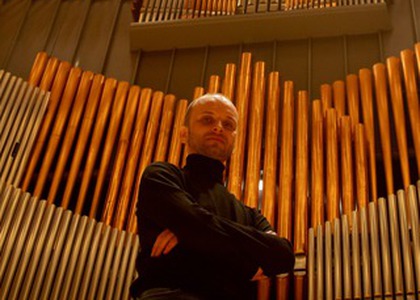
Interview with organist Eduard Antal about Bucharest Organ Fest “Cantus Ecclesiae”
From 9th to 24th May, the sixth edition of the Bucharest Organ Fest "Cantus Ecclesiae" will take place, one of the most prestigious events dedicated to organ music in Romania. We learn more from organist Eduard Antal, the festival's initiator, in a conversation with Ioana Țintea.
Mr. Eduard Antal, the Cantus Ecclesiae Festival has grown from one edition to another. What do you think essentially defines it today?
I'd like to think that one possible definition of festival, given how it has evolved over previous editions, lies in a continuity, if you will, of what the organ represents, of what we have managed to convey to the public, of how we have, perhaps, taught future organ players, because over the course of previous editions we have held all kinds of master classes aimed at the either school children or university students, who today, six years later have grown up and became organists themselves. And I think I would define this aspect of growth, of learning as much as possible about the organ so that we can talk about an audience of our own, a family of organ lovers.
This year's edition promotes the dialogue between organ, piano and harpsichord, as well as the collaboration with choir ensembles and vocal soloists. How did you plan this program? What are the main reference points?
We wished to present the organ's extended family and that's why we proposing piano and organ concerts, organ and harpsichord, two organs concerts, to clearly demonstrates what is the connection between these instruments, what are the their possibilities for combining them in a concert.
But, equally, we also have this organ's hypostasis, as an accompanist, whether for vocal soloists or choirs, because in this edition we also feature this combination of organ and the human voice.
What can you tell us about this edition's guests?
In this edition we will have guests from Switzerland, Austria, Italy, France. We will be joined in the final festival's concert by the organist of the Notre-Dame Cathedral in Paris, Mr. Vincent Dubois, whose presence honors and places a great responsibility on us. Also, the organist Andreas Jost, who is a professor at Zurich University of Music and the organist at the Grossmünster, or Ms. Magdalena Moser, who is organ professor at the University of Graz, the piano player Alessandro Marangoni, who comes for a piano and organ concert alongside the organ player Paolo Oreni, a performance at the Romanian Athenaeum. Also, Roman Perucki, guest of the Polish Institute with a performance at the Romanian Athenaeum.
And in addition to these names from outside of Romania, we, of course, have many guest from our country, whether they are well known organ players or students, Romanian teachers who are dedicated to train the future generation. And here, we're talking about Dan Racoveanu, Erich Turk, professor Amalia Erdos, Mr. Steffen Schlandt, who this time will be appearing as a conductor alongside the Bach Choir of the Black Church, joined by many pupils and students from Romanian schools.
Where will the events take place and how important is the venue for this type of music?
I think the venue is very important for this type of music, because each repertoire will sound different depending on the venue's instrument.
Something new, if you will, of this edition is the inclusion of instruments from two monasteries near Bucharest. I am referring here about to the organ at the Popești Leordeni monastery and organs at the Carmelite monastery in Ciofliceni.
We continue to feature well known places such as The Saint Joseph's Cathedral, the Romanian Athenaeum, The National University of Music in Bucharest, The Italian Church, The French Church and Adventist Church "Labyrinth".
As you mentioned, master classes play an important role in the program. How do you view young people's interest in studying the organ in Romania, at this time?
Based on the registrations we have received until now, I can only say that I've observed a big interest from those who are preoccupied with this instrument and I'm equally delighted by their interest because it's no small matter for a professor of Andrea Jost's stature to come to Romania to offer a master class and the students and pupils to be interested and express desire to participate at this master class, as well as for the Paolo Oreni's masterclass.
The relation between the performer, instrument and the acoustic venue is essential in the organ music and it is, without a doubt, something that is developed and learned over time. How much time do you need ideally to familiarize yourself with a new organ before a performance?
There is always this need of getting comfortable with the instrument and the venue. But I think this particular time is relative, it depends, perhaps, on each organ player's experience, whether they've played that particular instrument before, the repertoire also plays an important role. It's something that has more to do with the relativity, but also with the organ player's experience. You are forced to become flexible in regard with your career.
We don't have the advantage of a violinist, to have the same instrument with us all the time, and if we find ourselves having to adapt to new instruments, this aspect really helps in making the process of discovering a new instrument and its acoustics much easier.
What kind of audience attends an organ performance these days? Have you noticed any changes in recent years?
We are delighted to have an increasingly diverse audience. We welcome everyone at our concerts, from the youngest to the oldest. This may be due to the fact that we offer a variety of concerts that cater to complex varieties of taste and so, through this diversity of instrumental and vocal performances spanning through different periods, ranging from Baroque music to Romantic and contemporary music, we are able bring together a truly diverse audience.
We are truly delighted by this, and perhaps our greatest joy is seeing children and young people attending our concerts. And, maybe, in the early years we might have felt some hesitation... organ? What is that? going to a church for a concert?, today I can say from the bottom of my heart that we have succeeded, in a way, to break this preconception and attract more and more people who aren't just curious, but many of whom have become connoissuers.
Photo by: Zvasile Adrian
Translated by Cosmin Șerban,
University of Bucharest, Faculty of Foreign Languages and Literatures, MTTLC, year I
Corrected by Silvia Petrescu


