



> Interviews
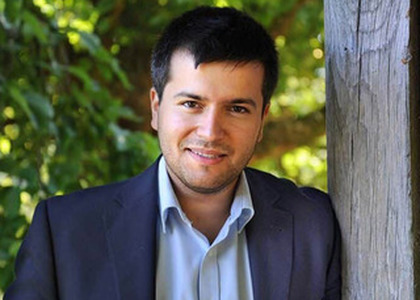
Interview with pianist Florian Mitrea
The Hoinar Festival returns from May 9th to May 19th, 2026, with an edition titled Unbroken. Under the motto "Fear is a reaction. Courage is a decision," this year's program brings to the forefront productions that challenge the limits of artistic performance, bringing together leading figures of the Romanian theatre scene and musicians who have redefined the boundaries of their genres. We learn more from pianist Florian Mitrea, Artistic Director of the Hoinar Festival, in an interview conducted by Ioana Țintea.
On the festival website, you state that for many people today, the simple right to live, dream, and create requires courage. How did this reality influence the conception of the Hoinar Unbroken program?
It was the primary source of inspiration, and the idea came to me during the 2025 edition, while I was in Bucharest. We were in the middle of the festival and could hardly imagine that we would still be in the midst of parliamentary and presidential elections, set against an unprecedented context not seen since 1989. I was deeply moved by people's resilience and by how they conducted themselves in a moment of crisis. I wanted to celebrate this through the 2026 festival, and I hope we have succeeded in bringing forward stories about courage, about how individuals find this extraordinary inner strength and how it can be expressed through art, music, and theatre. We offer multiple examples that highlight this capacity for adaptation, if you will, in the face of crisis.
What are the main new features compared to the previous edition?
This is a much more expansive edition; we are moving beyond the spaces you have already become familiar with. We open the festival at the Romanian Athenaeum, we gather at Teatrul Act alongside our main producer, and you will also see us outdoors, we are literally taking the piano into the park. We want to make music within the community, together with the people we address. We are also organizing an itinerant concert along Calea Victoriei, with three stops marking key moments in the cultural and artistic history of this major Bucharest thoroughfare. In addition, we are hosting an opening prelude conference at the Humanitas Bookstore in Cișmigiu. Because we are more than a music festival, we are interested in connecting music to social life and to other art forms. Among our guests are actor Marcel Iureș and Radu Filipescu, someone who, if you will, embodies the very notion of courage, in a free discussion moderated by Marina Constantinescu about what courage means. Marcel Iureș, for example, had the courage to open the first independent theatre in Romania. This edition is significantly developed compared to 2025, and I sincerely hope to meet you at as many events as possible.
The festival proposes an interdisciplinary marathon bringing together 10 events across 6 emblematic venues in the capital. How would you advocate for the strengths of this year's program?
There is something for everyone. We range from a specially designed educational performance for children, through which they can learn about classical music through play, to the conference I mentioned earlier, aimed at adult audiences. We also present a piano recital accompanied by a choreography rooted in physical theatre, as well as jazz performances and musical theatre numbers. I believe that any music lover, any cultural consumer, or even someone who has never attended a concert or performance, can find something of interest. The music is presented in its entirety, as we always do; we do not simplify it. However, the perspective we offer the audience is a new one, which I hope enhances its appeal.
What can you tell us about the invited artists?
We are particularly honoured this year to welcome a legend of the Romanian stage, Marcel Iureș, who will open the festival at the Romanian Athenaeum on May 13, alongside the festival musicians. The following day, May 14, he will revive a play he performed many years ago at Teatrul Act: Krapp's Last Tape by Samuel Beckett. This time, however, it is placed in dialogue with the music of Robert Schumann, in an extraordinary concept developed together with pianist Daria Tudor. We are also delighted to welcome back the beloved actress Alexandrina Halic, a long-time friend of the Hoinar Festival and a legendary voice of Romanian Radio, who brings this new performance to life. Mrs. Halic is a passionate music lover, and it is always a joy to collaborate with her. Among returning festival friends are soprano Sarah Gabriel and mezzo-soprano Verena Tönjes. We are also joined by new collaborators, including Martynas Levickis, a remarkable accordionist and winner of Lithuania's Got Talent, a true star of the classical music world, who successfully reaches new audiences. I sincerely hope he will enjoy his first visit to Bucharest. The festival artists include pianists Daria Tudor and Florian Mitrea, while cellist Andrei Ioniță will join us in the week following the festival to work within the Hoinar The Academy program in Bucharest's music high schools. We hope you will enjoy what we have to offer.
Within the festival, you have also launched a call for a cultural mediator. What motivated you to introduce this research and documentation component? Why is it important?
From the outset, I set out to create a festival for people, for the community, for society, and I am deeply interested in how it is received. Each year, we try to reinvent ourselves, to discover new ways of engaging, ways that can nurture our existing audience while also attracting new ones. Through this pillar, The Archive, we aim to conduct a more in-depth form of research. We already use certain methods to gather sociological data about our audiences, but we also want to combine this with the living testimony of spectators as they leave the performance space, to hear, in their own words, what moved them, what brought them into the concert hall, and what would encourage them to return. I believe all of us working in music and theatre need this. We need to understand what moves people. We must also reach out to them. We wanted to better understand what happens in a person's consciousness as they leave a performance. Together with statistical data, this will hopefully give us a comprehensive picture of what we can do going forward to meet audience needs in future editions.
Although your career is largely based in the United Kingdom, you regularly return to Romania through projects such as the Hoinar Festival. What motivates you to maintain this active connection with the Romanian cultural scene?
I will always remain a proud Romanian, and it gives me immense pleasure to work in Romania. There are wonderful people everywhere, I have had remarkable collaborations with the philharmonics in Iași and Cluj, as well as with the Radio Orchestras. It is an honour, and the collaboration has always been exceptional.
Translated by Carmen Badea,
University of Bucharest, Faculty of Foreign Languages and Literatures, MTTLC, year II
Corrected by Silvia Petrescu


