



> Interviews
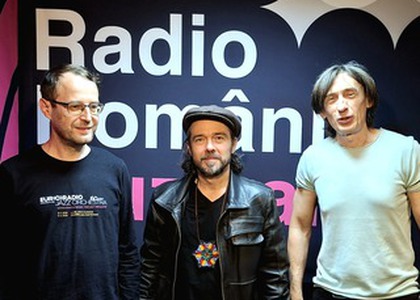
Saxophonist Cătălin Milea and Viorel Grecu – Guests of the Week on Perpetuum Mobile
Saxophonist Cătălin Milea is in the studio of Radio România Muzical. Good evening!
Cătălin Milea: Good evening!
And our colleague Viorel Grecu is also with us, the host of jazz programs on Radio România Muzical. Welcome, Viorel!
Viorel Grecu: Thank you! Hello, Gabi! Hello to all our listeners! I'm delighted to be here for the first time as a guest on Perpetuum Mobile!
Tomorrow marks the celebration of International Jazz Day. In November 2011, UNESCO officially proclaimed April 30th as International Jazz Day, and I quote, "with the aim of highlighting the diplomatic role of jazz, of uniting people, and of promoting cultural diversity from all corners of the world." A quote that is, in a way, quite diplomatic. Naturally, tomorrow jazz will be played all over the world-and, of course, here as well. But before that, and before inviting you to tell us what will be performed tomorrow, I would like to quote an Indian composer and singer, namely Shankar Mahadevan, who performs in a trio with John McLaughlin and Zakir Hussain, and who I believe captured the global essence of jazz in a single statement: "Jazz has no definition." "To understand jazz, you have to feel its pulse, lose yourself in its sounds, and let it flood your soul. It is the most democratic form of music-it has absorbed the sounds, movements, and rhythms of every musical tradition from all the countries it has traveled to."
I think that's quite telling, wouldn't you?
Cătălin Milea: It certainly is.
Jazz is no longer just American.
Cătălin Milea: It's no longer just American, that's true. Listening to this quote reminds me of Wynton Marsalis's perspective-he's American, of course-and he expresses a very similar idea: that jazz is an inherently democratic way of making music and of sharing the stage with others, without any form of authoritarianism and without allowing ego to take over the performance. And this means that jazz musicians aim to truly listen to one another and to communicate on stage, because there are many moments when decisions are made collectively-musical decisions that aren't discussed beforehand, but arise spontaneously.
Viorel Grecu: I believe there will be plenty of spontaneous moments at the Jazz Compas Gala as well, since that's the event you're organizing. And as an introduction, let's explain for those who may not know where the name Jazz Compas comes from, because it carries an older, deeper meaning-and also tell us who the protagonists will be. The lineup is very appealing and brings together multiple generations.
Cătălin Milea: Thank you. Jazz Compashas several meanings. In Spanish, compás means a musical measure, and at the same time, it also refers to the instrument navigators used to guide their route according to what the compass indicated. The Jazz Compasinitiative was conceived-and that's how it began-as a kind of direction or recommendation for those who wish to explore the world of jazz, offering what we consider to be the very best.
And the focus has been primarily on Romanian jazz, which, for a very long period of time, was not as widely exposed compared to jazz coming from outside our country-American jazz, Nordic jazz, European jazz. This was also due to the fact that Romanian jazz musicians were, to a large extent, isolated, as a result of the political and social periods we went through.
Cătălin Milea: And indeed, tomorrow will feel like a true display of strength across all generations. The young musicians from the Romanian Youth Jazz Orchestra will perform in the opening. The equally young-or perhaps not quite so young, but still young-members of Amphitrio will also perform, a group that, in my opinion, is emblematic of this period in recent years. And I will also perform in a duo with the exceptional pianist, in my view, Sorin Zlat.
Viorel Grecu: A nearly unanimous opinion, I would say. Let's also point out another important detail: the event will take place at Arcub Gabroveni and will start at 7:30 PM.
Viorel Grecu: Let's go through the names on the poster in order. The Romanian Youth Jazz Orchestra will appear in a reduced quintet version, but we should say that you are deeply involved in this project in its broader form-you are the mentor of the saxophonists. How does this process work? What can you tell us about the young saxophonists you work with-your "little great" saxophonists?
Cătălin Milea: Yes, the Romanian Youth Jazz Orchestra is a project initiated by UCIMR, Sebastian Gheorghiu and Sebastian Burneci, to which, of course, mentors contribute across the orchestra's different sections-such as the rhythm section, trumpets, trombones, and saxophones. Here I am the one who is directly involved and responsible for making sure things happen as they should. The young saxophonists-or "little saxophonists," although some of them are already quite advanced-are a great joy to work with, and I am very happy to be in this position of guiding them or passing on what I have learned myself. It is also a very interesting position because I, in turn, learn a great deal from them as well.
Viorel Grecu: From them?
Cătălin Milea: From them. And I learn a great deal from their questions as well. Because when a young musician asks you a question you hadn't thought about, you have to formulate an answer and find a solution on the spot. And that pushes me to progress as well, to grow together with them.
Viorel Grecu: I think it's both a challenge and a kind of exercise in mental and artistic well-being. You stay connected to what is new, you want to discover other things thanks to those who are coming up after you.
Cătălin Milea: Yes, and in this period I am truly amazed that today's generation has an extraordinary sense and a very strong capacity for learning. I see such talented young musicians, and I try to remember what I was like when I was 17 or 18 years old. I realize that the level is very high today. Indeed, this abundance of information and of opportunities to express themselves or to learn is something that helps them evolve more quickly. And of course, there is also a kind of genetic inheritance that they receive as time goes by.
Let's move on to Amphitrio, because Amphitrio has also performed here at Sala Radio alongside the Radio Big Band. It is a very well-known group and the initiator of an interesting project that they revealed to me here on Perpetuum Mobile. In fact, it is a composition competition for big band music, with the submission deadline set for May 10th. The jury that will evaluate the works includes several prominent musical personalities. I am thinking here of Dan Dediu, George Natsis, and Simona Strungaru. In fact, Amphitrio represented Romania last year at the major jazz music fair Jazzahead.
Viorel Grecu: It was actually the first Romanian band to be present there.
Jazzahead, where you were this year as well, Viorel, right?
Viorel Grecu: Yes, I was there in a rather special context, a meeting of jazz producers from EBU radio stations-the European Broadcasting Union.
I didn't stay for very long-basically I had one evening and one full day available. I took part in a meeting and a panel discussion, and I attended four concerts out of 161, but I'm satisfied. In the end, it was a good number, considering everything that happens there. And I also had a live broadcast from a mobile studio provided by Radio Bremen on Friday, for Perpetuum. It was a unique experience for me - a broadcast from a professional studio somewhere abroad. I would never have imagined something like this was possible, but it turns out it was, and I hope to repeat the experience in one way or another. This was already my second participation in this annual gathering of jazz producers.
And tomorrow, your show at 3:30 p.m. will bring some results from the contacts you have with jazz producers within the EBU, because tomorrow there will be a special edition of Planeta Jazz, which I'd like you to tell us about.
Viorel Grecu: Yes, starting at 3:30 p.m., there will be an International Jazz Day edition featuring music provided by my colleagues from the European Broadcasting Union. Twenty-one bands were proposed; we nominated the Răzvan Florescu Quartet, each participating act contributing three tracks.The show is 90 minutes long, so a tough selection process was necessary. I had to leave out four projects entirely, much to my regret, because the music is extraordinary, even though most of the artists are little known - or completely unknown -to the international audience.
So tomorrow, starting at 3:30 p.m., just before Perpetuum Mobile, here on Radio România Muzical, don't miss a special International Jazz Day edition of Planeta Jazz with Viorel Grecu. And now I'd like to ask you, Cătălin Milea: after International Jazz Day and tomorrow's concert, what else do you have planned, and where can the audience see you perform?
Cătălin Milea:After Viorel's show at 3:30 p.m., I invite you all to come to ARCUB - if listening to jazz has already whetted your appetite, come and see us live as well.
Viorel Grecu: We should mention that this is a premiere - your appearance alongside Sorin Zlat in this more intimate duo format.
Cătălin Milea:That's right. We've been talking for some time about putting together a format like this, because it's a major challenge to perform without a rhythm section, just saxophone and piano. And as for the question: what comes next? I'm currently very busy with a children's music album - actually my second one - which we will release in June. It also includes some of my own compositions, but there is also a piece that is very dear to me. Those who remember the film Pistruiatul…and there was that melody composed by Horia Moculescu, who, unfortunately, is no longer with us. I actually started writing lyrics for this little tune two years ago.
Viorel Grecu:I think everyone of a certain age remembers it. I admit I fall into that category.
Cătălin Milea:And I wrote some lyrics for this piece as well, and it will also be included on this children's music album. I care a lot about this project because it came from a need to let my daughter listen to good music, and I couldn't really find what I was looking for. And then I said, no, I have to…
Viorel Grecu: You didn't want to teach her directly John Coltrane or things like that, did you?
Cătălin Milea:I do play some for her from time to time, and she doesn't really have much patience for it, but I decided I want to create music -music that isn't made on a computer or generated by artificial intelligence, like so much of what's being produced nowadays. I want it to be music made with real instruments, performed by people, by musicians, the very best musicians -and I believe I've succeeded. It's music for children, but it's also for parents - meaning it's enjoyable to listen to. You can hear the warm sounds of the instruments we love so much, such as double bass, cello, flute, and, here and there, banjo.
Viorel Grecu:It's called Caruselul vesel - we definitely need to mention that.
Tetrismactic is your most recent jazz album, but as you told us before going on air, the concert dedicated to Gabi Dedeian last week did not go unnoticed, and you believe that it could…
Cătălin Milea:It may be that after a careful listening of the recordings we will decide whether to turn it into a discographic release. I hold Garbis Dedeian's personality very dear. He wrote very melodic and very beautiful music, and those who came last Thursday to the Radio Hall were able to enjoy Garbis Dedeian's compositions, which I am sure many of them didn't even know. Garbis Dedeian recorded an album toward the end of his life, somehow driven by a strong determination to do so. He was always extremely selective and very demanding with himself, and he probably would have wanted to release the perfect album, the perfect work - which, in my opinion, does not exist. Every album is like a photo album. In other words, it captures a moment in time. You look at how you looked ten years ago, and today things have changed, and it's time to make another album.
Thank you for being here with us, and I wish you, starting today for tomorrow, a Happy International Jazz Day!
Cătălin Milea: Thank you.
Translated by Ruxandra Ioana Șerban,
University of Bucharest, Faculty of Foreign Languages and Literatures, MTTLC, year I
Corrected by Silvia Petrescu


