



> Interviews
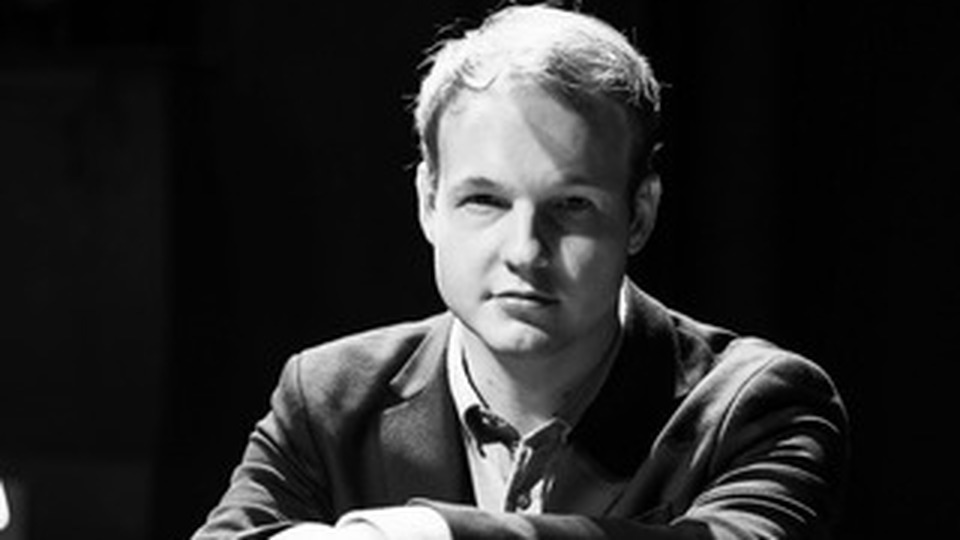
Interview with pianist Giovanni Bertolazzi
The young Italian pianist Giovanni Bertolazzi is set to debut on the Romanian concert stage tomorrow, May 7th, 2026. The artist will perform in Satu Mare alongside the Orchestra of the "Dinu Lipatti" State Philharmonic, under the baton of conductor Róbert Farkas.
Giovanni Bertolazzi has dedicated both of the albums he has released so far to the music of Franz Liszt and has received numerous accolades for his interpretations of this composer's works including a distinction from the Liszt Society in Budapest and nominations for the ICMA Awards, among others. His second album was also highlighted by Radio România Muzical in a CD Review segment in November 2023. Giovanni Bertolazzi kindly granted us an interview in which he speaks about tomorrow's event and his artistic journey so far.
Tomorrow you will make your Romanian concert debut together with the "Dinu Lipatti" State Philharmonic Orchestra of Satu Mare, conducted by Róbert Farkas. You will perform Maurice Ravel's Concerto for the Left Hand and Orchestra. What is your personal history with this work?
Maurice Ravel's Concerto for the Left Hand and Orchestra is a very special piece. I have been studying it for years and I truly love it of course, because of Ravel's genius conception and his extraordinary achievement in writing a work for only one hand that sounds as though it were written for both. So it is also an incredible challenge for the pianist, especially in terms of the polyphony that must be achieved with a single hand. But I have worked on this piece for many years and it holds a very special place for me. I am extremely excited to finally present it to the audience. It feels like a double debut: my debut with this remarkable piece, but also my debut in Romania. And I am very happy to perform it together with the "Dinu Lipatti" Philharmonic Orchestra and Maestro Róbert Farkas.
Listeners of Radio România Muzical are already familiar with your interpretative qualities, since your second album, featuring works by Franz Liszt, was highlighted in a CD Review edition in November 2023. In fact, both of your albums are dedicated to Franz Liszt's music and have received numerous distinctions including recognition from the Liszt Society in Budapest and ICMA nominations, among others. What draws you to Franz Liszt's music?
Liszt has actually been a composer very close to me ever since I was very, very young. I grew up listening to recordings by great pianists performing the established repertoire. But I especially remember certain Liszt recordings, pieces that deeply affected me from an early age. So, at first, it became a challenge for me: to one day be able to perform those works myself. But I want to make something clear: of course, I was fascinated by the virtuoso language, but what touched me most was Liszt's ability to recreate non-musical effects, certain atmospheres, and to use his musical language to evoke images and stories. His music completely absorbed me for years, and I kept exploring it more and more deeply.
We know he wrote an enormous number of works of extraordinary variety: there are pieces of incredible virtuosity, such as the Transcendental Études or the Hungarian Rhapsodies, but also music of profound depth, extending all the way to the late works, some even inspired by religion. For me, it has been an extraordinary journey. I explored all these diverse aspects of his music, and my recordings are dedicated to different sides of his creative universe. He truly is a very special composer to me. That is why participating in the Franz Liszt Piano Competition in Budapest felt completely natural, considering how passionate I had been about this composer for so many years. I was already performing the entire repertoire required for the competition, and Liszt remains an essential part of my recitals and concerts even today. He is certainly one of the composers dearest to me.
I also remember that Liszt's music represented an essential part of my artistic formation and a way of working on what I needed during those years. I could say the same thing about the works of Ludwig van Beethoven.
What would you consider some of the key moments or milestones in your artistic journey so far?
There have been several very important moments for me. Of course, for a young pianist, competitions can have a major impact, including on one's career. I would certainly mention the Franz Liszt Competition in Budapest, but I would also like to recall a truly special event connected to a unique Italian piano, a Borgato piano. I had the privilege of performing, at its very first public presentation, on the longest concert grand piano in the world. This piano measures 3 meters and 33 centimeters in length and is called the Borgato Grand Prix 333. I also had the chance to record my albums on this extraordinary instrument, entirely handcrafted in Italy. And of course, I will continue making future recordings connected to very special projects, not only with music by Franz Liszt, but also by Ludwig van Beethoven and other composers.
One of my most important memories also remains my performance of Sergei Rachmaninov's Piano Concerto No. 3 in Florence, together with the Orchestra del Maggio Musicale Fiorentino, once again playing on this remarkable instrument. And if I may add something else about this piano, I fondly remember a moment dedicated to both of us: the "Grand Prix du Disque" awarded by the Liszt Society in Budapest for these Liszt recordings was given not only to me, but also to Borgato pianos, in recognition of our partnership in bringing this project to life. Of course, I should also mention the many concerts I have performed at the Liszt Academy in Budapest, which have held particular significance for me.
I would also like to mention a very special connection. One of my favorite pianists of all time is Romanian Radu Lupu. Whenever he performed in Italy, he often chose Borgato pianos for his recitals and orchestral concerts. I had the honor of attending one of Radu Lupu's final concerts, although unfortunately I never had the chance to meet or speak with him personally. Still, in a way, I feel a special connection with him, because he considered these pianos among his favorite instruments. I feel that connection, and every time I play them, images and memories of Radu Lupu's interpretations come back to me. And that is something truly precious for me.
What aspects of Radu Lupu's artistry resonate most strongly with you?
I deeply admire his style and especially the way he approached polyphony at the piano. Yes, I can say he is a model for me a musical model. I am constantly inspired by his interpretations, especially in Beethoven and Schubert, of course, but also Schumann and Brahms. I truly see him as a landmark artist. It is true that he did not perform much Liszt, which for me has been an essential part of my repertoire so far. I know he played Liszt's Sonata in B minor until nearly the age of fifty, although unfortunately I do not have access to those interpretations. But regardless, yes, I can say that Radu Lupu remains one of my greatest sources of inspiration today.
You have often been praised for the poetic nature of your interpretations. What is the secret when approaching a score?
I can tell you that, beyond the world of piano, I have been deeply connected to opera since a very young age. I come from Verona, the city of the famous amphitheater and opera festival, so during the summer season it was natural for me to attend many opera performances. When approaching a score especially when I perform Liszt my attention is always directed toward the lyrical dimension, toward the singing quality of the music. And here, Radu Lupu has again been a major source of inspiration because of his incredible ability to make the piano "sing."
I can say that I am not especially impressed by the pure virtuosity so common today, since there are many performers of that type. What truly moves me is when I feel that the piano "sings." That is an extremely difficult thing to achieve, considering that the piano is, fundamentally, a percussion instrument. That is why, whenever I study a score in depth, I naturally search for a way to create the most lyrical musical discourse possible.
Translated by Adina Gabriela Văcărelu,
University of Bucharest, Faculty of Foreign Languages and Literatures, MTTLC, year II
Corrected by Silvia Petrescu


