


> Interviews
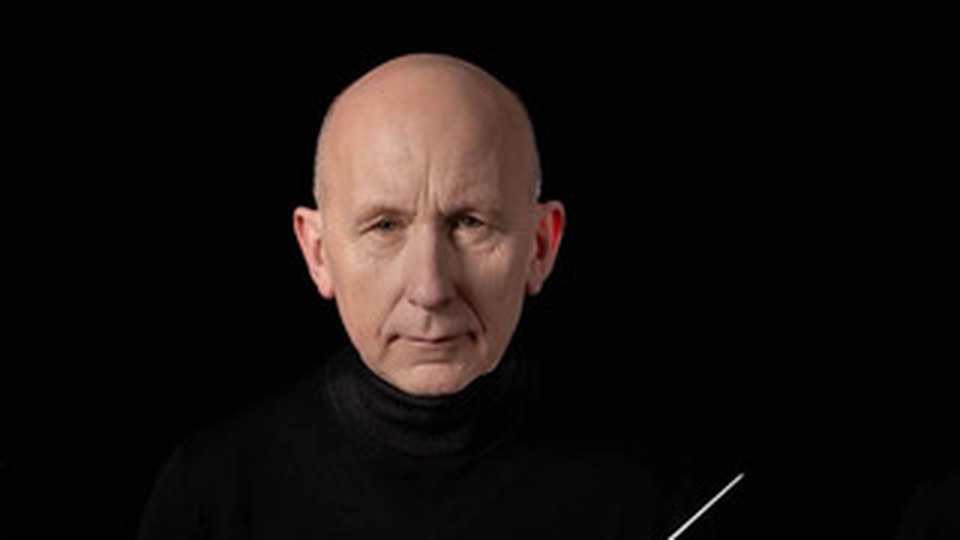
Interview with conductor Gerd Schaller
Conductor Gerd Schaller returns tomorrow, May 8th, 2026, to the podium of the Romanian Radio National Orchestra for the Royal Concert, which will take place starting at 7:00 PM at Sala Radio. The German artist is recognized as one of the most important contemporary interpreters of the works of Anton Bruckner. This time, Gerd Schaller will present together with the Romanian Radio National Orchestra a program consisting of the Royal Anthem by Eduard Hübsch, the Concerto in E minor for Cello and Orchestra by Edward Elgar, featuring Răzvan Suma as soloist, and Symphony No. 5 in F major by Antonín Dvořák.
You are conducting tomorrow's Royal Concert, dedicated to Royalty Day, celebrated on May 10th. Beyond the Royal Anthem by Eduard Hübsch, in what way do you believe the rest of the program reflects this theme of royalty?
I believe that the program we are performing on Friday - of course, we begin with the Royal Anthem, followed by the Concerto for Cello and Orchestra by Edward Elgar, and after the intermission - Antonín Dvořák's Fifth Symphony - possesses great nobility, a certain intrinsic regality, if we may say so, through the very nature of the music itself. If we think of Edward Elgar, he was a representative of the Victorian era of the 19th century, closely connected to the royal household and the style of that period. Antonín Dvořák's symphony, of course, is music that is so rich, so full of melodies and harmonies. And the orchestra manages to create these wonderful sonorities from the very first rehearsal. Therefore, I believe there are many elements of royalty in this music.
You are renowned for your interpretation of the works of Anton Bruckner - compositions to which you have dedicated yourself in a very special way. How do you think Antonín Dvořák's music, especially this symphony, relates to Anton Bruckner's style? Are they two different faces of Romanticism, or do you find something in common?
That is a very good question. Of course, I have conducted a great deal of Anton Bruckner, but I have also conducted much other repertoire. I have approached numerous operas - by Giuseppe Verdi, Richard Wagner and others. I have also conducted Antonín Dvořák - I love Antonín Dvořák very much and perhaps, in this respect, I am similar to Johannes Brahms, who also loved Antonín Dvořák deeply. For me, the music of the second half of the 19th century holds a special place; it is music that I love very much, music that I feel deeply. Of course, I also love the music of Ludwig van Beethoven from the earlier period. Late Romanticism has so many aspects, and what is very interesting is that although we speak about the same musical movement, there are such different variations within it. Antonín Dvořák is completely different from Edward Elgar, completely different from Anton Bruckner, from Johannes Brahms, from Pyotr Ilyich Tchaikovsky. We have so many individual styles, if we may say so, even though we are speaking about various countries, all of which developed during the 19th century. On the one hand, there is a great common line in music - they all regarded Ludwig van Beethoven as their ideal and tried to follow him, but on the other hand, each composer created a very personal Romantic style. And it is very interesting that many of these composers, on a personal level, were for the most part very modest. Especially if we look at Antonín Dvořák, who used to say: "Do not call me maestro, I am just a simple musician, that is all." And this is precisely the beauty of music: this simplicity.
Would you consider yourself a "Brucknerian" personality? I mean, do you resonate with Anton Bruckner in the way you relate to music - in the sense of a dedication to spirituality and an attention to detail?
There is a certain element of spirituality in all music - I am convinced of that. Even in a waltz by Johann Strauss II. There is a special feeling in music, a certain ideal, something that carries us to another, higher plane, and this is not necessarily connected to Anton Bruckner or Antonín Dvořák - the author does not matter. For me, this is very important, whether we are speaking about sacred music or organ music - I also play the organ. I believe that any kind of music can lead us toward an extraordinary state, if we may say so, into a feeling beyond the ordinary, everyday world, into an exceptional world. This is the great mystery of music in general, and especially of 19th-century music.
Could this belief be the force that guided your career and artistic journey?
It could be. I do not know… The older I grow, the less I think about such things. I believe that everything develops by itself. Everything in life is the result of a development. We simply have to trust and remain open, to look, to observe what happens, to become aware of it and carry it further, and one very important thing - with great love for people. Because the music we make - I believe that in truly great music there is always great love. And what we must do, our purpose as musicians and mine, of course, is to bring this love to people, to transmit it, because it connects us all. I am convinced that music can make the world better. I am sure that it does. People leave the concert with a smile, they are happy, and I am happy, the musicians are happy - because we have achieved our purpose.
Finally, how does it feel to return to Bucharest to work once again with the Romanian Radio National Orchestra?
For me, it is wonderful. I was very happy to be invited again and to return to Bucharest, to the Romanian Radio National Orchestra, because I feel very connected to the orchestra. For me, it feels like coming home, back to family. Of course, years have passed since my last appearance here, but when I stood once again in front of the orchestra at the first rehearsal and made music together with them, it was as though the previous concert had taken place yesterday. It is a wonderful feeling. I like the people of Romania very much, and I greatly appreciate Romanian musicians, because they have a very high level and they play with soul - and that is the most important thing in music: to play with soul.
Translated by Ioana Nicolescu,
University of Bucharest, Faculty of Foreign Languages and Literatures, MTTLC, year II
Corrected by Silvia Petrescu


