


> Interviews
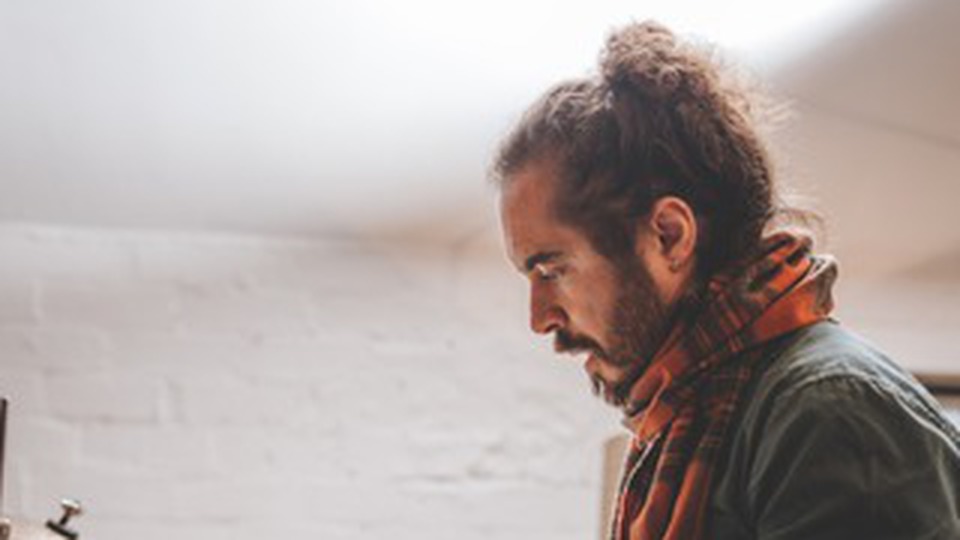
Interview with Conor McAuley, drummer of the band Córas Trio
The Northern Irish group Córas Trio will give three concerts in Romania. After appearing at the Tulip Jazz Festival in Pitești on May 8th, they will perform in Brașov at the Patria Hall of the local Philharmonic on May 9th, and on May 11th they will give a concert in the Small Hall of the Romanian Athenaeum, as part of the season organized there by UCIMR. For more information about Córas Trio, I conducted an interview with one of the band members, Conor McAuley.
Conor, first of all, please introduce the full band.
Córas Trio consists of Kevin McCullagh (violin and electronic effects), Paddy McKeown (guitar and electronic effects), and myself, Conor McAuley (drums and percussion).
How would you briefly describe your music? It's not exactly what audiences would normally expect from an Irish folk band.
Córas Trio's music is completely rooted in the Irish tradition. We take old Irish tunes and deconstruct them, using them as an open space for a three-way musical conversation in the form of free improvisation. We explore the emotion, the feeling of the original pieces, because the Irish tradition is so strong that we can take it apart, look inside it, and expand its expression, but everything we do musically remains connected to the original theme.
Since we are speaking for a jazz feature, let's talk about the jazz influence in your music. It can be clearly heard even in your drumming style.
Obviously, very often in our sets there is no fixed pulse or meter. I rely on the feeling of the moment, on the experience itself, so I prefer shifting rhythms-they are a more natural way of approaching improvisation. And because we are a trio, three is a special number and it gives each of us plenty of space to be a distinct voice. We are called Córas Trio, and in Irish "córas" means "system," because in our music we draw inspiration from different natural systems, such as the flow of fluids, especially water. Water has multiple dimensions, and we adopted that model in our musical conception. For example, I may play a fast rhythm while the guitarist plays much more slowly, and the violinist maintains the balance between us.
Are there other bands in Belfast with a similar musical approach?
Certainly in Belfast we are the only ones playing in this style, but across the island of Ireland there are other artists who approach tradition in similar ways, with openness toward improvisation and the integration of electronic effects. But as far as I know, through the way we develop our sound, we are a unique presence on the Irish scene.
Tell us a few details about your history. I understand you started as a duo with violin and drums.
Kevin and I began exploring the Irish tradition ten years ago because we both share a passion for free improvisation, electronic music, and Irish traditional music. Then we found Paddy, who studied fine arts and with whom we are a perfect musical match. At first we thought nobody would be interested in hearing us, but in recent years we've had concerts in Mexico, Paris, and at the London Jazz Festival. In the meantime, we released our debut album and we are now close to finishing the second one, which we hope will come out at the end of this year or perhaps at the beginning of next year.
What expectations do you have for the three concerts in Romania? The first one, in Pitești, will be outdoors at a jazz festival, while the other two will take place at the Brașov Philharmonic and the Romanian Athenaeum.
I think it will be interesting. Romanian audiences will probably identify similarities between our traditions, because both rely heavily on dance tunes. But because we improvise everything in concert, the mood of the audience directly influences us. So regardless of whether we are outdoors at a jazz festival or in concert halls, for us the process is the same, and when we step onto the stage we hope to share emotions with the audience as we journey through these traditional melodies in our own way.
Translated by Sorana Dumitrescu,
University of Bucharest, Faculty of Foreign Languages and Literatures, MTTLC, year II
Corrected by Silvia Petrescu


