



> Interviews
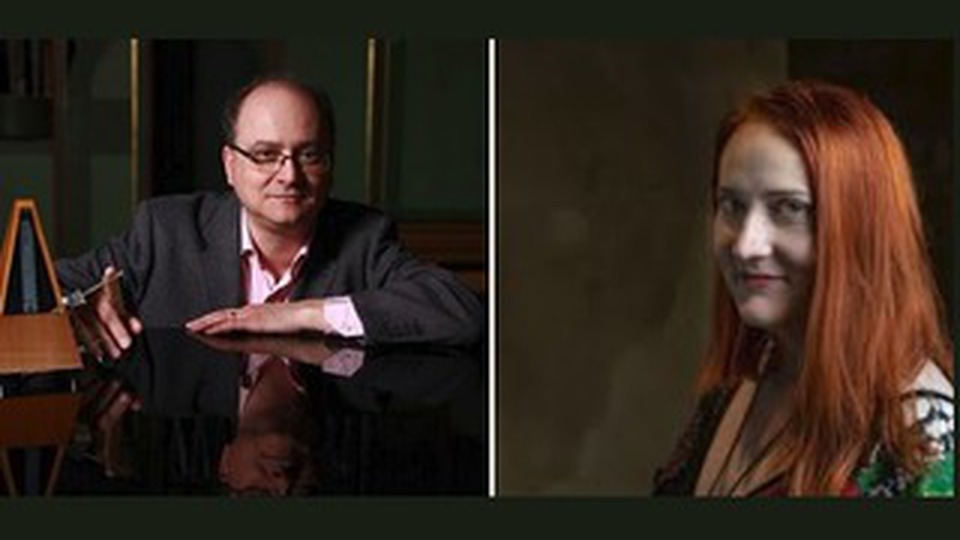
Composers Dan Dediu and Diana Rotaru – this week’s guests at Perpetuum mobile
World New Music Days will take place from May 23rd to May 31st-the theme of this edition is "Columna infinită" (The Endless Column), marking the 150th anniversary of Constantin Brâncuși's birth. The series of events is organized, in partnership with Artexim, by the Union of Composers and Musicologists of Romania, chaired by composer Dan Dediu, together with the Romanian National Section of the International Society for Contemporary Music, chaired by Diana Rotaru. The two composers are here with me in the Radio România Muzical studio. Good evening.
Dan Dediu: Good evening. Thank you for having us.
Diana Rotaru: Good evening.
Thank you for joining us. I'd like to start with a few words about this series of events in general. What should the audience know about this event?
Dan Dediu: I'll start. First, let me tell you a story. The Romanian section of the International Society for Contemporary Music was founded after the Revolution at the initiative of a group of composers led by Nicolae Brânduș, who worked tirelessly in the early 1990s to make this happen, with the support of the Composers' Union and its then-president, Adrian Iorgulescu, and together they organized an edition that took place for the first time in Romania in 1999, more than 80 years after the founding of this international contemporary music society, and it has not been held in Romania since. We are talking about a festival that is organized annually, each time in a different country. To organize this festival, you need to have a project, submit it, and have the other countries vote for that project. So that's what we did, Diana Rotaru and I, with the help of composer Irinel Anghel: we came up with a project, and we thought, "Look, 2026 is the Year of Brâncuși, and here's our chance to introduce the world to this great artist of visual modernism, who obviously has a significant influence on musical creation as well." That's when we chose this theme, "Columna infinită" (The Endless Column), in Romanian, no less, because, so to speak, everyone around the world can understand it, and the organizers were thrilled. We put together what I think was a very good project. Diana worked very hard on it, and last year, I remember it as if it were yesterday, it was March 4 when we presented it on Zoom to the entire community of contemporary composers worldwide, and they voted unanimously in favor of our project. So that's no small thing. At the time, we hoped we'd get a green light from all the major cultural institutions in Romania. That wasn't the case. We have to admit we had to really push a lot of institutions. This was not the case with the Radio Society, which embraced this project from the very beginning and which, simply through the close partnership it shares with the Union of Composers and Musicologists in organizing the "International Week of New Music" Festival every year, allowed us to succeed; so together we managed to convince other institutions as well, and now we have an impressive array of institutions involved, both media outlets and organizations that have come to support this festival. That's pretty much the backstory.
We won this project, and instead of the International Week of New Music, this year we are organizing the World New Music Days, with the theme "Columna infinită" (The Endless Column). This was followed by a call for scores; the selection process was rigorous, as over 400 works were submitted from all over the world.
Diana Rotaru: 480.
Dan Dediu: 480. So almost 500 works. Diana, Irinel, and I worked on this in November and December; we listened, and you can imagine, listening to 480 pieces isn't exactly easy, and at one point you feel like you're going crazy, but we had that resilience and we kept listening.
We hope that the selection we made is relevant, both aesthetically and geographically, because we have to say that since we were sending six scores from each country, at least one from each country had to be eliminated. We insisted that each concert include at least one piece of Romanian music, because if we're organizing it, it's only right that we also feature local works, at least to make them known, if not to impose them on others. And, very importantly, we selected a representative group of performers, because if this music isn't performed properly, then there's no point in performing it at all. But I think I've spoken long enough; I'll let Diana fill in the rest.
Diana Rotaru: I'd like to add that I'm a big fan of this festival; I've been fortunate enough to attend several times, both as a selected composer and as a delegate, and I have to tell you that this name, which may seem a bit pompous -the International Society for Contemporary Music-actually conceals a principle that I find very beautiful: the fact that there is room for everyone on the music scene, all cultures, all aesthetic perspectives and there is a kind of very well-conceived democracy within the ISCM, as well as, in fact, a great deal of empathy and friendship. That's how the society was born; it was the 1920s, and they tried to counterbalance the horror of war by coming together and listening to music together. So, not only is it an honor for us to organize this festival, but I think it's also a great joy, and I myself can't wait for it as a spectator.
What else I might add is the very specific format of this festival: you have to select one representative from each of the sections that submit entries, and you also include individual composers who aren't affiliated with any section and who submit music that is very often excellent. This provides a very, very wide diversity in the program, which other types of festivals may not have.
The programming is done somewhat regionally, people I know, people whose music I admire, but that's also how we've discovered all kinds of absolutely fabulous composers from very remote corners of the world whom we wouldn't have known about otherwise.
Dan Dediu: And whom we are introducing on this occasion.
Diana Rotaru: Exactly.
What exactly is on offer for the Bucharest audience at the end of this May? I know it involves a series of concerts, first and foremost.
Dan Dediu: Yes, Diana and I will be working closely together, and we'll complement each other. We have several orchestras. This was also one of our strengths: we were able to offer, as part of the festival, a partnership with the two Radio orchestras: the Radio Chamber Orchestra, conducted by Maestro Cristian Mandeal, and the National Radio Orchestra, conducted by Maestro Cristian Măcelaru. We have the "George Enescu" Philharmonic in Bucharest, conducted by Maestro Gabriel Bebeșelea. At the Romanian National Opera, we have Maestro Cristian Mandeal again, who will conduct the opening performance of the opera Revolution based on Caragiale by Adrian Iorgulescu. We have another orchestra closing the program, a string orchestra from the National University of Music in Bucharest, conducted by Bogdan Vodă, with soloist Ion Bogdan Ștefănescu. We have the "Profil" ensemble, conducted by Maestro Tiberiu Soare. We have two very important quartets from Romania, the "Arcadia" Quartet from Cluj and the "Gaudeamus" Quartet from Brașov. We have the "Couleurs" ensemble from Cluj, another contemporary music ensemble made up of young and, so to speak, spirited, very talented instrumentalists; the "Atem" ensemble from Timișoara, so we wanted to offer a spectrum of contemporary performance styles in this festival. We have the "Madrigal" Choir performing a marathon concert featuring 11 pieces, each from a different part of the world and a different cultural region. I believe we also have two electronic music concerts, three concerts, and one featuring video. We have experimental music with Irinel Angel, a presentation of Byzantine tradition with the "Psalmodia" Choir, led by Nicolae Gheorghiță, and a progressive rock concert with "Opening Theory." At the Brâncoveanu Palaces in Mogoșoaia, there is an entire day dedicated to contemporary music with the "Larson" Trio and, on the other hand, a recital by Ion Bogdan Ștefănescu. We have a recital by Adriana Maier and Diana Moș at Romanian Youth, featuring piano and violin. Also, Emil Vișenescu on clarinet and Adriana Maier, another clarinet and piano recital. It's a very rich program.
Diana Rotaru: We also have a cimbalom, so there will be contemporary cimbalom music. Cătălin Răducanu, who is also a phenomenal pianist, will be performing with Live Electronics.
Dan Dediu: There is a wide variety of performances and performers who, simply by being there, draw large crowds. As you can see, these are all big names we've selected ourselves.
Diana Rotaru: In addition to the concerts, there is a symposium organized by Ms. Valentina Sandu-Dediu dedicated to the two honorees, György Kurtág and Anatol Vieru, who are celebrating their centenary.
Dan Dediu: The two great composers the Hungarian composer György Kurtág and the Romanian composer Anatol Vieru have already met. In fact, I believe there is even a piece that Kurtág dedicated to Vieru. It's sensational.
Since we were talking earlier about young composers, I'd like to return to that selection of scores you mentioned earlier; you've narrowed down the 480 works to just 70. I'd like to know, what do these 70 works offer the audience? What should we, the audience, expect?
Dan Dediu: What I can tell you is that contemporary music today is extremely diverse. It no longer follows a single mainstream, so to speak, but is divided in a more rhizomatic way, I would say. There is no longer an aesthetic hierarchy, but rather multiple centers of aesthetic power that engage in dialogue, which is again a very important thing, and I believe an important aspect of this festival is that nearly 80% of the music performed will be international. Whereas during the International Week of New Music, very often, we have 60% and almost 70% Romanian works to encourage local creation, to motivate composers to write, now we have a festival where we import a great deal, because we are becoming a global hub, we are becoming the center of the world in terms of contemporary music in this festival.
Over these nine days, Bucharest will be the venue for defining what contemporary music is, especially since there will also be four general assemblies of representatives from this international contemporary music society.
Perhaps it wouldn't be a bad idea to talk about these general assemblies as well, because I'm sure they could spark the public's curiosity about this festival. I wouldn't want to forget to ask you about the Young Composers Award.
Diana Rotaru: Yes. Every year, this award is organized to essentially launch an international career; it offers an international career path to the young composer, aged 35 or younger, who receives it. This year, I believe we have 18 young composers under the age of 35, performing in all kinds of concerts. I must mention the composer from Serbia, who has an absolutely superb piece on Friday, conducted by Maestro Măcelaru, and a young Ukrainian composer, who also has an absolutely sensational piece with the Chamber Orchestra. We can't wait to see which of the 18 will win this prize, judged by an international jury, which will also result in a commission from the ISCM. Speaking of commissions, this year we're featuring two commissioned pieces that couldn't be performed due to the pandemic. These are a young woman from Estonia, Madli Marje Sink, and Samuel Hvozdík from Slovakia, who are incredibly lucky, because she wrote for the "Arcadia" Quartet, one of the best quartets in Europe, and Samuel wrote a piece for Live Electronics and the "Madrigal" Choir. They are very lucky, and so are we, because we'll get to hear them.
Of course. Let's talk a little about these general assemblies.
Dan Dediu: This organization holds annual general assemblies and, just like any other general assembly, they discuss a large number of reports, of course. What's important is that there is even a publication in which the musical life of Romania will be featured across several pages, in English, which is a huge deal, because this yearbook itself will circulate everywhere, from New Zealand to the Faroe Islands, where this festival was held two years ago, from Portugal, where it was held last year, and all the way to China, where it will be held in the coming years. It is an extraordinary opportunity to bring Romanian music to the forefront, what it was, what it is, and this will also influence what it will be. I can tell you, I don't know if in writing, but I can say this: in the most optimistic scenario, this festival will no longer be organized in Romania for the next 20 years. In the most optimistic scenario. So, let's take the bull by the horns and come to this festival, because you won't have this opportunity again. And this isn't just some kind of cheap promotion. It truly is the reality.
I am convinced this is a unique opportunity, especially given the current circumstances. Mr. Dediu, Ms. Rotaru, thank you very much for joining us in the Radio România Muzical studio, and best of luck at the festival.
Translated by Miruna-Andreea Vartic,
University of Bucharest, Faculty of Foreign Languages and Literatures, MTTLC, year II
Corrected by Silvia Petrescu


