



> Interviews
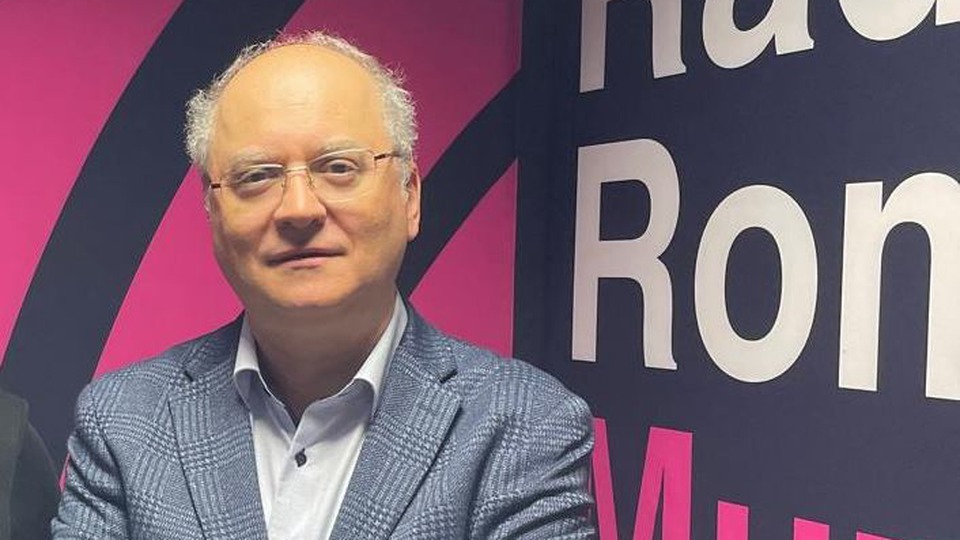
Interview with composer Dan Dediu
On Wednesday, 28th of October 2026, starting from 7PM, The Radio Chamber Orchestra will present a concert at the Radio Hall in Bucharest that blends Romanian creation with Spanish sounds, under the direction of conductor Mihnea Ignat. The program opens with the premiere of the work "Funambulia" by Dan Dediu. We will find more about the story of this creation and its sonic universe from the conversation Ioana Țintea had with composer Dan Dediu.
Mister Dan Dediu, in the description of the work provided in the press release I read, you mentioned a kaleidoscopic structure, a carnivalesque melody and an acrobatic orchestration. How did the idea for this piece, Funambulia, come about? What is the story behind this creation?
The creation appeared quite unexpectedly because Mihnea Ignat, the conductor of the concert, demanded a piece suitable for a chamber orchestra ensemble. I offered him a few of my works and suddenly, struck by inspiration, he asked me whether I wanted to compose a new piece. And since I was not going to turn down such an offer, I immediately agreed to do it. Afterwards, when I arrived home at my compositional "construction site", I realized that I could create some sort of overture, a suite of musical tableaux, using the music that I had already written for the opera "A Stormy Night", based on Ion Luca Caragiale's work. I still have not finished the opera, but I am almost there. The orchestration will follow and it will probably take long until it reaches the stage, but here I am with the opportunity and idea to use some of my themes from my work "A Stormy Night" to generate a completely new architectural turn, an entirely different, architectonic form, in the manner of an overture.
You have described Funambulia as a permanent state of proximity to the abyss, to danger and death. How have you managed to transcribe this existential tension into the musical language of the work?
I do not wish to reveal the whole secret just yet. There is an instrument belonging to the percussion part that has the gift of uplifting us and empowering us, and the music I have used is also quite evocative, because it truly represents someone that is walking on a tightrope. Actually, it is about all of us, because life is like walking on a tightrope. We are always walking along a tightrope between the joy of reaching a point and not falling, and the fear of abyss. This kind of music resonates with the listener, you can enjoy listening to it, it is accessible music, and I hope it will be successful.
Funambulia's world premiere will be performed by The Radio Chamber Orchestra under the baton of conductor Mihnea Ignat, as you have mentioned before. How does a composer feel when their music is performed for the first time before an audience?
One feels triumphant, of course, because it is a personal achievement to have your work performed by an orchestra. At the same time, it is a personal milestone that, certainly, one must approach with a degree of restraint and must be ready to learn from mistakes. Every time one of my orchestral pieces, concertos, or even a chamber music work is being performed, I listen very carefully; I am maybe my own worst critic, because I know what I intended to create and I am not always sure that the result matches my original vision and when that happens, I can learn a lot from my mistakes, sometimes I revisit my work and make changes if there are any obvious issues. That is why a premiere is always a leap into the void, and one can only hope that it won't be a fatal one.
As you have mentioned in your work, the funambulist is the one that walks on the tightrope, hanging between heaven and earth and they, consequently, take a risk, is that right?
Indeed.
In a way the composer needs to take risks to find their own musical language. From your perspective of composer and professor, how do you encourage young composers to discover their own voices and have the courage to explore new musical directions?
I encourage them to use role models that inspire them and, of course, each one likes something else and when that happens, I guide them by telling them to use that role model. When you learn to do what they do, we move forward and take another person as a role model because, in my opinion, no one can find their own voice if they are not guided by certain role models and if they don't reject some of them. So, everyone comes from a different background, has different readings, a different mindset, and wants to express something else; and I tell them that what you are capable of expressing, only you can do it. Neither I nor anyone else can express it, so envy is pointless, because it is what it is; you will express what you are capable of expressing. You just need to find technical and expressive means to do so.
Translated by Maria Alexandra Pletea,
University of Bucharest, Faculty of Foreign Languages and Literatures, MTTLC, year I
Corrected by Silvia Petrescu


