


> Interviews
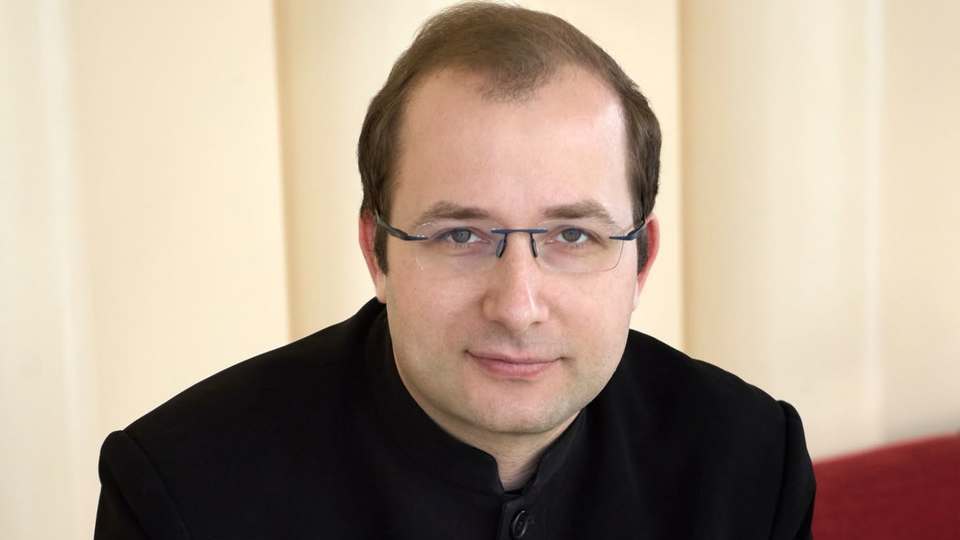
Interview with conductor Radu Paponiu
Radio România is celebrating 98 years of activity today, October 30th, 2026, through a concert held by the National Radio Orchestra at the Radio Room, under the baton of music director of the youth orchestra of the prestigious San Francisco Symphony and conductor Radu Paponiu. The program includes Three Romanian Dances by Theodor Rogalski, Piano Concerto No. 2 in D minor by Felix Mendelsssohn, featuring Cadmiel Boțac as soloist, and Rachmaninoff's Symphonic Dances.
You are conducting the Radio Romania anniversary concert, on which occasion you, alongside the National Radio Orchestra, are presenting Three Romanian Dances by Theodor Rogalski, Piano Concerto No. 2 in D minor by Felix Mendelssohn, featuring Cadmiel Boțac as soloist, and Rachmaninoff's Symphonic dances. How did you choose the program for this festive concert?
For this festive event I have chosen a program whose main theme was dance and we are starting with Three extremely beautiful Romanian Dances by Theodor Rogalski, who is also a very important figure in the National Radio Orchestra's history, while in the second part of the concert we have Rachmaninoff's Symphonic dances. It is Rachmaninoff's last symphonic work that he has written while living in the United States, and the fascinating thing about it is that it contains rhythms considered new for the year 1940, but at the same time it also retains Rachmaninoff's extremely beautiful romantic melodies. And it is a work that has so much color and truly outstanding orchestration. Also, in the first part we have a special guest, the young and talented pianist Cadmiel Boțac; this will mark my first collaboration with him.
You have been living in the United States of America for many years now. What memories connect you to Radio România?
Returning to Bucharest and the National Radio Orchestra is always extremely special for me because it feels as if I am returning home - I was born in Drobeta Turnu-Severin, but I moved to Bucharest from the seventh through the twelfth grade to take violin lessons at the George Enescu High school - because I was always attending the National Radio Orchestra's Friday evening concerts. So, it is always a very emotional experience for me to return to Bucharest and to the National Radio Orchestra.
How would you describe your collaboration with the National Radio Orchestra?
Ever since my first appearance here in the 2023-2024 season, it has been a pleasure to collaborate with the Radio orchestra and I am very happy to be here again, continuing our collaboration.
You are the music director of the Youth Orchestra of the prestigious San Francisco Symphony. What impresses you most about working with a youth ensemble?
I have an amazing experience working with the Youth Orchestra of the San Francisco Symphony, a very important historical ensemble. For me, the making of music alongside youth has always been truly special because, on countless occasions, it is their first experience working with these masterpieces of the symphonic repertoire.
I also remember that when I was in high school, and even before that, having these experiences of singing a Brahms symphony or a Rachmaninoff symphony for the first time, and I believe that it is a very important moment in a young musician's life; so, for me, as a conductor, this represents a big responsibility at every rehearsal or concert.
Moreover, it is so beautiful to be in a youth orchestra and there are so many life lessons you can learn from it, not only music lessons; you can learn about responsibility and teamwork that can be used in any field, not only in the musical one. So for me, being part of a youth orchestra and working with one is something completely special.
You are spending most of your career in the United States of America, but you are also familiar with the concert scene in Romania. Could you compare the two musical scenes?
For me, music is a completely universal realm, and every place has its own wonderful traditions which I enjoy a lot; I like being able to work with different orchestras and, as a conductor, to be able to adjust to situations, because in music and in working with an orchestra, there persists this idea of collaborating with the ones you are making music with, which means that every orchestra and every performance becomes completely unique. Comparisons are merely interpretative and beautiful, meaning that every place has its own beauty.
What would a greeting addressed to the Radio sound like?
First and foremost, Happy Birthday! And may you have an equally bright future! As for music lovers, may they enjoy many more wonderful concerts at the Radio!
Translated by Maria Alexandra Pletea,
University of Bucharest, Faculty of Foreign Languages and Literatures, MTTLC, year I
Corrected by Silvia Petrescu


