



> Interviews
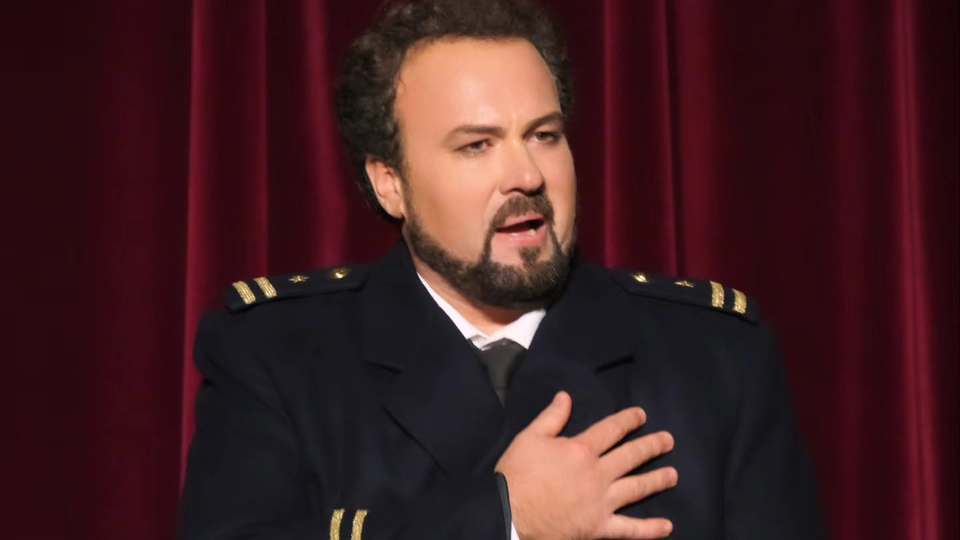
Interview with tenor Ștefan Pop
Mr. Ștefan Pop, you are returning to the stage of the Bucharest National Opera for a performance of Puccini's Madama Butterfly, a tribute production marking the centenary of the birth of soprano Teodora Lucaciu.
As always, it is a blessing for me to be able to return home to Bucharest, you know it's my favorite stage. I can't wait to arrive and delight the Bucharest audience with Puccini; he has been a part of my life for over 15 years now. In this recent phase of my career, it's been all about Puccini, people often say he has left a distinct mark on me. I believe that we Romanians, and I like to put it this way, have a certain "tear" in our voices that truly stands out. So, after five performances of "Madama Butterfly" at the Staatsoper Berlin, things have worked out perfectly, allowing me to come and sing a performance here in Bucharest as well. "Non vedo l'ora!", as the Italians say, I simply can't wait!
After that, I'm heading straight to Naples, where I'll be making my debut in Giuseppe Verdi's "Luisa Miller", taking on a new role, Rodolfo, under the baton of Maestro Daniel Oren. In February, as everyone already knows, I'll be celebrating my 40th birthday, on February 16th, to be exact, while performing in "La bohème" at Teatro alla Scala, once again with Maestro Daniel Oren. A busy spring lies ahead, too, as I'll be making another role debut, this time as Enzo Grimaldo at the Royal Opera House. So, if I hadn't come to Bucharest now, I wouldn't have been able to make it here at all.
The role of Pinkerton demands a great deal of lyricism. I'm thinking, for instance, of Addio, fiorito asil. It also contains moments that require significant power, particularly in the duet, Vogliatemi bene, I would say. What does this role mean for your voice at this stage? Where does your voice feel most comfortable now, and where do you perhaps need to be more careful?
I could say that, finally, I can truly call myself a full-fledged Pinkerton, because back in 2017, if I'm not mistaken, when I made my debut at the Teatro Carlo Felice in Genoa, I likely lacked the same vocal maturity, as well as what we might call acting maturity.
You've hit the nail on the head. The difficulty arises, in particular, during the duet, which concludes with a high C, not exactly the easiest note for a tenor. But that's not the hardest part, it's not the high C itself, but the duet as a whole; in fact, I've always liked to describe it as an aria, or perhaps two arias combined, since it lasts ten minutes, and the tenor is singing in the high register the entire time.
Furthermore, the critics, most recently in Berlin, have remarked that it has been a very long time since they've seen a tenor whose performance truly conveys genuine remorse for his actions, specifically in Addio, fiorito asil, which you just mentioned.
The Aria of Remorse
Exactly. I think that's where the difficulty lies. Most tenors sing it, they interpret it as best they can, but in Addio, fiorito asil, you really need to convey that genuine sense of regret. Even though he returns to Japan after three years with la vera moglia americana, the situation is complex. Personally, being a father myself helps me immensely. I'm living this experience fully. The sacrifice required for our career, which I'd call almost inhuman, is incredibly difficult for me, especially being so far away from my daughters. So, you can imagine that every time I sing Addio, fiorito asil, I'm practically on the verge of tears. The presence of the child on stage, it's inevitable, has an absolute, profound effect.
It might seem like a simple role, but it's anything but simple, because in the first act, which lasts 50 minutes, I'm essentially singing non-stop. And, as we know, Puccini's orchestration demands a certain caliber, and, I would add, a certain level of experience. My advantage is that I bring with me a substantial background in the bel canto tradition from Italy, along with a solid technique, also acquired in Italy. I've studied a great deal, and I still do; just this summer, I spent a month in Italy working on two new roles. I truly believe that nothing can be achieved without study, regardless of the profession.
Who are you studying with now, if I may ask?
Ever since my late vocal coach, Bonaldo Giaiotti, may he rest in peace, passed away, I have been studying with a pianist from Parma whom I met in 2015, Simone Savina. He has truly changed my life; you see, the way you speak, you have to think, speak, and act like an Italian, in other words, you have to be, or rather become, Italian. In fact, many people, critics included, especially in Italy, say that I am Italian, and that my pronunciation is even better than that of a native Italian.
When you sing opera, if you don't manage to spend several years living in Italy... Well, I've been fortunate enough to have, I believe, 23 roles under my belt, and with the two I'm adding this year, that brings the total to 25. I actually debuted all of them in Italy. So, out of these 25 roles, two in French, and the rest in Italian, mostly bel canto, Verdi, and Puccini, I'm beginning to feel Italian myself.
You are, in fact, known as a tenore italiano, it's true.
Exactly! Wherever I go, they call me Stefano!
Here in Bucharest, your partner is the soprano Marta Sandu Ofrim, in the title role. How would you describe working with her? She is an artist with a great deal of vocal and stage experience, who made her debut as Butterfly relatively recently, I was actually in the audience for that debut.
I can't wait. For me, every Butterfly I sing is a challenge, it's always a challenge, because, you know… the character of Pinkerton, he has to inspire you. I see him a bit like the Duke of Mantua, a role I've performed 150 times. He has to inspire you, musically, in terms of sensitivity, and in how you relate to the feminine perspective. That's very important.
In Berlin, I performed with Aleksandra Kurzak. She portrays Butterfly so well, and we went on to do two other productions… There are always differences, but I'm really looking forward to us singing together. I think it will be a joy for everyone. And as for being back home, since I visit so rarely, I can't wait to return, and when I do, I lay my soul bare.
Translated by Ioana-Cristina Bolbose,
University of Bucharest, Faculty of Foreign Languages and Literatures, MTTLC, year I
Corrected by Silvia Petrescu


