


> Interviews
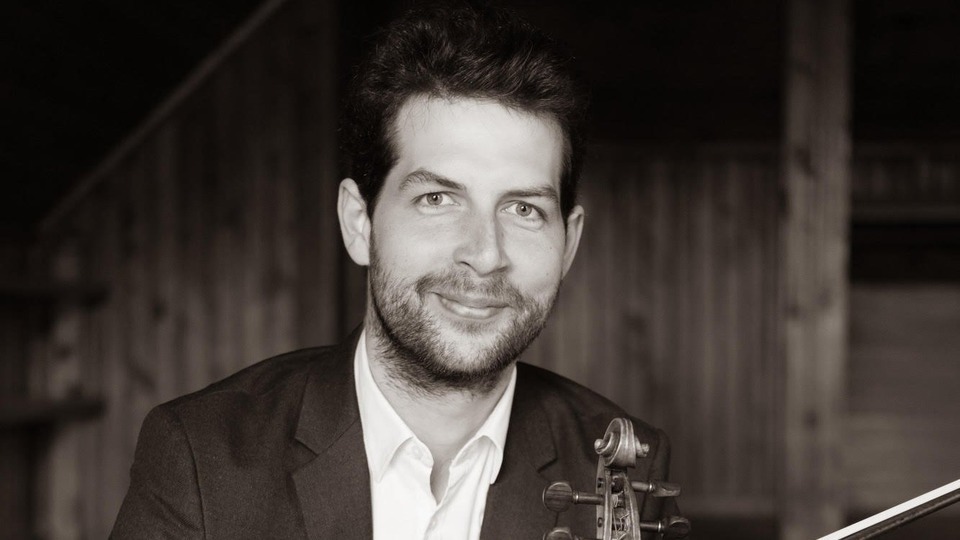
Interview with violinist Valentin Șerban
Violinist Valentin Șerban, artist-in-residence at the George Enescu Philharmonic, returns on Wednesday, October 28th, 2026, at 7:00 PM, to the stage of the Romanian Athenaeum, in a chamber concert alongside pianist Mihai Diaconescu and the Arcadia Quartet. During the same period, Valentin Șerban and Mihai Diaconescu are preparing, at the initiative of Radio România Muzical, a discographic project dedicated to the complete sonatas for Violin and Piano by Ludwig van Beethoven, to be presented in 2027. We learn more information from violinist Valentin Șerban in an interview conducted by Cristina Cîrjan.
On Wednesday, October 28th, you will perform alongside pianist Mihai Diaconescu and the Arcadia Quartet on the stage of the Romanian Athenaeum, as part of the George Enescu Philharmonic season, an institution where you are also artist in residence. What makes this event special?
We tried to approach a more unusual repertoire, one that is played extremely rarely, especially the Concerto in D major for Piano, Violin and String Quartet by Ernest Chausson. I don't know if it's ever been performed, at least in Bucharest. We want to take on the most serious music, as Iosif Sava used to say, the "grand music," because there's a need for it. These are times in which all sorts of projects exist, all sorts of simple catchy ideas, but less and less serious music, especially chamber music.
Alongside pianist Mihai Diaconescu, you are also making a series of special recordings at the Radio Hall during this period, dedicated to the complete sonatas for violin and piano by Ludwig van Beethoven. How did the idea for this discographic project come about?
First of all, we've had, for some time, the desire to play these sonatas. And we thought it's a good opportunity to release the recordings of the 10 sonatas on CD next year, being an anniversary year for Ludwig van Beethoven.
How important is it for a musician with a rich concert history to also have the opportunity to make recordings for a discographic project? What does the studio experience offer that is different from the direct encounter with the audience?
The recording process is totally different from that of the stage, from a concert. I would say the artistic process is slightly set aside. It is a more "mechanical" process in which, of course, since these are recordings, everything has to come out right. In a concert, details like playing in parallel, perfectly together are almost unimportant, because the artistic act takes precedence. Recordings are something special. Of course, for any artist it is necessary to make recordings, first of all for the sake of visibility. As an artist, you need to appear on the internet, on the various platforms where people listen to music, so you need to be visible. In addition, there is personal ambition, each with their own dreams and desires.
You have already completed the first stage of recording, in which you tackled three of the Beethoven sonatas. How did this first experience go, and how did the collaboration with the Radio România team unfold?
It actually went surprisingly smoothly, because, as many people probably know, or at least those who have recorded, it can be a very meticulous, stressful and lengthy process. But we still managed to record three sonatas in three days, which is formidable. The team helped us a lot. It's clear they are professional, experienced, very friendly people, so we had a very good collaboration, and the same is expected in the future.
Beethoven's sonatas for Violin and Piano have been approached by numerous generations of musicians and have also been captured in quite a few reference recordings. What do you aim to bring through your own interpretation, and what would you like listeners to discover in your version?
We try to steer clear of trends and traditions. There are many reasons why models emerge, but very often artistic freedom is restricted because of fixed ideas. And we try to start the process from zero. We have read everything that exists in documented and historical form about how music was played, about how Beethoven played, about how those around Beethoven played, in the musical world of that time. This is what we hope will be the result: an original vision, free of traditions and preconceived ideas.
Translated by Gabriela Mara Puiu,
University of Bucharest, Faculty of Foreign Languages and Literatures, MTTLC, year I
Corrected by Silvia Petrescu


