



> Interviews
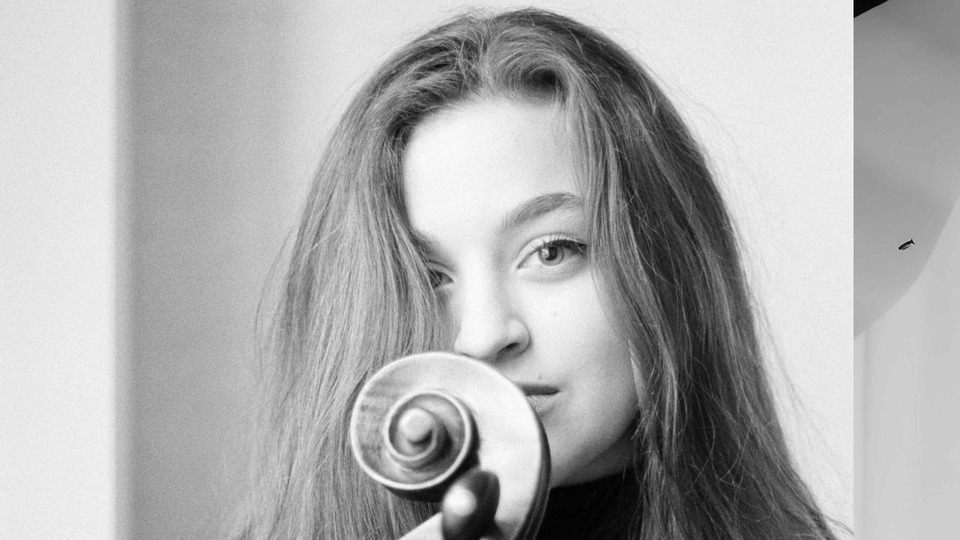
Interview with cellist Sofia Blându
Cellist Sofia Blându performs as soloist alongside the Radio Chamber Orchestra, conducted by Christian Câșleanu, in the concert on November 11th 2026. Alongside Sofia Blându, winner of the "Heirs of Musical Romania" scholarship in 2025, the Radio Hall concert brings to the stage guitarist Dragoș Ilie and pianist Dominik Ilisz, former winners of the aforementioned program. In the interview with Ana Sireteanu, cellist Sofia Blându talks about the importance of the "Heirs of Musical Romania" scholarship and other experiences that shaped her professional journey.
Sofia Blându, you started studying music in Romania and now you are continuing your professional development in Germany. Please tell us more about your studies and the experiences that shaped you.
I was born in Iași to a family of musicians. I started studying the cello at seven years old, then at 14 I moved to Bucharest, on the recommendation of Marin Cazacu, to study with professor Mircea Marian and, of course, with Marin Cazacu. Afterwards, when I was 19-20 years old, I moved to Berlin to continue my studies at the University of Arts in professor Konstantin Heidrich's class.
You participated in several important international competitions, and you were a scholar of the SoNoRo Interferences program for five years. How did these experiences shape your development and how did they bring you closer to chamber music?
I'd have to say that through these masterclasses, especially the ones for chamber music, my general appetite for music was awakened. I had the opportunity to meet international professors, these encounters contributing to my decision to travel abroad and continue my studies there.
In 2025, you received the "Heirs of Musical Romania" scholarship and, on November 11th you are performing as soloist alongside the Radio Chamber Orchestra in a concert that brings three receivers of the mentioned grant on the Radio Hall stage. Have you ever performed alongside the Radio Chamber Orchestra before? What does this performance mean to you?
For me, it's my debut with the Chamber Orchestra. I am honored to return to Bucharest, as this city represents a very important step in my evolution as a cellist and so much more. Prior colleagues of mine are part of the orchestra, as well as Mircea Marian, who was my teacher, and I am very excited to come back.
How do you feel on stage as a soloist?
As a soloist, there is a sense of calm that sets in once I step on stage, after the tumultuous emotions beforehand. For the concert on November 11th, I'm performing a famous piece from the cello repertoire, Concert No. 1 in C major, by Joseph Haydn. First and foremost, I must thank Cristina Comandașu and also the Rotary Pipera Club for organizing this event and the passion they have for helping young musicians, who are, în every sense, the present and future heirs of Romanian music.
What's next for you within the "Heirs of Musical Romania" project?
Personally, the scholarship was very important for my studies and also for participating in different projects and masterclasses, like the famous masterclasses in Kronberg, followed by other auditions, like Villa Musica and so on.
Thanks to this scholarship, I have the opportunity to tour four important cities in Romania this February, alongside Belgian-British pianist Nicolas Absalom. The recitals contain a pretty vast repertoire, with opera nuances. We begin the program with Felix Mendelssohn's Cello Sonata No. 2, a very dynamic work. Next, we have Ludwig van Beethoven's seven variations on a theme from the duet between Pamina and Papageno, from Mozart's The Magic Flute. In the second half, we have a cello and piano sonata by Debussy, ending the evening with a strongly opera-like piece that is also a bit bel canto, Une larme by Rossini.
Translated by Anna-Maria Tudosie,
University of Bucharest, Faculty of Foreign Languages and Literatures, MTTLC, year I
Corrected by Silvia Petrescu


