


> Interviews
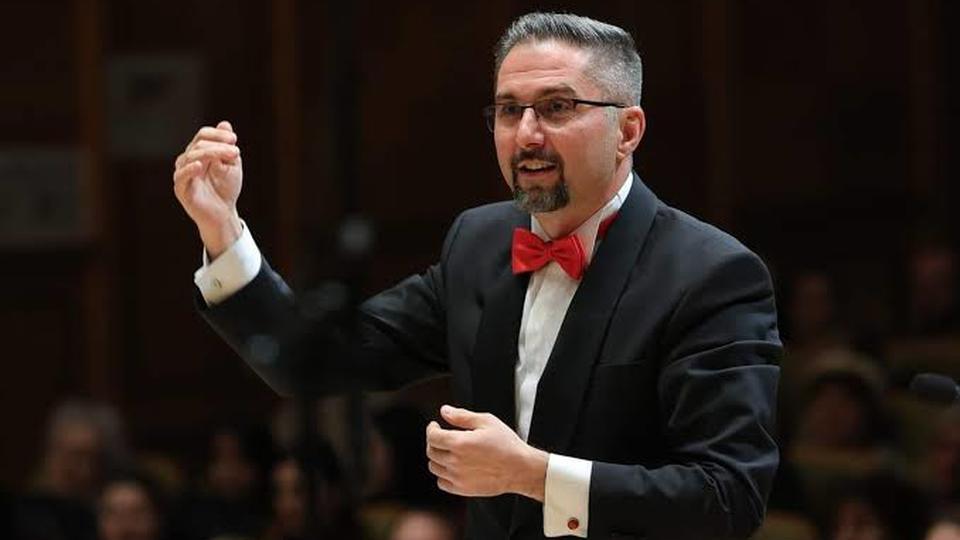
Interview with Ciprian Țuțu, conductor of Radio Academic Choir
The Radio Academic Choir will perform in the "Brahms - love, time, destiny" concert on Thursday, October 29th at Sala Radio. We find out more about this concert and future appearances of this ensemble from Ciprian Țuțu, conductor of the Radio Academic Choir, who spoke with Ana Sireteanu.
Mister Ciprian Țuțu, at the opening of the 2026-2027 season, on October 16th, the Radio Academic Choir performed alongside the Radio National Orchestra. Next, on October 29th, the Radio Academic Choir will make its first appearance in a concert titled "Brahms - live, time, destiny". Why did you choose to dedicate this performance to the music of Brahms?
First of all, I would like to note, with big emotion and great joy alike, that this esteemed, long-standing ensemble is still present on the posters and on the stage of Sala Radio during such beautiful events that fill the audience, much like the opening of this season. The season opened with Tchaikovsky's 1812 Overture, in a version with choir, which we all enjoyed, a short but intense choir moment, and an extraordinary season opening.
Naturally, at the start of this season, the Academic Choir has dedicated the majority of rehearsal time to preparing for this Brahms concert. While in recent years we have accustomed the Academic Choir's audience to thematic concerts usually dedicated to anniversaries, commemorations, or, anyhow, a blend of various themes, this time we have chosen to present the creation of a single composer in a cohesive manner: a musical portrait of Brahms. Many probably associate Brahms with symphonic creation first and miniature piano works second, and as for the choir's involvement, most of the times it is invited to sing the masterpiece A German Requiem. However, what I want to highlight during this concert is that in Brahms' creation there are actually many a cappella choral pieces, as Brahms, throughout his career, also served as a choral conductor for several ensembles, and thus his interest in this form of multi-voiced expression found various modes of realization.
For this performance I have chosen four pieces, not only 3 Songs, Op. 42, but also the final a cappella opus, 5 Songs, Op.104. I have also chosen to introduce a piece that is usually presented in its vocal-symphonic version, Song of the Fates, and we will use the reduction by Brahms himself and show the audience this piece with piano accompaniment. And, last but not least, we will finish on an optimistic and relaxed note, by presenting the 18 pieces that make up Opus 52, Liebeslieder-Walzer. So, a program as diverse as possible, that encompasses and captures a wide range of facets of the composer's expression: from his work around the age of 30, in Opus 4, to the composer who, in his final a cappella cycle, looks back with melancholy upon the life he has lived.
How does Brahms' choral work fit into the German choral music directions and what are the performing particularities of this music?
First of all, we begin with the premise that Brahms is a keen connoisseur of the musical language of his predecessors, as we often see polyphonic passages and sonorities that allude to the idiom and expressive style of the Renaissance composers. On another note, a phenomenon exists with amateur choirs, as we call them today, a bit vulgar, these beer choirs and evening hangouts choirs, but actually Brahms transcends this level of expression, although he also has such pieces intended for amateur ensembles. However, through these chosen Opuses, Brahms demonstrates artistry and consistency, the majority of them are written for a six-person choir.
Also, a specific challenge for us, as a Latin people, is expressing ourselves is a language such as German, which has its particularities. From this point of view, I believe that, even if we are approaching a romantic composer, the music is really beautiful, pleasant, very consistent, and full of meaning. This is exactly the challenge we faced and which we hope to bring to a successful conclusion, to the satisfaction of the audience, be it listening from home or watching from the audience.
What is next for the choir?
After this performance, there are three other events. That is, the participation of the Radio Academic Choir, alongside the Radio Children Choir, in the third movement of Enescu's Symphony No. 3, on November 13th, with the Radio National Orchestra, under the baton of maestro Gabriel Bebeșelea. Moreover, we have the pleasure of reuniting with the Radio Chamber Orchestra on November 16th, when we will be presenting Saint-Saëns' Christmas Oratorio. We are proud to have three members of the Radio Academic Choir perform as soloists. And last but not least, another concert exclusively for the choir, a Christmas carol concert on December 10th.
Translated by Cătălina Badea,
University of Bucharest, Faculty of Foreign Languages and Literatures, MTTLC, year I
Corrected by Silvia Petrescu


