



> Interviews
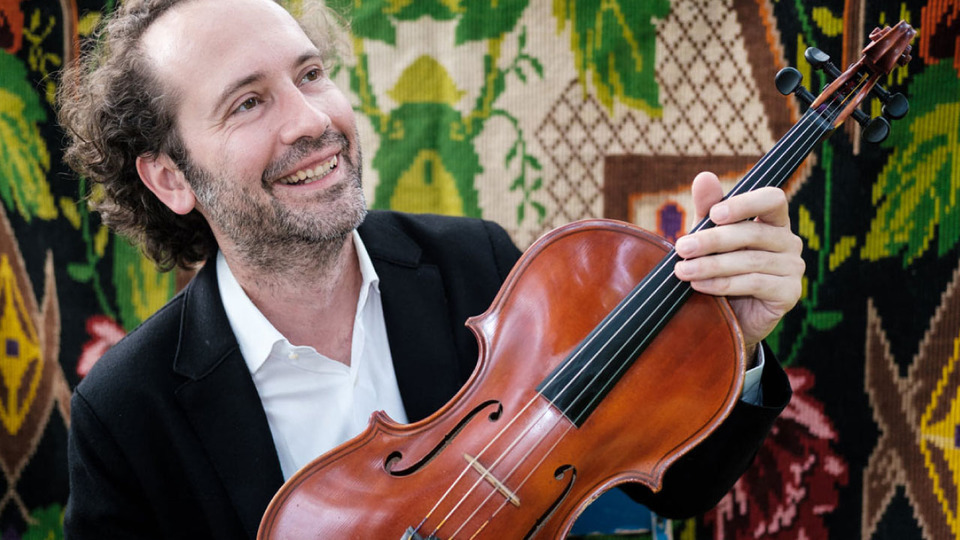
Interview with violist Răzvan Popovici, executive director of the SoNoRo Festival
"Melodia infinită" (The Infinite Melody) is the title of the 21st edition's programme of the SoNoRo Festival, which is taking place between October 30th and November 15th in Bucharest and Cluj-Napoca. We will find out more about this programme from Răzvan Popovici, the executive director of the festival:
The XXI-st edition of the SoNoRo Festival starts in Bucharest on the 30th of October. This year's theme is called "Melodia Infinită" (The Infinite Melody), inspired by Wagner. What made you choose this theme and how is it reflected in the festival's programme?
As you know, the festival's artistic director, Diana Ketler, always strives to surprise the audience and find a theme that isn't only of particular interest to us, but also to audiences in Bucharest and Cluj. She grew up in Riga, practically within its opera house, with a father who was a great bass-baritone and a mother who was a choral conductor and voice teacher. So she was, in a sense, very close to the world of opera. I was also very pleased that we chose this subject. Wagner was a highly controversial figure, yet at the same time, an extremely fascinating and captivating one, a revolutionary who, for some, was even an influencer of his time.
And I am happy we managed to put together an extraordinary programme, one that is unlike anything we've presented before during these 21 editions of the SoNoRo Festival. It is a very sophisticated programme, very captivating, I would say. We managed to grow closer to Wagner in many unusual ways. The audience will discover-or perhaps they already know-that Wagner wrote only two works for the chamber music repertoire: the Wesendonck Lieder and the Siegfried Idyll. Beyond that, through this chamber music, we have managed to create, or so I believe, a portrait of Wagner, presented, naturally, in dialogue with Liszt, Brahms, Mozart, Korngold, and many other composers who were deeply influenced by him.
Furthermore, let us not overlook the fascinating aspects of this work by Wagner, which are, in fact, cinematic, and, naturally, we explore chamber music from this perspective as well. If the audience takes a moment to look into and unravel the program, I believe they will encounter, much like at every SoNoRo edition, a wealth of surprises and discoveries.
Year after year, artists from the international stage return to the SoNoRo Festival, while new artists also join the fold. What can you tell us about the artists featured in this edition?
As you mentioned, there are many artists whom SoNoRo values just as highly as the audiences in Bucharest and Cluj do. If I were to name just a few: Valentin Răduțiu, Mihaela Martin, Barnabas Kelemen, Erik Schumann, Justus Grimm, Jan-Erik Gustafsson, Diana Ketler-myself, of course-and several others.
But we also have, of course, some new faces, such as the Russian cellist Alexey Stadler, a professor at the Hamburg Conservatory; the great Canadian pianist Louis Lortie, who returns to join us (he has only been to Bucharest once before, about 10 years ago, I believe); the distinguished pianist Eldar Nebolsin, based in Berlin, who joins us for the first time; Konstantin Lifschitz, who returns to the concert stage in Cluj after many years; the violists Sara McElravy and Mathis Rochat-with the former performing in Bucharest and the latter in Cluj; and the Hungarian violinist Julia Pusker, one of the most prominent violinists of the moment.
Of course, Boris Brovtsyn and Anna-Liisa Bezrodny are returning. And, I am very pleased to add, so is Ksenia Parkhatskaya, along with her ensemble. This great Russian dancer, who has lived in Barcelona for several decades, will present a unique concert at the Bragadiru Palace on the second evening of SoNoRo, featuring a blend of dance, jazz, and more.
I imagine it must be very difficult, but do you think you could pick out a few key highlights of this year's festival?
Exactly! It is difficult. As always, SoNoRo is designed as a puzzle. In fact, it is a labyrinth, and the more concerts you attend, the better you come to understand what we intended to achieve with this theme, in this instance, the Wagnerian one.
I would particularly recommend the two major concerts at the Athenaeum, one of which is titled The War of the Romantics. We all know that, at the time, the European musical landscape was divided between the followers of Brahms and those of Wagner, who harbored intense animosity toward one another. In this concert, we will explore the differences between them, while also highlighting the fact that, in reality, they shared a great deal in common. The program will feature works by Mahler, Wagner, Strauss, Scriabin, and Brahms.
Then, the second concert at the Athenaeum, titled Cosmic Chord, is dedicated to the most significant chord in the history of music: the "Tristan chord," from the well-known opera "Tristan and Isolde". The program will feature the Siegfried Idyll, a magnificent piece that Wagner gifted to his wife, Cosima, upon the birth of their first child, as well as the Wesendonck Lieder, performed by Diana Ketler alongside the wonderful and renowned mezzo-soprano Roxana Constantinescu. Furthermore, Mihaela Martin will perform Chausson's celebrated Poème for violin and piano, and we will conclude the concert with Schoenberg's "mini-opera," Verklärte Nacht (Transfigured Night), arranged for a string sextet.
These are two concerts. Then, as I mentioned, there's the evening at Bragadiru with Ksenia Parkhatskaya, which is a bit "out of the box" and outside the regular program, featuring a unique jazz and dance performance.
As for the audience in Cluj, the opening concert returns to the city's well-known Casino after a two-year hiatus. It is titled Alte Weise, or "The Ancient Melody." We will also present two wonderful concerts at Casa Numaa and Boema. Furthermore, the festival's grand finale in Cluj, aptly titled "The Infinite Melody," echoing the festival's own name, is highly recommended; it will once again feature Brahms and Wagner on the same program, bridged by the music of Wolfgang Amadeus Mozart.
Translated by Ioana-Cristina Bolbose,
University of Bucharest, Faculty of Foreign Languages and Literatures, MTTLC, year I
Corrected by Silvia Petrescu


