



> Interviews
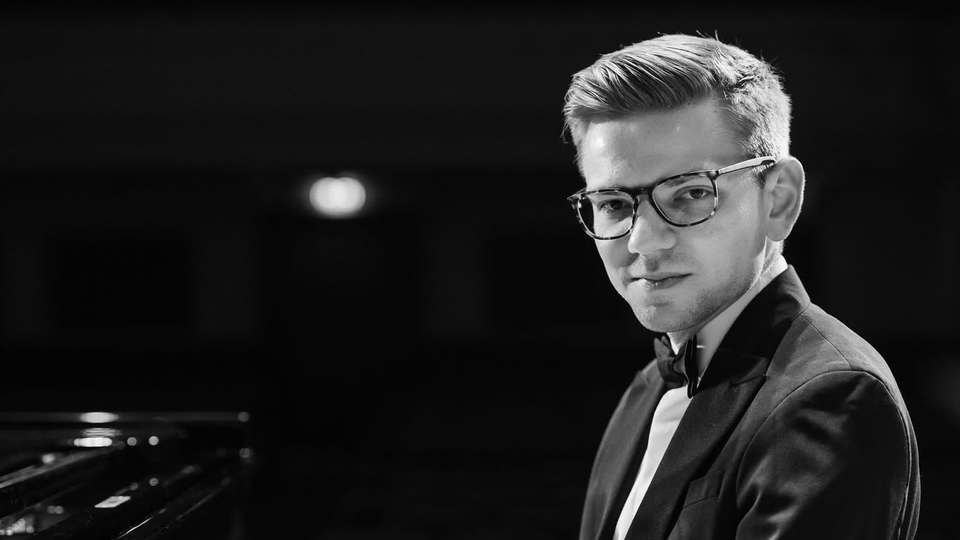
Interview with pianist Cadmiel Boțac
Radio România will celebrate its 98th anniversary this Friday, October 30th, 2026, with a concert performed by the National Radio Orchestra at the Radio Hall, conducted by Radu Paponiu. The soloist for the occasion will be the young pianist Cadmiel Boțac. In the following interview, Cadmiel Boțac tells us about the piece he has chosen to perform for this special occasion, his connection with Radio Romania, and his hopes for the future.
You are the soloist at the concert taking place at the Radio Hall on October 30th, marking the 98th anniversary of Radio România. You will be performing Felix Mendelssohn's Piano Concerto No. 2 in D minor, a work that is less frequently performed on concert stages. What made you choose this particular piece?
I chose this concerto precisely because it is performed so rarely in Romania. I regret that this is the case, because it is an absolutely remarkable work, full of beauty and Romantic passion. Mendelssohn composed his First Piano Concerto in G minor when he was younger, while the Second Piano Concerto was written in 1837. Although we can still consider him a young composer at that time, his musical language had clearly become much more mature and profound.
The second reason is that I had already performed the First Piano Concerto in G minor quite extensively, ever since my high school years. Having noticed the similarities between the two concertos, as well as the fact that the Second is more mature and profound, I thought it would be a good idea to take it on and include both of Felix Mendelssohn's piano concertos in my repertoire.I am therefore delighted that this Friday, October 30th, I will have the opportunity to perform the Second Piano Concerto in D minor at the Radio Hall.
Your connection with Radio România goes back several years. The release of your debut album with Casa Radio Publishing House coincided with another anniversary of Radio România, in 2021. You were also among the first recipients of the Heirs of Musical Romania Scholarship, a project initiated by Radio România Muzical and the Rotary Club Pipera...
My relationship with Radio România Muzical goes back even further, predating both the Heirs of Musical Romania Scholarship and the release of my album, which you also mentioned.
I would, however, like to go back to the end of 2010, when I had the joy and opportunity to take part in the Dinu Lipatti Competition, organized by Radio România Muzical. Although I was competing in the younger age category, I was fortunate enough to win First Prize. That award marked the beginning of such a wonderful collaboration with Radio România Muzical, one that has continued throughout all these years. And here we are, looking back from 2010 to this year, celebrating more than 15 years of collaboration.
First and foremost, I would like to express my heartfelt thanks and gratitude to the entire team at Radio România Muzical, for believing in and investing in young Romanian artists, for giving them the opportunity to perform on stage, to grow, to develop and to mature as artists. No matter how much we study, whether at school, in the practice room or at home, it is the stage that truly helps us mature. It is the stage that brings us into direct contact with the audience and plays such an essential role in shaping each and every one of our lives. So, I can only express my deepest gratitude for all the projects I have had the privilege of being part of in collaboration with Radio România Muzical since 2010. Whether they involved recording sessions, recitals or concerts, each and every experience, in one way or another, has contributed to my growth and maturity as an artist and as a pianist.
Indeed, in 2021, my first album was released, featuring special recordings made at the Radio România Muzical studios back in 2018. Then, a few years later, a second album followed, recorded together with cellist Cornelius Zirbo, also as part of the prize awarded through the Heirs of Musical Romania Scholarship. I can only express my deepest gratitude for this wonderful relationship and collaboration, and for the trust that Radio România Muzical continues to place in young Romanian artists.
Let's travel even further back in time. When did you know that you wanted to pursue a career as a pianist?
Probably in the fifth grade, in 2007. Circumstances unfolded in such a way that I took part in several competitions that year and received some very wonderful prizes. One competition in particular comes to mind, held in Zagreb, Croatia. I was only ten years old at the time, while the competition was open to young pianists up to the age of twenty. Being just a child, a preteen at the time, I went to that competition out of curiosity, without any expectations or hopes of winning a prize. I was fully aware that I would be competing against young pianists from several different countries. However, to the great surprise and delight of both myself, my teacher and the people accompanying us, I ended up winning the Grand Prize. At first, I could hardly grasp what was actually happening. At first, we thought we had received a special prize, and of course, we were delighted. However, the organizers tried several times to explain to us that it wasn't a special prize, but in fact the Grand Prize of the entire competition. When I finally realized what had happened, I remember my teacher, Mrs. Monica Chifor, from Sighetu Marmației, looking at us and saying: "I don't know whether I should cry with happiness or smile with happiness." That is how overwhelming the emotions of that moment were.
And I believe that year, and especially that particular experience at the competition in Zagreb, Croatia, was a major turning point for me. It motivated me enormously and made me realize that this was the path I wanted to pursue.
What lessons have stayed with you from the mentors you have had along the way?
First and foremost, one of the most important lessons I have learned is that the life of a musician, the life of a pianist, is about much more than simply practising an instrument intensively. A musician needs to embrace a lifestyle in which music is an integral part of every aspect of life. Beyond practising, a musician should read, attend concerts and, during their years of study, take part in competitions in order to become familiar with performing on stage and gain valuable stage experience. A musician should read extensively, not only books related to their field, but literature in general. Reading enriches you, opens up new perspectives and broadens your horizons.
I believe this is one of the greatest lessons I have learned. And, of course, there is also the lesson of patience: learning and mastering an instrument is a lifelong process. We never stop learning. Even at the age of 70 or 80, there is still so much more to discover and understand. I believe this process of learning, absorbing knowledge, refining and perfecting one's art never truly comes to an end.
This is a very important lesson I learned from my mentors. Even when they were already retired or approaching retirement age, at a stage in life when many people might think there is nothing left to learn, I would see them becoming even more dedicated to deepening their knowledge and continuing their studies. I find this truly admirable. My mentors were also my piano teachers, who meant so much more to me than just educators. They were role models, not only through the way they taught me to play the piano, but also through the way they lived their lives. They inspired me through both their teaching and their personal example. First and foremost, there was Mrs. Monica Chifor, from Sighetu Marmației. I could say that she taught me the ABCs of piano playing, laying the foundations of my musical education. Then, when I began high school, I moved to Cluj, where I had the opportunity to study with Professor and pianist Daniel Goiți, who also became much more than just a teacher to me. From him, I learned what it truly means to be a pianist and what challenges come with this vocation.
Then, in 2019, I moved to Vienna, where I continued my master's and postgraduate studies in the class of Professor Stefan Arnold. Once again, he took all the knowledge and experience I had accumulated up to that point and helped me bring them to an even higher level of maturity, refinement and artistic development.
I can only express my deepest gratitude to all three of them.
Sadly, Mrs. Monica Chifor is no longer with us. However, I am fortunate to have maintained a very close relationship with my other two teachers, Daniel Goiți and Stefan Arnold. Today, we share not only a wonderful bond as teacher and student, but also a genuine friendship. I even have the honour of being a colleague of Daniel Goiți now, as I joined the Music Academy in Cluj as an assistant professor last year. So our relationship has evolved: what was once a teacher-student relationship has now also become a relationship between colleagues and fellow educators.
From a very young age, you were considered one of the great hopes of Romanian piano playing. But what would your own hopes and aspirations be as an artist?
I believe that many musicians dream of performing on the greatest stages around the world, and that is certainly a wonderful aspiration. It is something worth striving for, something that brings fulfilment, satisfaction and joy. However, I have come to realize that, regardless of the stage we perform on, whether there are just ten people listening to us or a thousand people in a concert hall, our purpose as artists remains the same: to bring joy to those who come to listen to us, wherever we may be.
So that is what I wish for most. It is not necessarily about reaching one particular place or another, but rather about being able, wherever I have the opportunity to perform and step onto a stage, to bring people joy and hope. Especially in a world marked by so many conflicts, so much uncertainty and insecurity, I believe that music and art have an even greater role to play in people's lives.
If we look around us, in every aspect of life, we see so many unanswered questions. We don't know what this year or next year will bring, nor do we know what awaits us ten years from now. But whatever direction life may take us, our purpose as artists remains the same: to bring joy to people, regardless of the circumstances in which we find ourselves.
Translated by Ruxandra Ioana Șerban,
University of Bucharest, Faculty of Foreign Languages and Literatures, MTTLC, year II
Corrected by Silvia Petrescu


